
Last Updated: October 2026
On a Davis-Bacon project, certified payroll tells one side of the story. The crew on site tells the other. A labor standards interview gives the agency overseeing your project a way to hear directly from workers and confirm that both sides line up.
Maybe an SF-1445 or HUD-11 form showed up in your contract documents. Or a compliance officer mentioned interviews at the preconstruction meeting. Either way, here is what to expect and how to keep your team ready.
Key Takeaways
- A labor standards interview is a private, one-on-one conversation between a government agency representative and a worker on a Davis-Bacon project.
- The interview confirms that a worker's job classification, pay rate, fringe benefits, and hours match the contractor's certified payroll.
- Direct federal construction contracts use Standard Form 1445 (SF-1445). HUD-assisted projects use Form HUD-11, Record of Employee Interview.
- Interviews are confidential. The agency does not share a worker's identity or statement with the contractor without the worker's permission.
- There is no single federal interview schedule. Each agency sets its own frequency based on the project and its phases.
- Accurate, on-time certified payroll is the most reliable way to prepare for a labor standards interview.
Navigate This Article
- What Is a Labor Standards Interview?
- Why Labor Standards Interviews Matter
- SF-1445 vs. Form HUD-11: Which Form Applies?
- What Does a Labor Standards Interview Cover?
- How Is a Labor Standards Interview Conducted?
- How to Prepare for a Labor Standards Interview
- Keep Payroll Interview-Ready
- FAQs
What Is a Labor Standards Interview?
A labor standards interview is a confidential conversation between an agency representative and a laborer or mechanic on a project covered by the Davis-Bacon and Related Acts. The interviewer asks about the worker's classification, pay rate, fringe benefits and hours. Those answers are then compared with the contractor's certified payroll for the same pay period.
The agency that awards or funds the contract conducts these interviews as part of its day-to-day enforcement duties under 29 CFR Part 5. Under FAR 22.406-7, employee interviews are one of four regular compliance checks. The other three are on-site inspections, payroll reviews, and comparisons with daily logs and other project records.
Why Labor Standards Interviews Matter
Interviews support everyone on the project:
- Workers get a direct, confidential way to confirm they are paid correctly for the work they perform.
- Agencies verify that payroll records reflect what is happening on site.
- Contractors get an early check on their records. This makes it easier to correct a classification or rate while it is still a small fix.
Interviews are a routine part of federally funded construction. HUD alone estimates about 37,944 HUD-11 interviews each year, according to its 2025 Federal Register notice.
SF-1445 vs. Form HUD-11: Which Form Applies?
The form your project uses depends on where the funding comes from.
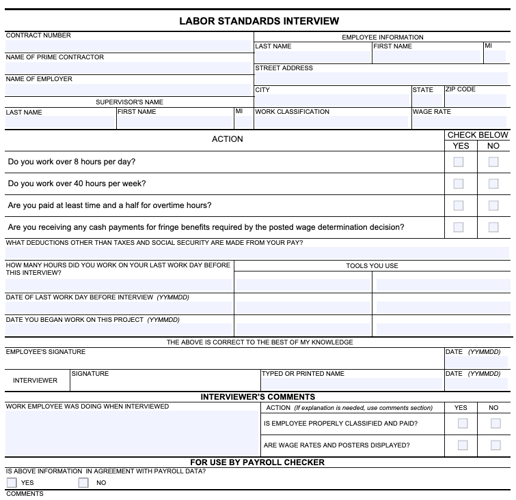
Standard Form 1445 (SF-1445)
SF-1445, Labor Standards Interview, is used on direct federal construction contracts. These include projects awarded by GSA, the National Park Service, and the Department of Defense. The form is prescribed by FAR 53.222, and the current version is Rev. 12/96. At the National Park Service, the interviewer completes and signs the form, then attaches it to the payroll report for the same period.
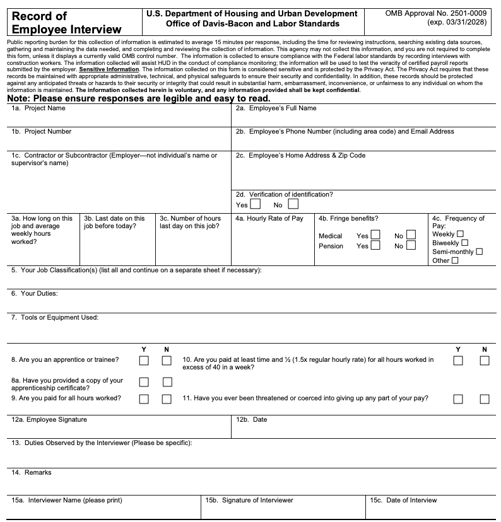
Form HUD-11
Form HUD-11, Record of Employee Interview, is used on HUD-assisted projects such as CDBG, HOME and public housing work. A city, county or housing authority often manages these projects. The current edition is dated 03/2025, and a Spanish version (HUD-11-SP) is available. Each interview takes about 15 minutes.
|
|
SF-1445 |
Form HUD-11 |
|
Used on |
Direct federal construction contracts |
HUD-assisted projects (CDBG, HOME, public housing) |
|
Current version |
Rev. 12/96 |
03/2025 edition |
|
Spanish version |
Check with your agency |
HUD-11-SP |
|
Conducted by |
Federal agency staff |
HUD or local grantee staff |
Some state agencies, including many state DOTs, use their own interview forms modeled on these federal versions.
What Does a Labor Standards Interview Cover?
Interview questions mirror the information on your certified payroll, so each answer can be checked line by line. Based on the HUD-11, workers are typically asked about:
- Their employer (prime contractor or subcontractor)
- Their job classification by specific trade, such as Carpenter or Electrician
- Daily duties and the tools or equipment they use
- Hourly pay rate and pay frequency
- Fringe benefits, such as medical and pension
- Hours worked on their last day and average weekly hours
- Apprentice or trainee status, and whether they have a copy of their apprenticeship certificate
- Whether they are paid for all hours worked and receive time and a half after 40 hours
- Whether anyone has asked them to give back part of their pay
Interviewers ask for specific trade names rather than general titles like "journeyman" or "mechanic." A clear classification on payroll makes the comparison quick and straightforward.
The interviewer also records the duties they observe in person. A payroll examiner then compares the full record with the certified payroll and notes any differences.
How Is a Labor Standards Interview Conducted?
Who Conducts the Interview
Agency staff conduct the interviews. On federal contracts, that may be the contracting officer, the contracting officer's representative or a project manager. On HUD-assisted projects, HUD or local grantee staff lead them. On state transportation projects, the resident engineer often takes the lead.
Where and How Interviews Happen
According to the DOL Prevailing Wage Resource Book, interviews are held one-on-one and in private, without a contractor representative present. They usually take place on site during working hours, and contractors are required to make workers available. Phone, virtual or mail interviews are used when meeting in person is not practical.
Confidentiality
Worker identities and statements stay confidential. The agency does not share them with the contractor without the worker's permission. For workers, participation is voluntary.
How Often Interviews Happen
There is no single federal schedule. Agencies interview a representative sample of each classification as often as needed. Two examples show how this varies:
- The National Park Service conducts a new round of interviews for each trade when a new phase of work begins.
- Maine DOT interviews at least two workers every 90 days, each with five or more days on the project.
Ask about the interview schedule at your preconstruction meeting so your team knows what to expect.
How Discrepancies Are Resolved
Most interviews simply confirm that payroll is accurate. When an answer and the record don't match, agencies follow a clear process:
- The interviewer notes the difference and shares it with the contracting officer or contract specialist.
- The agency takes a closer look, which may include more interviews in that trade and a review of timecards and payroll records.
- If wages are owed, the contractor pays restitution to the affected workers. Overtime differences may also involve liquidated damages under the Contract Work Hours and Safety Standards Act.
- If restitution isn't made, the agency can withhold contract payments and refer the case to the DOL Wage and Hour Division.
Prime contractors are responsible for their subcontractors' compliance, so it helps to keep the whole project team aligned. Most findings trace back to a few common recordkeeping errors, and each one can be prevented with consistent processes. Clean records also go a long way toward avoiding Davis-Bacon violations more broadly.
How to Prepare for a Labor Standards Interview
Preparation is mostly about consistency. When classifications, rates and hours are recorded accurately every week, there is nothing extra to do when an interviewer arrives. A little coordination across your team keeps the process smooth for everyone involved.
 Who Should Be Prepared
- Owners and project managers should know that interviews can happen during any phase and that workers need to be available.
- Foremen and supervisors should give workers space for private interviews.
- Payroll and compliance staff should confirm that certified payroll reflects the work performed.
- Subcontractors follow the same requirements as the prime contractor.
- Workers should know their trade classification and pay rate. Bilingual crews may find it helpful to know a Spanish HUD-11 is available.
Interview-Readiness Checklist
- Classifications on payroll match the work performed and the trade names on the wage determination.
- Pay rates and fringe benefits match the current wage determination.
- Apprentices are registered, certificates are on file and ratios are met.
- Overtime is paid at time and a half for hours over 40 in a workweek.
- The WH-1321 poster and wage determination are posted on site.
- Certified payroll is submitted on time for every contractor and subcontractor, using the current WH-347 or an approved equivalent.
Keep Every Payroll Interview-Ready
Labor standards interviews give agencies a direct view of what your certified payroll reports. SF-1445 covers direct federal contracts and HUD-11 covers HUD-assisted projects. Both focus on classification, pay, fringe benefits and hours. When payroll is accurate and submitted on time, the interview becomes a simple confirmation step.
Points North offers two options based on how much of the process you want to manage in-house. With Managed Services, our team partners with you to generate certified payroll reports and manage submissions. With WageIQ, correct wages are calculated before payroll runs, and rates and forms become manageable by your team.
Ready to make interview day a routine check-in? Our team can walk you through how Points North supports certified payroll on Davis-Bacon projects.
FAQs