

Last Updated: March 2026
If you're managing prevailing wage projects, apprentice-to-journeyman ratios are one of those compliance details that can quietly create big problems. These ratios determine how many apprentices can work under each qualified journeyman on a job, and they vary depending on the trade, the state, and the apprenticeship program itself. Get them wrong, and you could be looking at back wages, penalties, and a certified payroll audit you didn't see coming.
Whether your work falls under the Davis-Bacon Act, state prevailing wage laws, or the newer Inflation Reduction Act (IRA) requirements for clean energy projects, ratio compliance affects how you staff jobs, how you pay workers, and how you report on certified payroll. This guide breaks down how apprenticeship ratios work at the federal level, where states add their own rules, what the IRA requires, and how to keep your projects compliant day to day.
Navigate This Article
- What Is an Apprentice-to-Journeyman Ratio?
- How Apprenticeship Ratios Work on Davis-Bacon Projects
- How Apprentices Are Paid on Prevailing Wage Projects
- Prevailing Wage Apprentice Rates: How Apprentice Pay Is Calculated
- State-Specific Apprenticeship Ratio Requirements
- IRA Requirements
- Best Practices
- How Apprenticeship Ratios Impact Certified Payroll Reporting
What Is an Apprentice-to-Journeyman Ratio?
An apprentice-to-journeyman ratio is a rule that limits the number of registered apprentices who can work under the supervision of qualified journeymen on a job. These ratios are established by the apprenticeship program in which the apprentice is enrolled, and they are enforced by the U.S. Department of Labor's Office of Apprenticeship (OA) or the applicable state apprenticeship agency.
The ratio applies per trade, not across the entire jobsite workforce. An electrical apprentice, for example, can only be counted against electrical journeymen on the project. You can't balance a shortage of journeyman carpenters by pointing to extra electricians on site.
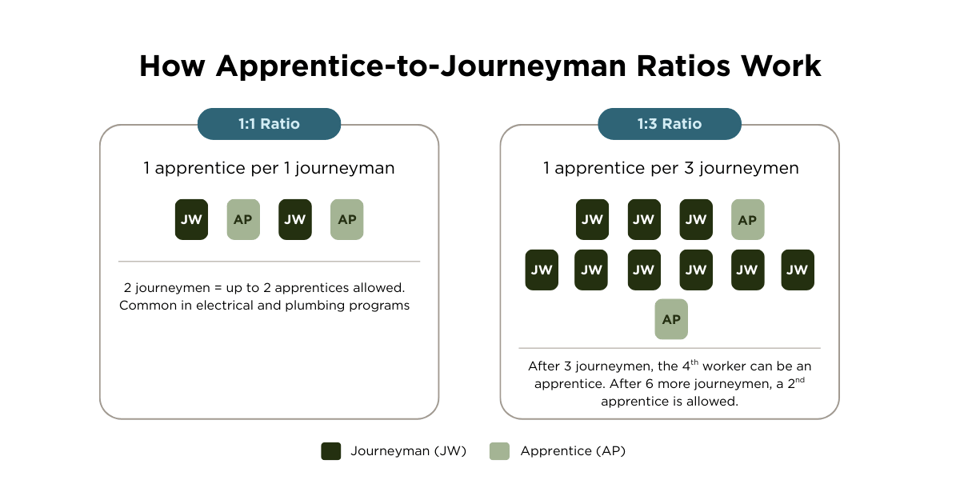
A common ratio structure is 1:1, meaning one apprentice is permitted for every one journeyman of the same trade who is present and performing work. Other programs may set the ratio at 1:3, which means after three journeymen are working, a fourth worker in that trade can be an apprentice. Once six more journeymen are on site, an eighth worker may be another apprentice. The specific ratio depends entirely on what the registered apprenticeship program has established and what the relevant agency has approved.
If the ratio is exceeded on any given day, the excess apprentice hours typically must be paid at the full journeyman prevailing wage rate for that classification.
How Apprenticeship Ratios Work on Davis-Bacon Projects
On federally funded projects subject to the Davis-Bacon Act, only apprentices who are individually registered in a program approved by the DOL's Office of Apprenticeship or a recognized state apprenticeship agency may be paid at the apprentice wage rate. This is a firm requirement. Workers who are not properly registered in an approved program must be classified and paid as journeymen, regardless of their experience level or job title.
The approved apprenticeship program dictates the ratio, the wage progression schedule (typically expressed as a percentage of the journeyman rate), and the fringe benefit obligations. The Davis-Bacon wage determination posted for your project will include the journeyman rate for each trade, but the apprentice-specific details come from the program itself.
A few critical rules to keep in mind for Davis-Bacon ratio compliance:
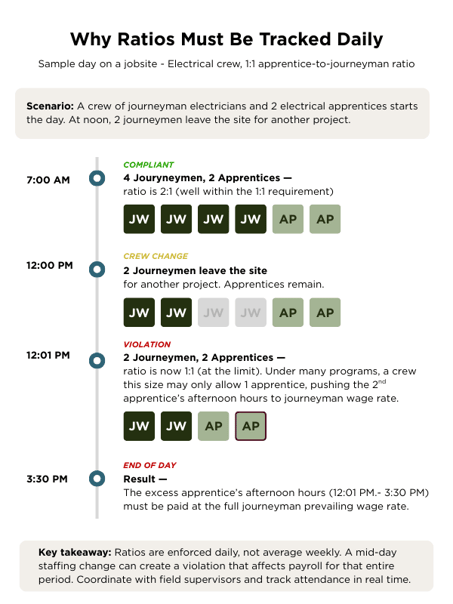
- Ratios are enforced daily, not weekly. If a journeyman leaves the site at noon and the ratio falls out of compliance for the afternoon, those remaining apprentice hours may need to be paid at the journeyman rate.
- Ratios are not portable across locations. If a contractor is performing work in a locality other than where the apprenticeship program is registered, and the local jurisdiction requires a higher ratio of journeymen to apprentices, the contractor must follow the stricter local standard.
- Fractions are generally not permitted. Unless the apprenticeship agreement specifically allows fractional ratios, you cannot round up to justify an additional apprentice on site.
- Documentation is required from day one. Contractors must maintain written evidence of the apprenticeship program registration, individual apprentice enrollment, and the applicable ratio and wage rate schedule. This documentation should accompany the first certified payroll report on which each apprentice appears.
How Apprentices Are Paid on Prevailing Wage Projects
Before an apprentice can be paid at an apprentice rate on any prevailing wage job, one thing has to be true: the worker is individually registered in an apprenticeship program approved by the DOL's Office of Apprenticeship or a recognized state apprenticeship agency.
Registration is individual, not organizational. It is not enough for the contractor to participate in a program. The specific worker on the specific job has to be enrolled, and you need documentation showing it.
Anyone who isn't registered gets the full journeyman prevailing wage rate. That holds regardless of the worker's experience, their job title, what they're called on the crew, or what they were paid on a previous project. A worker with twelve years in the trade who isn't in a registered program is a journeyman for prevailing wage purposes.
Who sets the apprentice rate
The wage determination posted for your project gives you the journeyman rate for each classification. It does not give you the apprentice rate. That comes from the apprenticeship program, which sets:
- The wage progression schedule, as a percentage of the journeyman rate
- The ratio of apprentices to journeymen
- The fringe benefit obligation at each period
- The hour and instruction thresholds for advancing to the next period
If you don't have the program standards on file, you don't have what you need to run payroll correctly.
When ratio and rate collide
An apprentice working outside the approved ratio doesn't just create a ratio violation. Those hours generally have to be paid at the full journeyman rate for the classification. One staffing decision changes the pay rate for that worker on that day.
This is the practical reason ratio tracking and payroll can't be separate processes. If the field makes a crew change and payroll doesn't hear about it until Friday, the certified payroll report going out that week is already wrong.
Documentation from day one
Contractors are expected to keep written evidence of program registration, individual apprentice enrollment, and the applicable ratio and wage schedule. That documentation should accompany the first certified payroll report on which each apprentice appears — not produced later when an agency asks for it.
Prevailing Wage Apprentice Rates: How Apprentice Pay Is Calculated
Ratios control who can be paid as an apprentice. The rate schedule controls how much they get paid. The two are separate rules, and contractors get tripped up when they treat them as one.
An apprentice's prevailing wage rate is expressed as a percentage of the journeyman rate for their classification. That percentage is not on the wage determination. It comes from the registered apprenticeship program's standards, which set both the ratio and the wage progression.
How the progression works
Most programs break the apprenticeship into periods, often eight periods across a four-year term, though this varies by trade. The apprentice advances after completing a period of on-the-job hours and related classroom instruction. Each advancement raises the percentage.
Here is what a common four-year structure looks like. Treat this as illustrative only. Your program's actual schedule is the one that governs.
| Period | Typical % of journeyman base rate |
|---|---|
| 1st period | 50% |
| 2nd period | 55% |
| 3rd period | 60% |
| 4th period | 65% |
| 5th period | 70% |
| 6th period | 75% |
| 7th period | 80% |
| 8th period | 90% |
| Journey level | 100% |
Some programs start first-period apprentices as low as 40%. Others begin closer to 60%. Shorter programs compress the steps. The only schedule that matters for compliance is the one in your approved program standards.
Fringe benefits are handled separately
This is where the calculation is most often missed. The percentage applies to the base hourly rate. Fringe benefits do not automatically follow the same percentage.
Some programs require the full journeyman fringe amount to be paid for every apprentice hour, regardless of period. Others prorate fringes at the same percentage as the base rate. Some prorate certain fringes and not others. Wage determinations occasionally spell this out; often they don't, and the program standards are the only source.
Training fund contributions are their own line. Many determinations include a training fund amount that is owed for every apprentice hour worked, and that contribution is typically a flat cents-per-hour figure rather than a percentage.
If you are calculating apprentice pay, you need three inputs, not one:
- The journeyman base rate for the classification, from the wage determination
- The apprentice's current period percentage, from the program standards
- The fringe treatment for that period, also from the program standards
Common Ratio Structures by Trade
Ratios vary by trade as well as by state and program. The differences generally track how much direct supervision the work requires and how licensure is structured in that trade.
| Trade family | Common pattern | Why it tends to run this way |
|---|---|---|
| Electrical | Often 1:1 | Supervision-intensive work with licensure requirements layered on top of apprenticeship standards |
| Plumbing & pipefitting | Often 1:1, with some flexibility by program period | Similar licensure structure; later-period apprentices sometimes carry different requirements |
| Carpentry & general labor | 1:2 or 1:3 in some programs | Broader task range and different supervision requirements |
| Heavy equipment operation | Tighter ratios | Safety exposure drives closer supervision |
| Specialty trades (glazing, roofing, sheet metal) | Varies widely | Small program populations mean standards differ significantly between locals |
These are patterns, not rules. The binding ratio for your project is whatever the registered apprenticeship program has established and the relevant agency has approved — and if the locality where you're working enforces a stricter standard, that one wins. When you can't confirm it from the program documents, contact the program sponsor or the state apprenticeship agency directly.
The key point is that there is no universal ratio. You need to verify the approved ratio for the specific trade, in the specific jurisdiction, under the specific apprenticeship program your workers are enrolled in. When in doubt, contact the program sponsor or the state apprenticeship agency directly.
State-Specific Apprenticeship Ratio Requirements

Federal Davis-Bacon rules provide the baseline, but many states layer on their own prevailing wage and apprenticeship requirements. These state rules may set different ratios, impose additional registration obligations, or define compliance standards that go beyond what the federal government requires.
California
California's Department of Industrial Relations (DIR) maintains its own apprenticeship standards that apply to all state-funded public works projects. Contractors working on California prevailing wage jobs must use apprentices registered in DIR-approved programs, and the ratio requirements are set by those programs. California is known for strict enforcement, and the state's apprenticeship rules do not always mirror federal standards. Contractors bidding on California projects should verify ratio requirements through the DIR and the applicable local Joint Apprenticeship Committee. For a deeper look at California's requirements, visit our California Prevailing Wage guide.
New York
New York's Department of Labor oversees apprenticeship programs and sets ratio standards that apply to state-funded construction. The ratios are determined by the approved apprenticeship program and enforced at the state level. New York also has specific requirements around apprentice utilization on public works, and contractors should confirm the applicable standards before staffing a project. More detail is available in our New York Prevailing Wage guide.
Other States to Know
Several other states maintain their own apprenticeship ratio frameworks worth tracking:
- Washington has well-defined apprenticeship utilization requirements administered through the Department of Labor & Industries (L&I). Our Washington Prevailing Wage guide covers apprenticeship tracking and craft codes in detail.
- Illinois requires apprentice utilization on public works and enforces ratios through the state's Department of Labor.
- Colorado has an active State Apprenticeship Agency that works closely with the federal Office of Apprenticeship and provides state-specific guidance for IRA-related projects.
- Texas follows federal Davis-Bacon standards on federally funded projects, but contractors should still verify program-specific ratio requirements.
Contractors working across state lines need to verify ratio requirements in each jurisdiction where work is performed. What's compliant in one state may not be compliant in another, even for the same trade and the same apprenticeship program.
IRA Prevailing Wage and Apprenticeship Requirements
The Inflation Reduction Act introduced a new set of prevailing wage and apprenticeship requirements tied to clean energy tax credits. For qualifying projects where construction began on or after January 29, 2023, meeting these requirements allows taxpayers to multiply the base tax credit or deduction amount by five. That is a substantial financial incentive, and it has brought many contractors and developers into the prevailing wage world for the first time.
The IRA's apprenticeship rules include three distinct components that all must be satisfied:
Labor Hours Requirement. A minimum percentage of the total labor hours on the project must be performed by qualified apprentices from a registered apprenticeship program. The applicable percentage is 12.5% for projects that began construction in 2023 and 15% for projects beginning construction in 2024 or later. This is measured across the entire construction phase of the project, not on a daily or weekly basis.
Ratio Requirement. The applicable apprentice-to-journeyworker ratio established by the registered apprenticeship program must be maintained for all apprentices working on the facility each day. This is where the IRA directly intersects with the traditional ratio compliance discussed throughout this article. The daily ratio standard applies regardless of whether the project is also subject to Davis-Bacon.
Participation Requirement. Any taxpayer, contractor, or subcontractor that employs four or more individuals at any point during the construction of the facility must employ at least one qualified apprentice in connection with that work.
If a contractor cannot find apprentices, the IRA does include a good faith effort exception. A taxpayer is deemed to satisfy the apprenticeship requirements if they request qualified apprentices from a registered apprenticeship program and either receive no response within five business days or are denied for reasons unrelated to the taxpayer's willingness to comply. Importantly, new requests must be submitted annually to maintain the exception.
The penalties for falling short are significant. If the labor hours requirement is not met, the taxpayer owes $50 for each hour that fell short of the target. If the participation requirement is not met, the penalty is calculated based on the total labor hours of the non-compliant party. And if the IRS determines the noncompliance was intentional, those penalties increase tenfold to $500 per hour.
For energy contractors and developers new to prevailing wage work, the IRA apprenticeship rules add a layer of complexity that demands careful planning from the start of a project.
How to Stay Compliant: Best Practices for Tracking Apprenticeship Ratios
Staying on top of apprenticeship ratios requires coordination between your office and the field. Compliance isn't something you can set at the start of a project and forget about. Staffing changes, trade coverage, and daily attendance all affect whether your ratios hold up under scrutiny.
Start by verifying apprentice registration before assigning any worker to a prevailing wage project. Confirm that each apprentice is individually enrolled in a program approved by the Office of Apprenticeship or the applicable state agency. Keep copies of registration letters, program standards, and ratio schedules on file and readily accessible.
Next, confirm the approved ratio for each trade on your project. Do not assume a ratio from a prior project still applies. Programs update their standards, and different jurisdictions may enforce different rules for the same trade. Pull the current ratio from the program documentation and make it part of your project setup.
Track ratios on a daily basis. This is one of the most commonly misunderstood requirements. Many contractors try to average ratios over a pay period or a week, but federal rules and most state rules require daily compliance. If a journeyman calls in sick or leaves the site early, you need to account for that shift in your staffing and payroll records.
Coordinate with your field supervisors regularly. They are the ones making real-time staffing decisions, and they need to understand how those decisions affect compliance. A simple mid-day crew change can push a ratio out of balance if no one is tracking it.
Common Mistakes That Trigger Violations
Even experienced contractors run into ratio problems. The most frequent mistakes include assuming ratios are universal across all trades or all states, when in reality they vary widely. Others count non-performing supervisors or foremen as journeymen for ratio purposes, which most programs do not allow unless those individuals are actively performing trade work.
Averaging ratios over a weekly pay period instead of tracking them daily is another common pitfall. Paying apprentice rates to workers who are not verified as registered in an approved program is a violation from the first hour, and it is one of the easiest for auditors to catch. Finally, failing to adjust payroll when ratios are exceeded can compound a small staffing issue into a significant back-wage liability.
How Apprenticeship Ratios Affect Certified Payroll Reporting
Apprenticeship ratio compliance is directly connected to your certified payroll reporting. On the WH-347 form and equivalent state reporting formats, apprentice classifications, wage rates, and hours must align with the approved apprenticeship program standards. Agencies reviewing certified payroll reports will cross-reference your reported apprentice data against the program files to verify that ratios were maintained, wages were correct, and registration was current.
When a ratio violation is identified, it can trigger a broader review of the entire project's payroll records. What starts as a staffing question can quickly become a full compliance audit covering wages, fringe benefits, and classification accuracy across all trades.
Maintaining clean, well-organized records is your best defense. Keep apprenticeship documentation linked to your payroll data so that you can demonstrate compliance for any day on any project if asked.
Key Takeaways
Apprentice-to-journeyman ratios are an enforceable part of prevailing wage compliance, not a guideline or a best practice. They vary by trade, by state, and by apprenticeship program, so there is no single rule that applies everywhere.
Federal Davis-Bacon projects, state prevailing wage projects, and IRA clean energy projects each bring their own layer of requirements. For IRA projects in particular, the combination of labor hour thresholds, daily ratio tracking, and the participation requirement creates a compliance framework that demands attention from project kickoff through final reporting.
The fundamentals remain consistent across all of these frameworks: verify registration, confirm the approved ratio, track daily, coordinate with the field, and document everything. Contractors who build these practices into their standard workflow are far less likely to face surprises during an audit.
If managing apprenticeship ratios, prevailing wage rates, and certified payroll across multiple trades and jurisdictions feels like a lot to track manually, that's because it is. Certified Payroll Reporting software from Points North helps contractors centralize compliance tracking, connect apprenticeship data to payroll, and generate accurate reports without the spreadsheet headaches. Learn more or request a demo using the form below.
.png)