

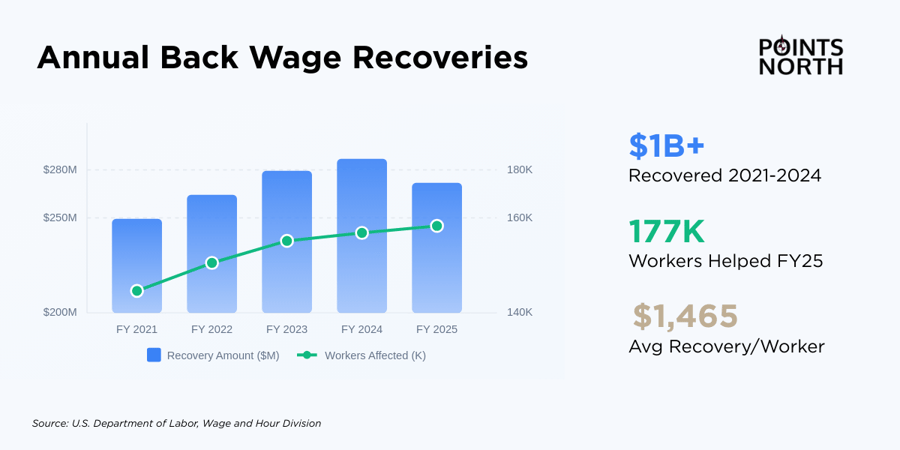
A single Davis-Bacon violation cost one mid-sized contractor $180,000 in back wages and penalties. In the largest prevailing wage criminal case in U.S. history, Glenn O. Hawbaker, Inc. paid $20.7 million in restitution to 1,267 workers. These aren't outliers; in fiscal year 2025 alone, the Department of Labor recovered $259 million in back wages for nearly 177,000 employees.
For contractors working on federally funded projects, the financial impact extends far beyond immediate fines. Project delays, debarment from future bidding, reputational damage, and legal costs often exceed initial penalties themselves. Understanding the true financial impact helps contractors justify investment in prevention systems and approach compliance as a competitive advantage rather than an administrative burden.
This article breaks down the real cost of Davis-Bacon violations using national enforcement data, examines both direct and hidden expenses, and demonstrates how prevention systems deliver measurable return on investment for contractors pursuing public works projects.
Understanding Davis-Bacon Violations and Prevailing Wage Requirements
Before examining costs, contractors need to understand what constitutes a violation and why these mistakes occur so frequently in the construction industry.
What Constitutes a Violation
Davis-Bacon violations occur when contractors fail to meet federal prevailing wage requirements on government-funded construction projects. The most common violations include paying below prevailing wage rates for qualified workers, incorrect fringe benefit calculations or documentation, missing or incomplete certified payroll reports (WH-347 forms), failure to post required wage determinations on job sites, and misclassifying workers into incorrect job classifications.
These requirements are more complex than many contractors initially realize, which is why violations remain surprisingly common even among experienced firms.
Who Enforces Compliance
Multiple entities monitor and enforce prevailing wage compliance. The U.S. Department of Labor's Wage and Hour Division serves as the primary federal enforcer, conducting investigations, assessing penalties, and maintaining contractor compliance records. State-level enforcement agencies conduct independent investigations and impose additional penalties. Contracting agencies and project owners actively monitor compliance and can withhold payments or recommend debarment. Third-party auditors hired by project owners add another layer of scrutiny.
Common Triggers for Investigations
Understanding what triggers investigations helps contractors recognize risk areas. Worker complaints or whistleblower reports remain the most common trigger—even a single complaint can launch a full investigation. Routine audits of federal and state-funded projects occur regardless of suspected issues. A contractor's history of non-compliance leads to increased scrutiny on subsequent projects. Issues flagged during project closeout can trigger retroactive investigations examining entire project timelines.
Direct Financial Penalties: What Davis-Bacon Violations Actually Cost
Davis-Bacon violations carry substantial financial penalties at both federal and state levels. Understanding the penalty structure helps contractors quantify compliance risk and make informed decisions about prevention investments.
Federal Penalty Structure
Federal Davis-Bacon penalties include back wages with no cap, civil monetary penalties up to $10,000+ per violation, liquidated damages potentially doubling back wages owed, interest compounding daily at statutorily established rates, and administrative costs for DOL investigation and enforcement.
The 2023 Davis-Bacon Final Rule strengthened enforcement mechanisms significantly. DOL can now cross-withhold back wages from a contractor's other federal contracts, even those issued by different agencies. Prime contractors are now responsible for subcontractor back wages regardless of any showing of intent, making subcontractor compliance monitoring critical.
Recent cases demonstrate the financial scale:
- DOL ordered a federal contractor to pay $85,000+ to six workers for misclassification
- A mid-sized contractor faced $180,000 on a single federal highway project
- Hawbaker paid $20.7 million after violations spanning $1.7 billion in contracts
State and Municipal Penalties
State prevailing wage laws often impose penalties separate from and in addition to federal requirements. Contractors working on projects funded with both federal and state money may face cumulative penalties from multiple jurisdictions for the same underlying violation.
California, New York, Illinois, and other states enforce particularly strict state-level prevailing wage requirements with their own penalty structures, investigation processes, and debarment rules. A single violation on a jointly funded project can result in combined penalties exceeding $85,000 when federal and state fines are assessed together.
Contract-Specific Consequences
Additional contract-specific consequences compound these costs. Project owners routinely withhold contract payments until compliance is resolved, creating severe cash flow problems. Many contracts require payment of government attorney fees and legal costs. Interest accrues on unpaid wages throughout investigation periods. Prime contractors bear responsibility for pursuing and correcting subcontractor violations—often discovering subcontractors lack assets for repayment.
.png?width=900&height=450&name=Annual%20Back%20Wage%20Recoveries%20(1).png)
Hidden Costs: The Indirect Financial Impact of Prevailing Wage Violations
The indirect costs of Davis-Bacon violations frequently exceed direct penalties and can have longer-lasting impacts on business operations, growth trajectories, and market position.
Project Delays and Productivity Losses
Investigations typically last six to eighteen months. During this period, contractors face project hold costs that accumulate daily, staff time diverted from billable work to compliance response, timeline delays affecting other project commitments, and operational inefficiencies across the organization.
Debarment and Lost Bidding Opportunities
Federal debarment typically lasts three years minimum. For contractors deriving significant revenue from public works, debarment costs hundreds of thousands annually in lost bidding opportunities. The ripple effect impacts workforce planning, equipment investments, and overall business growth trajectories.
Reputation and Relationship Damage
Public disclosure requirements make violations visible to clients, competitors, and potential partners. This visibility negatively impacts future bid evaluation scores, strains relationships with general contractors and project owners, creates bonding and insurance difficulties, and erodes client trust and referral opportunities.
Legal and Administrative Burden
Attorney fees range from $15,000 to $50,000+ per violation defense. Following a violation, contractors face increased audit frequency for three to five years, enhanced monitoring requirements and reporting obligations, and internal compliance program implementation costs.
Cost Summary: Direct vs. Hidden
| Cost Category | Direct Costs | Hidden Costs |
|---|---|---|
| Penalties | $85,000+ | — |
| Legal Defense | $15,000–$50,000+ | — |
| Project Delays | — | 6–18 month investigations |
| Debarment | — | $100,000+ annually (3 years) |
| Reputation | — | Lower bid scores, bonding issues |
Industry Data: The Scope of Payroll Compliance Mistakes
National enforcement data from the Department of Labor demonstrates both the scale of prevailing wage violations across the construction industry and the effectiveness of federal enforcement efforts.
National Statistics
The numbers reveal that compliance violations are both common and costly:
- FY 2025: DOL recovered $259 million for 177,000 employees (averaging $1,465 per worker)
- FY 2024: $274 million recovered, with construction representing significant violations
- 2021–2024: More than $1 billion in back wages recovered nationwide
Davis-Bacon and Related Acts apply to approximately $217 billion in federal and federally assisted construction spending annually, representing about 63% of all government construction. These laws provide wage rates for an estimated 1.2 million U.S. construction workers.
Enforcement Trends
Despite DOL Wage and Hour Division investigator headcount at 611, the lowest since at least 1973 and less than half the agency's 1978 peak, recovery amounts have increased substantially. This suggests DOL is focusing enforcement resources on larger, higher-impact cases with more substantial violations, meaning contractors face greater scrutiny when violations do occur.
Recent trends indicate rising penalty amounts year-over-year, increased enforcement focus specifically on the construction sector, greater scrutiny driven by federal infrastructure spending programs, and state-level expansion of prevailing wage laws beyond federal minimums.
Beyond Prevailing Wage: Other Costly Payroll Compliance Mistakes
Contractors working on public works projects face multiple layers of payroll compliance risk beyond Davis-Bacon requirements. Understanding how these requirements interact helps prevent violations affecting multiple regulatory areas simultaneously.
Union Wage Compliance
Union wage compliance is critical in preventing certified payroll errors on public works projects. Many federal and state prevailing wage rates are directly derived from collective bargaining agreements (CBAs) negotiated between unions and contractors.
Contractors must apply wage rates, fringe benefits, and worker classifications exactly as specified in the relevant CBA. Using incorrect rates—even when the error appears minor—can trigger penalties, require back wage payments, or delay project progress while issues are resolved.
Effective union wage compliance requires accurate interpretation of CBA wage schedules and classification systems, real-time tracking of rate changes and contractual escalations, proper allocation of fringe benefits as defined in union agreements, and ongoing validation that actual payroll matches approved wage determinations for each project and worker classification.
ACA Reporting Penalties
Applicable large employers face $310 per employee for 1095-C filing failures. A 100-employee company could owe $31,000+ annually for incomplete or incorrect filings.
FLSA Violations
Misclassifying exempt vs. non-exempt employees, failing to pay proper overtime rates, and incorrectly applying overtime premiums to prevailing wages all trigger separate penalties that compound Davis-Bacon exposure.
Multi-State Complexity
Different rates by jurisdiction, varying registration requirements, and reciprocity challenges multiply penalty exposure for contractors working across state lines.
Manual Payroll Costs
The DOL estimates 55 minutes per WH-347 report. For contractors managing three concurrent projects with weekly reports required, this represents significant annual hours devoted to manual compliance tasks.
Consider the math: Three projects requiring weekly certified payroll means 165 minutes (2.75 hours) per week on report preparation alone. Over a year, that totals 143 hours. At average payroll administrator salaries, contractors spend thousands annually on manual tasks, while simultaneously increasing error rates for incorrect wage application, misclassified hours, missing fringe documentation, and late submissions.
Prevention ROI: Why Compliance Systems Pay for Themselves
When contractors compare the cost of compliance software against the potential cost of even a single violation, the return on investment becomes immediately clear.
Cost-Benefit Analysis
The economics strongly favor prevention:
- Average violation: $85,000+ (direct penalties only)
- Compliance software: Industry average of $200–$2,000+ monthly, depending on workforce and reporting complexity
- Break-even: One prevented violation pays for years of software
What Proper Systems Prevent
Automated systems deliver operational benefits beyond violation prevention. Proper compliance solutions provide automated wage rate management within your system, real-time monitoring and alerts that flag issues before submission, accurate certified payroll report generation across more than 100 different report formats required by various agencies, seamless integration with existing payroll platforms, and centralized audit-ready documentation across all projects.
Key Features That Reduce Risk
Effective compliance systems offer automated prevailing wage calculations based on the rates you manage within the solution, built-in compliance checks that validate payroll against your managed wage determinations, centralized rate management across multiple projects and jurisdictions, and electronic certified payroll generation and submission capabilities.
How Points North Helps Contractors Avoid Costly Mistakes
Points North provides comprehensive certified payroll solutions designed specifically for contractors working on prevailing wage projects.

Certified Payroll Reporting Solution
The platform seamlessly integrates with existing payroll systems, eliminating duplicate data entry while preserving established workflows. Points North simplifies wage determination matching and generates certified payroll reports across more than 100 different formats, far beyond just the WH-347, addressing requirements from federal, state, and local agencies nationwide.
Real-time compliance alerts flag potential issues before submission, allowing correction before violations occur. Multi-state and multi-project management capabilities keep contractors compliant everywhere they operate from a single centralized platform.
Managed Services
For contractors seeking additional assurance or lacking internal compliance expertise, Points North managed services provide hands-on support. The managed services team handles rate sourcing and management on behalf of clients, validating that wage and fringe benefit data is correct before submission. They also manage report generation and submission, reducing administrative burden on internal teams while ensuring accuracy and timeliness.

Key Takeaways
Davis-Bacon violations cost contractors far more than direct penalties suggest. Hidden costs including debarment, reputational damage, legal defense, and operational disruption frequently exceed initial fines and can affect business viability for years.
Industry data confirms compliance mistakes are common and expensive. With the Department of Labor recovering over $1 billion in back wages between 2021 and 2024, and enforcement focus increasing despite reduced investigator headcount, contractors face real and growing compliance risk.
But here's the opportunity: Contractors who implement proper compliance solutions don't just avoid penalties, they position themselves to grow and scale by confidently taking on more public works projects. Government construction represents $217 billion annually in opportunities. With the right systems managing compliance complexity, contractors can pursue this work knowing their certified payroll, union wage obligations, and multi-jurisdictional requirements are handled accurately and efficiently.
Prevention systems pay for themselves many times over. The cost of compliance software represents a fraction of a single violation, while delivering ongoing benefits in time savings, accuracy, and peace of mind that enable sustainable business growth.
Ready to simplify your certified payroll reporting? Schedule a demo to see how Points North streamlines compliance, supports union wage requirements, and positions your business for sustainable growth in public works contracting.