

When bidding on government construction projects, contractors often encounter two critical wage requirements: union wages and prevailing wages. While these terms are sometimes used interchangeably, they represent distinct wage standards with different legal requirements and applications.
Understanding the difference between union wage vs prevailing wage is essential for contractors to remain compliant, avoid costly penalties, and accurately bid on public works projects. This guide breaks down the key differences, when each applies, and how to navigate union construction requirements effectively.
What Are Prevailing Wages?
Prevailing wages are the minimum hourly wage rates, including fringe benefits, that contractors must pay workers on publicly funded construction projects. These rates are established by government agencies and designed to ensure that workers on public projects receive compensation comparable to what's paid in the local market.
At the federal level, the Davis-Bacon Act requires contractors on federally funded projects over $2,000 to pay prevailing wages. Many states have their own prevailing wage laws with varying thresholds and requirements. For example, California's prevailing wage requirements apply to projects over $1,000 for new construction and $15,000 for alteration, demolition, repair, or maintenance work.
Prevailing wage rates are determined through surveys of wages and benefits paid to workers in specific trades within a given geographic area. The U.S. Department of Labor publishes federal prevailing wage determinations, while state labor departments issue their own rates for state-funded projects.
Each prevailing wage rate consists of two components: the basic hourly rate and fringe benefits. Fringe benefits can include health insurance, pension contributions, vacation pay, and training funds. Contractors must pay workers the total of both components, either as direct wages, bona fide fringe benefits, or a combination of both.
What Are Union Wages?
Union wages are compensation rates established through collective bargaining agreements (CBAs) between labor unions and employers or employer associations. These agreements are negotiated contracts that specify hourly wages, benefits, working conditions, and other employment terms for union members.
Unlike prevailing wages, which are mandated by law on qualifying projects, union wages apply when contractors have signed agreements with unions or when projects require union labor through project labor agreements (PLAs). Union wage structures typically include detailed pay scales based on experience levels, overtime provisions, and comprehensive benefits packages.
Union wages are often higher than non-union rates because they're negotiated to reflect the value of skilled, trained workers. These rates vary by union jurisdiction and trade, and they're updated periodically as collective bargaining agreements are renewed.
Key Differences Between Union Wages and Prevailing Wages
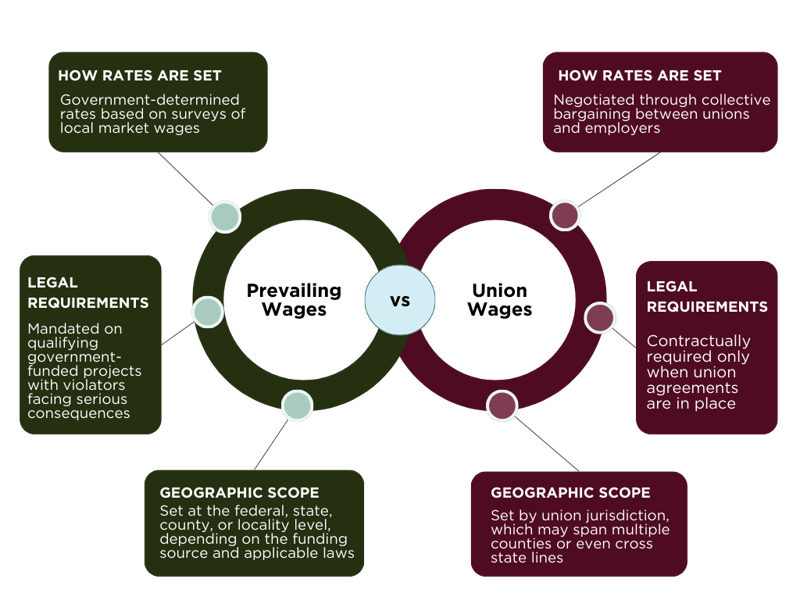
While both wage types aim to ensure fair compensation for construction workers, they differ significantly in their origin, application, and requirements.
How Rates Are Set
Prevailing wages are government-determined rates based on surveys of local market wages. Government agencies collect data on what workers in specific trades are paid within a geographic area and use this information to establish prevailing rates.
Union wages, by contrast, are negotiated through collective bargaining between unions and employers. These negotiations consider factors like cost of living, industry standards, worker skills, and market conditions. The resulting rates reflect what union leadership and employers agree is fair compensation.
Legal Requirements
Prevailing wages are legally mandated on qualifying government-funded projects. Contractors who fail to pay prevailing wages face serious consequences, including back pay requirements, penalties, debarment from future government contracts, and potential criminal charges.
Union wages are contractually required only when union agreements are in place. A contractor without a union agreement isn't legally obligated to pay union rates unless working on a project with a project labor agreement or similar requirement. However, contractors working with unions face their own set of compliance risks. Payroll errors, miscalculations, or late payments can result in fines, grievances filed by the union, and potential litigation. Many collective bargaining agreements include specific penalty clauses for late or inaccurate wage payments, making precise payroll management essential for union contractors.
Geographic Scope
Prevailing wages are set at the federal, state, county, or locality level, depending on the funding source and applicable laws. A project in Los Angeles County will have different prevailing wage rates than one in San Francisco, even within the same state.
Union wages are set by union jurisdiction, which may span multiple counties or even cross state lines. A union local's territory determines where its negotiated rates apply.
Do Union Wages Count as Prevailing Wages?
This is one of the most common questions contractors ask, and the answer isn't always straightforward. In many cases, union wages meet or exceed prevailing wage requirements because prevailing wage surveys often reflect union rates in heavily unionized areas. However, contractors cannot simply assume their union rates satisfy prevailing wage obligations.
To determine if union wages meet prevailing wage requirements, contractors must compare their union rates to the applicable prevailing wage determination for each job classification. The comparison must include both the basic hourly rate and fringe benefits. If the union rate falls short in either component, the contractor must make up the difference.
Importantly, even when union wages exceed prevailing wages, contractors working on Davis-Bacon or state prevailing wage projects must still submit certified payroll reports. The reporting requirement applies regardless of whether workers are union or non-union. Contractors must document that all workers received at least the prevailing wage rate for their classification.
A common misconception is that union contractors are automatically exempt from prevailing wage compliance. This isn't true. Union contractors must still verify rates, track hours by classification, calculate fringe benefits correctly, and submit certified payroll reports on qualifying projects.
Union Construction Requirements: What Contractors Must Know
Project Labor Agreements (PLAs)
Project labor agreements are pre-hire collective bargaining agreements that establish the terms and conditions of employment for a specific construction project. When a project has a PLA, all contractors and subcontractors working on that project must follow the agreement's terms, regardless of whether they're typically union or non-union shops.
Recent federal policy has expanded PLA requirements on large federal construction projects. Executive orders have mandated PLAs on federal projects over $35 million, meaning more contractors are encountering union construction requirements than ever before.
PLAs typically require contractors to hire workers through union hiring halls, pay union wages and benefits, and follow union work rules. Understanding these requirements before bidding is essential for accurate cost estimation and successful project execution.
Certified Payroll Reporting for Union Projects
Union contractors working on prevailing wage projects must submit certified payroll reports just like non-union contractors. These reports document the wages and benefits paid to each worker, their job classifications, and hours worked.
The certified payroll requirement applies to all Davis-Bacon projects regardless of union status. Contractors must complete weekly payroll reports using Form WH-347 or an equivalent format accepted by the contracting agency. Each report must be signed by an authorized company representative certifying the accuracy of the information.
Documentation requirements include maintaining payroll records for at least three years, recording actual hours worked by each employee, tracking work by job classification, and documenting fringe benefit payments. Proper recordkeeping protects contractors during audits and investigations.
Navigating Wage Compliance on Government Projects
 Determining Which Wage Applies to Your Project
Before starting any government project, contractors should take a systematic approach to identifying wage requirements. Start by reviewing the contract documents, which should specify applicable wage determinations. Federal projects will reference Davis-Bacon wage determinations, while state projects will cite state prevailing wage rates.
Next, check for project labor agreements or other union requirements. The bid documents or contract should indicate if a PLA is in place. If you're unsure, ask the contracting agency directly before submitting your bid.
Finally, compare the applicable rates to your current wage structure. If you're a union contractor, verify that your union rates meet or exceed the prevailing wage for each classification you'll use on the project. Document your analysis and factor any necessary adjustments into your bid.
Common Compliance Challenges
Managing wage compliance becomes complex when projects involve multiple wage types. Contractors often face challenges when mixing union and non-union workers on the same project, handling workers who perform multiple job classifications, tracking different wage rates for different portions of a project, and calculating fringe benefits correctly across various benefit structures.
These challenges multiply on multi-state projects or when working across different union jurisdictions. Each situation requires careful attention to applicable rates and meticulous recordkeeping.
Best Practices for Contractors
Successful wage compliance starts with due diligence during the bidding process. Always verify wage requirements before submitting a bid, including both prevailing wage rates and any union or PLA requirements. Build these costs into your estimates from the start.
Maintain accurate payroll records throughout every project. Track hours by employee and classification daily, document all fringe benefit payments, and keep records organized for easy retrieval during audits.
Use automated certified payroll reporting software to reduce errors and save time. Manual processes are prone to mistakes and consume valuable administrative resources. The right software can handle rate lookups, calculations, and report generation automatically.
Stay current on prevailing wage rate changes. Rates are updated periodically, and using outdated rates can result in underpayment violations. Subscribe to updates from the Department of Labor and relevant state agencies.
Finally, document everything consistently. Consistent documentation practices protect your company during audits, help resolve disputes, and demonstrate good-faith compliance efforts.
How Points North Simplifies Wage Compliance
Managing both union and prevailing wage requirements doesn't have to be overwhelming. Points North's Certified Payroll Reporting and WageIQ solutions help contractors streamline compliance through rate management, rate calculations, automated reporting, multi-state compliance, and integration with existing payroll systems. These tools take the complexity out of tracking multiple wage types, calculating correct payments, and generating accurate certified payroll reports.
Understanding the difference between union wage vs prevailing wage is crucial for contractors working on government-funded projects. While union wages are set through collective bargaining and apply when union agreements are in place, prevailing wages are legally mandated rates for qualifying public works projects. Many contractors must navigate both requirements, and regardless of union status, certified payroll reporting remains mandatory on Davis-Bacon projects. By understanding these distinctions and implementing proper tracking systems, contractors can ensure compliance, avoid penalties, and confidently bid on government construction contracts.
Simplify your wage compliance and certified payroll reporting with Points North's solutions. Learn more about Certified Payroll Reporting for Davis-Bacon compliance and WageIQ for comprehensive union and prevailing wage management across all your projects.