

One payroll miscalculation based on Home and Away Logic can cost thousands in penalties and damage your reputation with union partners. Yet many contractors struggle to navigate the complex web of jurisdictional boundaries, rate differentials, and compliance requirements that govern union construction projects.
Home and Away Logic represents one of the most challenging aspects of union compliance, determining how workers are paid based on their home union local versus the project location. Getting it wrong doesn't just mean financial penalties—it can lead to work stoppages, union grievances, and exclusion from future project bidding.
This comprehensive guide will walk you through everything you need to understand about Home and Away Logic, from basic definitions to implementation best practices that keep your projects compliant and profitable.
What is Home and Away Logic?
Home and Away Logic is a union compliance system that applies different wage rates based on project location versus a worker's home union local membership. This means the same electrician might earn different wages depending on whether they're working in their "home" territory or "away" from their local union's jurisdiction.
.png?width=912&height=517&name=Home%20and%20Away%20Territory%20Graphic%20(1).png)
Real-World Example
Consider this scenario: A Local 11 electrician from Los Angeles,CA is assigned to work on a project in San Francisco,CA, which falls under Local 6's jurisdiction. Under Home and Away Logic:
- Home rate: What the worker would earn on Local 11 projects in LA
- Away rate: The rate negotiated between Local 11 and Local 6 for outside workers
- Jurisdiction: Local 6's San Francisco territory governs which rate applies
Key Components of Home and Away Logic
- Home Local: The union local where a worker holds membership and typically works. This determines their base wage structure and benefits, though benefit fund allocation can vary based on inter-local agreements.
- Away Work: Any project outside the worker's home local jurisdiction. These assignments trigger different rate calculations and compliance requirements, as well as potential changes in which benefit funds receive contributions.
- Rate Differentials: The wage variations between home and away work, which can be higher, lower, or equal to home rates depending on inter-local agreements.
- Geographic Boundaries: Precise territorial lines that determine jurisdiction. These boundaries aren't always intuitive, a project just miles away might fall under a different local's control.
- Benefit Fund Allocation: Determines which union benefit funds receive contributions for health, pension, training, and other benefits. While health-related benefits typically go back to the home local, other benefit funds may be paid to the union with jurisdiction over the project. Misallocation of benefit funds creates significant compliance and restitution issues.
- Union Dues: Determines which local receives dues for hours worked on away projects. Inter-local agreements specify whether dues go to the home local or the jurisdiction local.
Understanding these components is essential because jurisdictional rules can overlap, especially in metropolitan areas where multiple locals operate in close proximity.
Why Home and Away Logic is Critical for Union Compliance
Legal Compliance Requirements
Every Collective Bargaining Agreement (CBA) outlines specific Home and Away provisions that carry the force of law. Contractors who fail to apply correct rates face immediate compliance violations that can trigger legal action.
Union contracts explicitly define how workers from outside locals must be compensated, and these agreements supersede standard payroll practices. Ignorance of these requirements isn't a defense, contractors are expected to understand and implement proper rate structures.
Financial Impact of Errors
Incorrect rate application creates significant financial exposure beyond the initial miscalculation. Common costs include:
- Back-pay requirements for underpaid workers
- Interest and penalty fees on unpaid wages
- Administrative costs for correction and reprocessing
- Legal fees for dispute resolution
A single project with multiple rate errors can generate tens of thousands in unexpected costs, completely erasing project margins.
Restitution Requirements and Compliance Monitoring
Union locals and project owners closely monitor Home and Away compliance, particularly when restitution issues arise. Contractors with poor Home and Away track records face increased scrutiny on future projects, including more detailed documentation requests and closer oversight of rate applications.
This scrutiny extends beyond individual projects, patterns of non-compliance can result in contractor debarment from union projects and loss of union partnerships.
Impact on Project Relationships
Union locals maintain detailed records of contractor compliance performance. Poor Home and Away compliance damages relationships with both sending and receiving locals, affecting your ability to secure skilled workers for future projects.
Strong compliance records, conversely, position contractors as preferred partners for complex multi-local projects that require sophisticated workforce coordination.
How Home and Away Rates are Determined
.png?width=513&height=648&name=Home%20and%20Away%20Logic%20Rate%20Determination%20Process%20(1).png) Union Local Jurisdictional Maps
Union Local Jurisdictional Maps
Each union local maintains precise geographic boundaries that determine their jurisdiction. These boundaries aren't always logical or convenient—they reflect historical agreements, political considerations, and geographic features that may seem arbitrary to contractors.
Jurisdictional maps are updated periodically, and contractors must stay current with boundary changes that could affect ongoing or planned projects.
Rate Setting and Negotiation Cycles
Inter-local rate agreements follow complex negotiation cycles that don't always align with standard contract periods. Some key factors include:
- Bilateral agreements between specific locals
- Regional multi-local compacts
- National union guidelines and standards
- Local economic conditions and market factors
Rate changes can occur mid-project, requiring contractors to track effective dates and implement changes precisely.
Seasonal and Project-Specific Variations
Many Home and Away agreements include seasonal rate adjustments or project-specific modifications. Emergency work, overtime scenarios, and special project classifications can trigger different rate structures that deviate from standard Home and Away calculations.
Understanding these variations requires ongoing communication with both sending and receiving locals to ensure compliance throughout project duration.
Common Home and Away Compliance Challenges
Identifying Correct Jurisdictional Boundaries
The biggest challenge contractors face is determining which local has jurisdiction over a specific project location. Urban areas often have overlapping boundaries, and projects near boundary lines require careful verification to avoid disputes.
Geographic boundaries don't always follow logical patterns like city limits or county lines. A project address might fall under a different local than expected based on proximity or municipal boundaries.
Managing Multi-Local Workforces
Projects that require workers from multiple locals create complex compliance scenarios. Each worker-local combination may have different rate structures and documentation requirements, requiring sophisticated tracking systems to ensure accuracy.
Contractors must maintain detailed records showing:
- Each worker's home local affiliation
- Applicable rates for their work location
- Proper documentation supporting rate decisions
- Accurate time tracking for rate application
Rate Change Timing and Notifications
Rates are rarely provided with adequate advance notice to contractors. New rates may become effective immediately upon agreement, leaving little time to update payroll systems and notify affected workers.
This timing challenge is compounded when multiple locals are involved, as each may have different notification procedures and effective date requirements.
Documentation and Record-Keeping Requirements
Home and Away compliance requires extensive documentation that goes beyond standard payroll records. Contractors must maintain proof of worker local affiliation, rate verification communications, benefit fund allocation determinations, and jurisdictional determinations for potential compliance reviews.
Missing or inadequate documentation can result in compliance violations even when rates were applied correctly, making comprehensive record-keeping essential.
Multi-State Projects and Overlapping Jurisdictions
Large projects that cross state lines or involve multiple jurisdictions create particularly complex compliance scenarios. Different states may have varying Home and Away rules, and federal projects can introduce additional requirements that override local agreements.
These projects require careful coordination with legal and compliance teams to ensure all applicable rules are properly implemented.
Best Practices for Home and Away Compliance
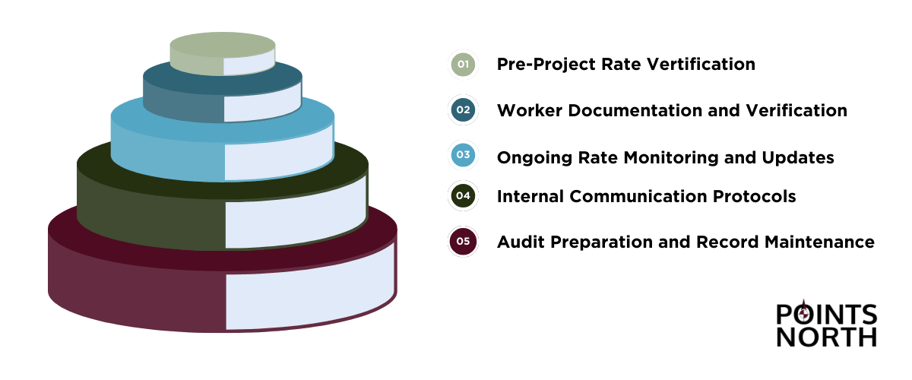
Pre-Project Rate Verification
Establish rate verification procedures before project commencement to avoid mid-project surprises and compliance issues. This includes:
- Contacting relevant locals to confirm current rates
- Documenting rate structures and effective dates
- Verifying benefit fund allocation requirements and payment destinations
- Confirming union dues payment procedure for away workers
- Identifying potential workers and their local affiliations
- Establishing communication channels for rate updates
Early verification prevents costly corrections and ensures accurate project budgeting from the start.
Worker Documentation and Verification
Implement robust systems for verifying and documenting worker local affiliations. Require workers to provide current union membership documentation and maintain copies for compliance records.
Don't rely on verbal confirmations or assumptions about local membership—workers may have transferred locals, changed classifications, or have special status that affects rate application.
Ongoing Rate Monitoring and Updates
Establish procedures for monitoring rate changes throughout project duration. This includes regular communication with locals, subscription to rate notification services, and systematic review of contract modifications.
Assign specific team members responsibility for rate monitoring to ensure changes are identified and implemented promptly.
Internal Communication Protocols
Develop clear communication protocols between project management, payroll, and compliance teams to ensure rate information flows efficiently and accurately throughout the organization.
Regular cross-functional meetings help identify potential issues early and ensure all teams understand current rate requirements and compliance obligations.
Compliance Record Maintenance
Maintain comprehensive records that support every rate decision and calculation. This includes correspondence with locals, rate verification documents, worker documentation, and detailed calculation records.
Organize records systematically to demonstrate compliance with Home and Away requirements.
Consequences of Home and Away Errors
Financial Penalties and Restitution Requirements
Home and Away errors trigger immediate financial liability that extends beyond simple rate corrections. Contractors face:
- Full restitution payments for all affected workers
- Interest calculations from original pay dates
- Benefit fund corrections and potential penalties for misallocated contributions
- Administrative penalties for non-compliance
- Potential liquidated damages under contract terms
These costs compound quickly across multiple workers and extended time periods, often exceeding original project margins. Benefit misallocation adds additional complexity, as funds must be recovered from one trust and redirected to the correct one, a process that can take months and generate significant administrative costs.
Union Grievances and Work Stoppages
Incorrect Home and Away rate application can trigger union grievances that result in work stoppages and project delays. Union locals take rate violations seriously, viewing them as direct attacks on member welfare and local authority.
Grievance procedures can extend for months, creating ongoing project uncertainty and additional legal costs that far exceed the original rate differences.
Damage to Union Relationships
Poor Home and Away compliance creates lasting damage to contractor-union relationships. Locals maintain detailed records of contractor performance, and compliance failures affect future project opportunities and worker availability.
Rebuilding trust after compliance failures requires consistent performance over multiple projects and ongoing demonstration of commitment to proper procedures.
Impact on Future Project Bidding
Contractors with poor Home and Away track records face restrictions on future project bidding. Public agencies and private developers increasingly review compliance history when evaluating contractor qualifications.
This reputational damage extends beyond individual clients to affect overall market position and competitive opportunities.
Staying Compliant with Home and Away Rules
 Mastering Home and Away Logic requires ongoing commitment to education, documentation, and systematic compliance procedures. The complexity of jurisdictional boundaries, rate structures, and documentation requirements demands sophisticated tracking and management systems that go far beyond basic payroll processing.
Key takeaways for maintaining compliance include establishing pre-project verification procedures, implementing robust documentation systems, maintaining ongoing communication with relevant locals, and investing in compliance tracking tools that can manage the complexity of multi-local projects.
Ready to streamline your union compliance process? Consider how specialized compliance software can help you navigate Home and Away Logic requirements with confidence. WageIQ is designed specifically for contractors who need sophisticated union compliance tracking without the complexity of managing payroll processing internally.
Looking for more union compliance guidance? Check out our Union Payroll 101 for foundational concepts and Managing Union Pay Scales for rate management best practices.