
.png)
Union payroll compliance affects every aspect of your project success and bottom line. When contractors take on projects with union employees, they enter a complex world of specialized wage structures, fringe benefit calculations, and reporting requirements that go far beyond standard payroll processing. A single compliance misstep can result in costly penalties, project delays, and damaged relationships with union partners.
Union payroll compliance encompasses the accurate processing of wages, benefits, and deductions according to collective bargaining agreements, along with proper documentation and reporting to various unions and regulatory bodies. Unlike standard payroll, union environments require contractors to navigate multiple pay scales, overtime rules, and benefit contribution calculations that vary by trade, location, and local union.
This comprehensive guide covers everything contractors need to know about union payroll processing, compliance requirements, and practical solutions to streamline these complex operations while maintaining accuracy and meeting regulatory obligations.
Union Payroll Fundamentals
Union payroll differs significantly from standard payroll processing in several fundamental ways that contractors must understand before taking on union projects. While regular payroll focuses primarily on wages, taxes, and basic deductions, union payroll introduces multiple layers of complexity that require specialized knowledge and systematic approaches.
The foundation of union payroll lies in collective bargaining agreements (CBAs), which establish specific wage rates, benefit contribution amounts, working conditions, and reporting requirements for each trade and geographic area. These agreements create a framework that contractors must follow precisely, with little room for interpretation or deviation from established procedures.
Key compliance requirements include accurate wage calculations based on union pay scales, proper handling of fringe benefit contributions, timely collection and remittance of union dues, and comprehensive documentation of all payroll activities. Contractors must also understand that union payroll incorporates varied overtime rules, often including double-time provisions and specific calculation methods that may not apply to non-union work.
Union payroll processing complexities include geographic considerations, reciprocity agreements, and the need to track employee classifications with precision. Each trade may have different apprenticeship levels, specialty classifications, and geographic boundaries that affect wage rates and benefit contributions. Understanding these nuances is essential for maintaining compliance and avoiding costly mistakes that can impact both current projects and future union relationships.
Essential Components of Union Payroll Compliance
Successfully managing union payroll compliance requires mastering several interconnected components, each with its own rules and requirements that must work together seamlessly.

Wage Structure Management
Base wages and pay scales form the foundation of union payroll calculations. Unlike standard hourly rates, union pay scales are typically established through collective bargaining agreements and vary by trade classification, experience level, and geographic location. Contractors must ensure they're using current rates for each specific union local and trade classification involved in their projects.
Finding accurate pay scales is crucial for compliance, as using outdated or incorrect rates can result in underpayment violations and subsequent penalties. Pay scales often include multiple tiers for journeyman workers, apprentices at various levels, and specialty classifications that command premium rates.
Common Pay Scale Categories:
- Journeyman rates (experienced workers)
- Apprentice levels (1st year through completion)
- Foreman and supervisor premiums
- Specialty trade classifications
- Geographic zone differentials
Overtime calculations in union environments follow specific rules. Many union agreements include provisions for double-time pay after certain daily or weekly thresholds, premium pay for weekend work, and shift differentials that must be calculated accurately. Understanding the fundamentals of union payroll processing helps contractors navigate these complex calculation requirements.
Geographic rate variations add another layer of complexity, as the same trade may have different pay scales depending on the specific county, city, or even job site location. Some projects may involve work across multiple jurisdictions, requiring contractors to track and apply different rates based on where the work is performed. Reciprocity agreements can affect which rates apply when workers from one local work in another local's territory.
Fringe Benefit Processing
Fringe benefits represent a significant portion of total labor costs in union projects and require careful attention to ensure proper compliance. These benefits typically include; health and welfare contributions, pension/401k contributions, vacation and PRO, and training fund payments that must be calculated and remitted according to specific schedules and requirements.
Health and welfare contributions usually require payments to specific benefit funds designated in the collective bargaining agreement. These contributions are typically calculated as a fixed amount per hour, but may vary based on the number of hours worked in a given period or the employee's benefit election status.
Pension and training fund requirements involve additional per-hour contributions that support retirement benefits and ongoing education programs for union members. These funds often have specific reporting requirements and deadlines that contractors must meet to avoid penalties and maintain good standing with the union.
Deduction Management
Union dues collection and remittance represents a critical component of union payroll compliance. Contractors must accurately calculate dues based on the specific formula outlined in each collective bargaining agreement, which may be an hourly amount percentage of gross wages, a flat weekly or monthly amount, or a combination of these.
Assessment fees may apply for special union programs, organizing activities, or political action committees. These fees are typically temporary but must be collected and remitted according to union specifications. Proper documentation of all deductions is essential for audit purposes and maintaining transparent relationships with union partners.
Proper remittance procedures involve not only collecting the correct amounts but also submitting payments and reports to the appropriate union offices according to established schedules. Late or incorrect remittances can result in penalties and may affect the contractor's ability to bid on future union projects.
Union Payroll Processing Best Practices
Implementing systematic approaches to union payroll processing helps contractors maintain compliance while reducing administrative burden and minimizing the risk of costly errors.
Accurate record-keeping requirements extend beyond basic time and attendance tracking to include detailed documentation of work locations, trade classifications, and specific union locals involved in each project. These records serve as the foundation for all payroll calculations and provide essential documentation for union audits and compliance reviews.
Time cards need precise coding for different trades, locations, and work types to ensure proper rate application. Digital time tracking systems can help automate this process while providing real-time visibility into labor costs and compliance status.
Documentation standards for compliance include maintaining copies of collective bargaining agreements, pay scale notifications, and benefit fund requirements for each union local involved in projects. This documentation should be easily accessible and regularly updated to reflect any changes in rates or requirements.
Creating a centralized system for tracking rate changes helps ensure that payroll calculations always use current information. Union pay scales can change multiple times per year, and staying current with these changes is essential for compliance and accurate project costing.
Timeline management for submissions involves understanding the various reporting and payment deadlines associated with different unions and benefit funds. Some require monthly submissions, while others operate on quarterly schedules. Missing these deadlines can result in penalties and administrative complications. For example, similar to a mortgage payment, most unions do not allow partial payment of fringes. All fringes due for all workers and hours for a particular timeframe are due in full upon deadline. Partial payments will be returned.
Common Compliance Challenges & Solutions
Even experienced contractors face significant hurdles when managing union payroll compliance, but understanding these challenges helps develop effective solutions and prevention strategies.
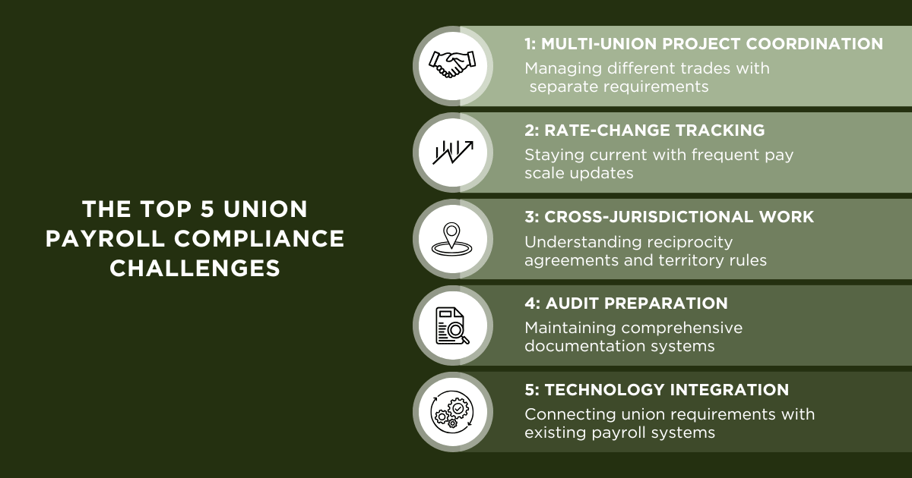
Multi-union project management becomes complex when a single project involves workers from different trades and union locals, each with their own pay scales, benefit requirements, and reporting procedures. Contractors must track which workers belong to which unions and ensure that payroll calculations and remittances are handled correctly for each group.
Rate change tracking presents ongoing challenges as union pay scales are updated throughout the year. Contractors need systems to monitor these changes and implement them promptly to avoid underpayment issues. Utilizing a system that allows for updating and backdating tables to account for late rate adjustment notifications can help mitigate risk.
Audit preparation and response requires maintaining comprehensive documentation and being able to quickly provide detailed records when unions or regulatory bodies request compliance reviews. Having organized, easily accessible records makes the audit process smoother and demonstrates a commitment to compliance.
Cross-jurisdictional work adds complexity when projects span multiple union territories or states with different reciprocity agreements. Understanding which rates apply and how to handle workers who may be traveling outside their home local's territory requires careful planning and coordination with affected union offices.
Specialized software can help automate many compliance tasks, from rate tracking to benefit calculations to report generation. The right technology can significantly reduce administrative burden while improving accuracy and compliance.
Leveraging Technology for Union Payroll Compliance
Modern technology offers powerful solutions for managing the complexities of union payroll compliance, helping contractors streamline operations while maintaining accuracy and meeting all regulatory requirements.
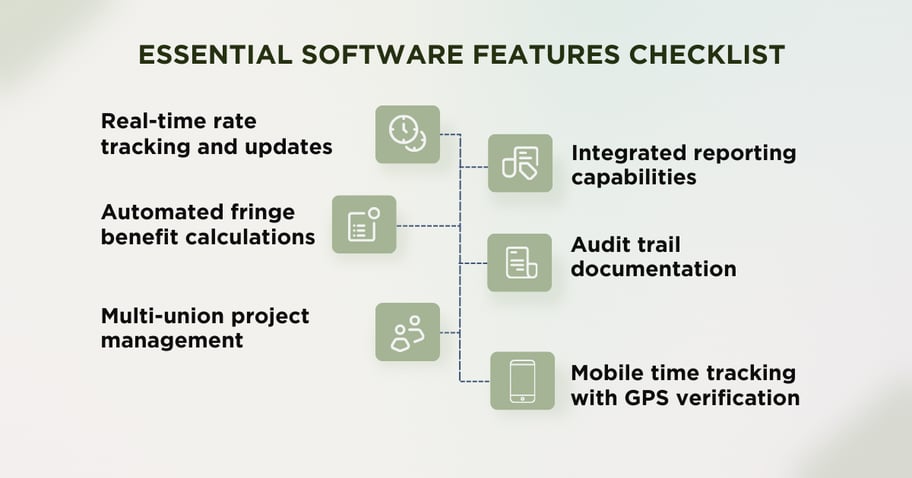
Benefits of specialized union payroll software include automated rate tracking, integrated benefit calculations, and streamlined reporting capabilities that reduce manual effort and minimize errors. These systems can handle the complex calculations required for multiple unions, trades, and geographic areas while maintaining detailed audit trails.
Key features to look for in compliance tools include real-time rate updates, automated fringe benefit calculations, integration with existing payroll systems, and comprehensive reporting capabilities. The most effective solutions provide centralized management of all union-related payroll activities while maintaining the flexibility to handle unique project requirements.
Modern compliance platforms can automate fringe calculations, helping contractors manage variable hour employees and seasonal work patterns more effectively. These tools can track contribution requirements across multiple benefit funds and generate the reports needed for timely submission to union offices.
Integration with existing payroll systems ensures that union payroll processing fits seamlessly into established workflows without requiring complete system overhauls. The best solutions work alongside current technology while adding specialized capabilities for union compliance requirements.
Advanced features like mobile time tracking, GPS verification, and automated rate application help ensure that payroll data is accurate from the initial time entry through final processing. These capabilities are particularly valuable for contractors managing multiple job sites and diverse workforces.
Your Path to Seamless Union Payroll Compliance

Successfully managing union payroll compliance comes down to understanding the unique requirements, implementing systematic processes, and leveraging the right tools to handle complex calculations and reporting requirements efficiently.
The combination of accurate rate management, proper benefit processing, and timely reporting creates a foundation for successful union relationships and project profitability. Contractors who invest in understanding these requirements and implementing appropriate systems find that union payroll compliance becomes a manageable part of their operations rather than a constant source of stress and potential problems.
Key compliance strategies include staying current with rate changes, maintaining comprehensive documentation, and establishing reliable processes for handling the various components of union payroll. Regular communication with union offices and benefit fund administrators helps prevent issues and builds positive working relationships.
Next steps for implementation involve assessing current payroll processes, identifying areas where specialized tools or procedures are needed, and developing a systematic approach to managing union payroll requirements. Whether through enhanced internal processes or specialized compliance software, the goal is creating reliable, accurate, and efficient union payroll operations.
Taking a proactive approach to union payroll compliance not only prevents costly penalties and project delays but also positions contractors for success in the competitive union construction market. The investment in proper systems and procedures pays dividends through improved project profitability, stronger union relationships, and the ability to bid confidently on union projects.