
If you're working on government contracts, union projects, or prevailing wage jobs, you've likely encountered wage determinations, those dense, complex documents that dictate how much you must pay your workers. Understanding how to read and interpret these documents correctly is essential for compliance, but let's be honest: they can be incredibly confusing.
Whether you're dealing with federal Davis-Bacon determinations, state prevailing wage requirements, or collective bargaining agreement (CBA) rates, this guide will walk you through everything you need to know to read wage determinations confidently and pay your workforce correctly.
Table of Contents
- Where to Find Wage Determinations
- Understanding Wage Determination Numbers
- Construction Types Under Davis-Bacon
- Reading Wage Determination Classifications
- Understanding Wage Rates and Fringe Benefits
- How to Apply Wage Determinations to Your Payroll
- Common Challenges
- Simplify Wage Determination Compliance
What is a Wage Determination?
A wage determination is a formal ruling that establishes the minimum wage rates and fringe benefits for various job classifications within a specific geographic area. These determinations ensure fair compensation for workers on:
- Government-funded construction projects (federal, state, or local)
- Projects involving unionized workforces
- Public works contracts requiring prevailing wage compliance
Wage determinations are issued by different authorities depending on the project type. For federal projects, the U.S. Department of Labor (DOL) issues determinations under the Davis-Bacon Act. State projects are governed by state-specific departments, such as the California Department of Industrial Relations (DIR), the New Jersey Department of Labor, or the New York State Department of Labor. For union projects, labor unions issue rates through collective bargaining agreements.
Understanding these documents isn't just about compliance, it's about avoiding costly penalties, back-wage payments, and project delays. Misclassifying workers or miscalculating wages can result in significant financial and legal consequences.
Where to Find Wage Determinations
The location of your wage determination depends on the project type:
Federal Wage Determinations (Davis-Bacon)
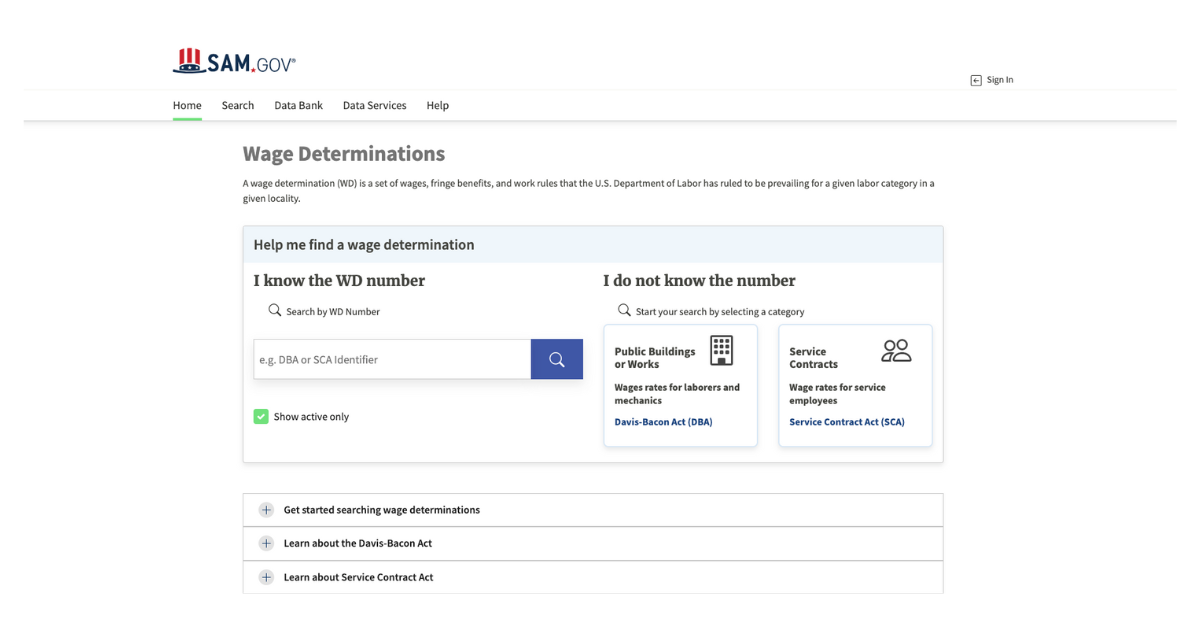
All federal wage determinations are available on SAM.gov. This platform offers advanced search capabilities and historical determination access.
State Wage Determinations Each state maintains its own prevailing wage database:
- California: Department of Industrial Relations (DIR)
- New Jersey: New Jersey Department of Labor
- New York: New York State Department of Labor
Learn more about the differences between state and federal prevailing wage laws.
Union Wage Determinations
Union rates typically come directly from the applicable union or may be available through union websites and local labor councils.
Information You'll Need Before Searching
Before you start your search, gather these essential details: the state and county where the work will take place, the name of the union (if applicable), the type of work (construction vs. services), your project award date, and the construction category (Building, Highway, Heavy, or Residential). Having this information ready will streamline your search process significantly.
Once you've located the appropriate determination on SAM.gov or your state's platform, always check the revision history to ensure you're using the version that corresponds with your project's award date.
Understanding Wage Determination Numbers
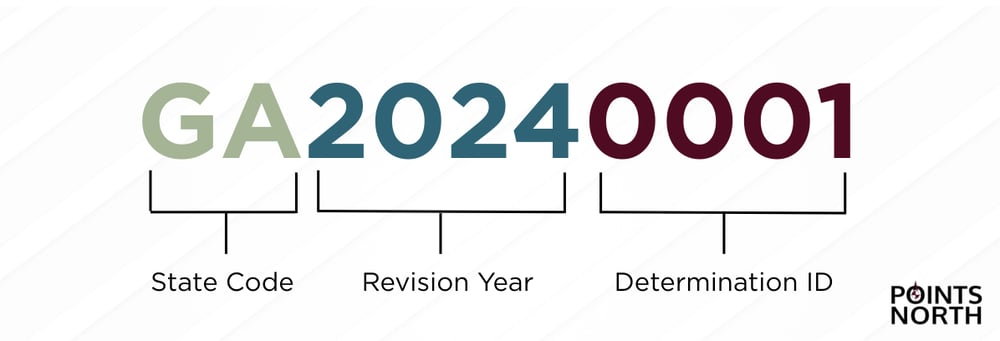
Federal wage determinations use a standardized numbering system with three components:
- State Code: Two-character identifier (e.g., GA for Georgia)
- Year: When the determination was revised
- 4-Digit Identifier: Specific code for the determination
For example, GA20240001 indicates a Georgia determination revised in 2024.
Note: Union and collective bargaining agreements typically don't follow this numbering format and instead use contract-specific identifiers.
Construction Types Under Davis-Bacon
Federal wage determinations fall into four broad construction categories:
- Building: Commercial buildings, hospitals, schools
- Highway: Roads, streets, highways, runways
- Heavy: Dams, water/sewer lines, non-building infrastructure projects
- Residential: Single-family houses, townhouses, apartment buildings
Always read the full definition of the construction type carefully, as it may contain specific inclusions or exclusions. Some determinations apply to multiple construction types, while others are narrowly focused (e.g., dam construction or dredging projects only).
Geographic Coverage and Special Considerations
Pay close attention to the geographic scope of each determination. Some determinations apply statewide, while others cover specific counties or cities. Special exclusions may apply to certain regions (such as tribal lands), and individual classifications within a determination may have different geographic boundaries. For union wage determinations, rates are almost always specific to particular trades and geographic areas. A carpenter's union rate in Manhattan will differ significantly from a suburban rate, even within the same county.
Even if a county is mentioned at the top of a wage determination, not every classification necessarily applies to that entire county. Some determinations subdivide counties based on geographic features, for example, areas east versus west of a railroad station.
Reading Wage Determination Classifications
Classifications define the type of work an employee performs and determine their applicable wage rate. Finding the right classification is critical to paying workers correctly.
Understanding Rate Identifiers
Each classification group begins with a rate identifier that provides context about how the rate was determined:
- UAVG: 100% of data came from unions, but no single majority rate existed
- SU: Rates derived from a weighted survey average
- Union codes (no SU prefix): Rates based on the local union agreement
Finding the Right Classification
When searching for classifications:
- Look for classifications that explicitly match your worker's tasks
- If no exact match exists, move toward broader classifications
- Some roles (like welding) may be considered "incidental" and inherit the classification of the primary work being performed
Classifications can have numerous modifiers based on:
- Specific work conditions or tasks
- Geographic area within counties
- Equipment specifications (e.g., crane capacity, equipment size)
- Experience levels
Navigating Multiple Classifications Across Determinations
Each wage determination has its own unique set of classifications that can vary significantly—even within the same state. Never assume classifications are consistent across different determinations. Evaluate each project's determination independently.
Tired of manually calculating wage determinations across multiple projects? See how Points North CPR automates the entire process so you can focus on running your business, not decoding complex wage tables.
Understanding Wage Rates and Fringe Benefits
.png?width=738&height=955&name=Wage%20Determination%20Annotated%20Sample%20(1).png)
Base Wage Rates
The determination specifies the minimum hourly rate for each classification. These rates may include modifiers based on equipment size, experience level, or special conditions.
For example, a power equipment operator's rate might vary significantly depending on whether they're operating a small crane (under 50 tons) or a large crane (over 100 tons).
Fringe Benefits
Fringe amounts must be paid in addition to the base wage. Here's what you need to know about calculating total wages and fringe benefits: Fringes can be provided as actual benefits (health insurance, pension contributions, etc.). Any unpaid portion can be paid as a separate hourly rate on the paycheck, added to the hourly cash wage, or contributed as an additional fringe benefit (such as a 401K contribution). Some fringes are expressed as percentages of gross wages, and fringes typically must be "annualized", offered year-round, not just during government projects.
Understanding Percentage-Based Fringes: When you see a percentage, you must pay that percent of the employee's gross wages in fringes. This ensures that fringe amounts scale appropriately for workers paid above the prevailing wage. Learn more about fringe benefit rates and requirements.
Special Pay Considerations
Geographic Pay Differentials: Remote or difficult-to-access work locations may require additional compensation. Determinations may specify distance-based pay differentials based on distance from a city center, often calculated "as the crow flies." Some determinations also designate specific geographic zones (such as Zone 25 in Texas, which covers multiple counties) with their own rate structures.
Holiday Pay: Even if not explicitly mentioned, federal holidays typically require payment. Some classifications list specific holidays that qualify for pay, and state-specific holidays may also apply (e.g., Nevada Day).
Union-Specific Variables: Collective bargaining agreements often include unique provisions such as opt-in/opt-out fringe benefits that require careful tracking to ensure each employee receives their entitled compensation.
How to Apply Wage Determinations to Your Payroll
Accurate compliance starts with proper systems. Learn more about getting started with certified payroll reporting software:
- Map classifications: Connect determination classifications to your internal task codes or time-tracking system
- Train employees: Ensure workers document task changes in real-time
- Calculate correctly: Your payroll system must account for multiple variables—base rates, modifiers, fringes, and geographic pay differentials
- Document thoroughly: Maintain detailed records showing how you determined each worker's classification and rate
Common Challenges and How to Avoid Them
Misclassification and Geographic Errors
The most frequent compliance issues stem from misclassifying workers—using the wrong classification for the work actually performed—and missing geographic exclusions by applying rates from the wrong geographic area. These errors often occur when contractors assume classifications are consistent across determinations or fail to read the fine print about geographic boundaries within counties.
Fringe Benefit and Rate Management
Failing to account for all fringe benefits remains a persistent challenge, particularly when contractors overlook percentage-based fringes or holiday pay requirements. Similarly, not updating for determination revisions can leave you using outdated rates that no longer reflect current requirements. Always verify you're working with the most current version that corresponds to your project award date.
Union-Specific Complications
For union projects, ignoring CBA-specific variables creates additional risk. Collective bargaining agreements often include unique provisions for fringe opt-ins and opt-outs that require careful employee-by-employee tracking to ensure each worker receives their entitled compensation.
Don't get shortchanged on prevailing wages. Always confirm your interpretation with your contracting agency or union representative when in doubt.
Simplifying Wage Determination Compliance

Managing wage determinations manually is time-consuming and error-prone. Modern certified payroll software can help you manage proper classifications, calculate correct wages and fringes based on multiple variables, track employee time across different classifications and projects, and generate compliant certified payroll reports for federal, state, and union requirements.
Points North's Certified Payroll Reporting (CPR) solution is designed specifically to handle these complexities, whether you're working with Davis-Bacon determinations, state prevailing wage requirements, or union collective bargaining agreements.
Wage determinations are complex documents, but with the right knowledge and tools, they're entirely manageable. Understanding how to locate, read, and apply these determinations correctly protects your business from penalties while ensuring your workers receive fair compensation.
The key is accuracy: correct classification, proper calculation, and thorough documentation. Whether you're managing federal, state, or union wage requirements, investing time in understanding wage determinations—and implementing systems to manage them—pays dividends in compliance and peace of mind.
Ready to simplify your prevailing wage and union payroll compliance? Learn how Points North CPR can help you manage wage determinations across all your projects with confidence.