
For employers in industries like healthcare, restaurants, hospitality, and retail, managing variable hour employees under the Affordable Care Act can feel like navigating a moving target. These are the workers whose schedules shift from week to week, making it difficult to determine at the time of hire whether they’ll meet the ACA’s threshold for full-time status.
Getting the classification wrong isn’t just an administrative headache. Employers who fail to properly track and offer coverage to eligible variable hour employees risk penalties under IRC Section 4980H, which can amount to thousands of dollars per employee per year. This guide walks you through everything you need to know: how variable hour employees are defined under the ACA, how to classify and track them accurately, when benefits must be offered, and common mistakes to avoid.
What Are Variable Hour Employees Under the ACA?
Under the ACA, a variable hour employee is someone whose weekly hours of service cannot reasonably be determined to consistently average 30 or more hours per week at the time of hire. This definition comes from the IRS regulations at 26 CFR 54.4980H-1 and applies specifically to Applicable Large Employers, those with 50 or more full-time equivalent employees.
The distinction matters because ALEs are required to offer affordable minimum essential coverage to employees that meet the ACA definition of full-time. When you can’t determine at the point of hire whether a new employee will work enough hours to qualify as full-time, the ACA allows employers to use a measurement period to track their actual hours before making a benefits determination.
It’s important to understand that “variable hour” is not the same as “part-time.” A part-time employee, as defined in the ACA regulations, is reasonably expected to work fewer than 30 hours per week. A variable hour employee, on the other hand, could end up working well above or below that threshold depending on business needs, seasonal demand, or client schedules. It is important to track all part-time, variable hour, and seasonal employees to ensure compliance with ACA requirements.
Common Examples of Variable Hour Employees
- Restaurant servers and bartenders with fluctuating shift schedules
- Home healthcare aides whose hours depend on patient caseloads
- Retail associates with schedules that change based on store traffic
- Temporary, on-call, or per diem workers
- Substitute teachers and event staff
- Hospitality workers in seasonal tourism markets
Variable Hour vs. Full-Time vs. Seasonal Employees
Understanding the differences between these employee classifications is critical for ACA compliance:
|
Classification |
Definition |
ACA Implications |
|
Variable Hour |
Cannot determine at hire if employee will average 30+ hours/week |
Tracked through measurement period before benefits determination |
|
Full-Time |
Reasonably expected to work 30+ hours/week at hire |
Must be offered benefits immediately (or within initial waiting period) |
|
Seasonal |
Position is temporary for a specific season, typically 6 months or less |
Tracked through measurement period; seasonal exemptions may apply |
|
Part-Time |
Reasonably expected to work fewer than 30 hours/week |
Tracked through measurement period to determine benefit eligibility |
How to Determine If an Employee Is Variable Hour
The classification decision happens at the time of hire and hinges on whether it is “reasonably expected” that the employee will average at least 30 hours of service per week. This is not a gut feeling, the IRS expects employers to base this determination on objective factors and to document the rationale.
Key Classification Criteria
- The nature of the position and whether similar roles have historically averaged 30+ hours
- Whether the role is advertised or structured as variable or flexible
- The employee’s stated availability and schedule preferences
- Contractual terms regarding hours of work
- Industry norms for the type of role
Documentation Best Practices
Strong documentation protects your organization if you’re ever audited, receive a Letter 226-J, or a Letter 5699 from the IRS. For every new hire classified as variable hour, maintain records that include:
- A written job description reflecting variable scheduling expectations
- The classification decision and the reasoning behind it, recorded at hire
- Historical hour data for comparable positions in your organization
- Annual reviews of classifications, with updates as circumstances change
Tracking Variable Hour Employees for ACA Compliance
Once an employee is classified as variable hour, the ACA requires employers to use a lookback measurement method to track their actual hours of service over a defined period. This data is what determines whether the employee must be offered health coverage. Without a reliable tracking system, employers are left guessing, and guessing creates compliance risk.
The measurement and stability period framework is at the core of ACA compliance for variable hour employees. Measurement periods can range from 3-12 months. The most common length of the measurement period is 12 months. Rather than repeating the full mechanics here, we’ve created in-depth guides on each.
Why Establishing a Tracking Process Early Matters
One of the most consequential decisions an employer can make is whether to build a consistent hour-tracking process proactively or deal with the consequences of not having one later. The difference is significant.
Employers who establish a routine process for tracking variable hour employees during each measurement period can verify employee status in minutes, respond to IRS inquiries with confidence, and make timely benefits determinations without scrambling. It becomes part of the normal workflow.
On the other hand, employers who lack a process often discover the problem only after receiving a Letter 226-J from the IRS—a notice proposing employer shared responsibility penalties or a Letter 5699 from the IRS —a notice that you have not filed 1094/1095-C forms with the IRS. At that point, reconstructing several years of payroll data, cross-referencing historical schedules, and piecing together employee records is enormously time-consuming and stressful. What could have been a simple ongoing task becomes a retroactive audit that drains HR resources and increases the likelihood of errors that lead to penalties.
The takeaway: investing a small amount of time in a consistent tracking process now saves exponentially more time and money down the road.
What Hours Must Be Tracked
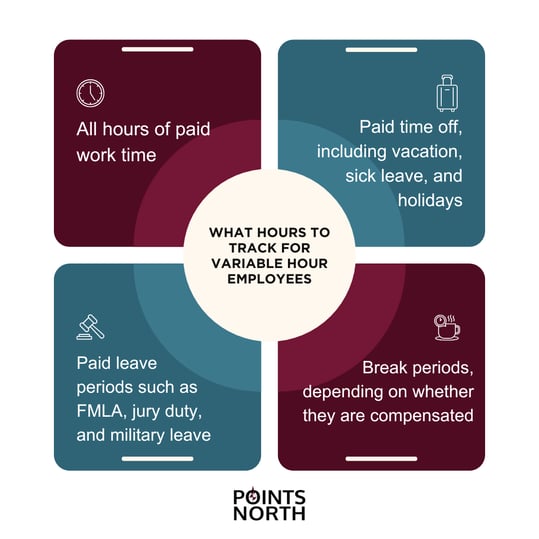
The IRS defines “hours of service” broadly. When tracking variable hour employees, employers must count:
- All hours of paid work time
- Paid time off, including vacation, sick leave, and holidays
- Paid leave periods such as FMLA, jury duty, and military leave
- Break periods, depending on whether they are compensated
Calculating Full-Time Status
At the end of a measurement period, calculate the employee’s average hours. An employee is considered full-time if they averaged 130 hours per month (or 30 hours per week) during the measurement period. If they meet this threshold, the employer must offer coverage during the corresponding stability period.
Simplify Variable Hour Employee Tracking with ACA Reporter
Managing ACA compliance for variable hour employees doesn't have to be complicated. ACA Reporter automatically tracks hours, calculates measurement periods, and ensures you stay compliant, no matter how complex your workforce. Schedule a demo today to see how we can save you time and eliminate compliance headaches.
Variable Hour Benefit Eligible Employees vs. Benefit Ineligible
The measurement period is what transforms a variable hour employee’s status from uncertain to defined. Based on the results, they either become benefit eligible or remain benefit ineligible for the upcoming stability period.
When Variable Hour Employees Must Be Offered Benefits
- They averaged 30 or more hours per week (or 130+ hours per month) during the measurement period
- Coverage must be offered for the full duration of the corresponding stability period
- The coverage offered must be affordable and provide minimum value under ACA standards
When Variable Hour Employees Remain Benefit Ineligible
- They averaged fewer than 30 hours per week during the measurement period
- The employer is not required to offer coverage during the corresponding stability period
- The employer must continue tracking hours for the next measurement period
Managing Changes in Status
Hours can shift over time. An employee who was benefit ineligible last year may cross the 30-hour threshold this year, and vice versa. Employers need a process for monitoring these transitions, reclassifying employees when appropriate, and communicating any changes in benefits eligibility clearly and in a timely manner.
Promotions and changes in an employee's status can affect an employee's ACA benefit eligibility. If a part-time or variable hour employee received a promotion or status change that designates them as a full-time employee, an offer of coverage will need to be made.
Common Mistakes When Managing Variable Hour Employees
Even well-intentioned employers can run into trouble when managing ACA compliance for variable hour employees. Here are the most common pitfalls:
- Misclassifying employees at hire. Assuming a new hire is part-time when their hours are genuinely unpredictable. If there’s any uncertainty, the safer classification is variable hour.
- Inconsistent tracking. Tracking hours for some employees but not others, or using different methods across departments and locations, creates gaps that the IRS can identify.
- Missing measurement period deadlines. Failing to calculate hours and offer coverage on time is one of the most common triggers for penalty assessments.
- Lack of documentation. Without a clear paper trail explaining why each employee was classified the way they were, defending your decisions during an audit becomes significantly harder.
- Forgetting about rehires. Employees who leave and return may be subject to break-in-service rules. Failing to apply these rules correctly can lead to incorrect benefits determinations.
- Failure to aggregate hours. The hours for employees working at multiple locations/employers who are a part of the same ownership group (Controlled Group / Aggregated Reporting Member) need to have their hours aggregated to be measured correctly.
Industry-Specific Considerations for Variable Hour Employees
While the ACA’s rules are the same across industries, the practical challenges of tracking variable hour employees differ depending on the nature of your workforce.

Healthcare Organizations
Home health agencies and healthcare staffing firms often employ large numbers of aides, per diem nurses, and on-call staff whose hours depend on patient needs and scheduling. Tracking hours across multiple patient locations and reconciling data from different scheduling systems is a common challenge. For agencies with 150 or more aides, manual tracking quickly becomes unsustainable.

Restaurants and Hospitality
Restaurant groups face seasonal demand swings, servers with schedules that change weekly, and multiple part-time employees who may creep above 30 hours during busy periods. Multi-location employers also need to aggregate hours across all locations under the same EIN, which adds another layer of complexity.

Retail
Retail employers deal with seasonal hiring peaks, variable schedules driven by store traffic, high employee turnover, and part-time workers who pick up extra shifts. Each of these factors makes it harder to predict which employees will cross the full-time threshold without a reliable tracking system in place.
How Technology Simplifies Variable Hour Employee Tracking
Manually tracking variable hour employees with spreadsheets is technically possible, but it’s error-prone, time-consuming, and increasingly risky as your workforce grows. ACA compliance software automates the most labor-intensive aspects of the process, including payroll integration, real-time hour monitoring, measurement period calculations, compliance deadline alerts, and 1095-C form generation.
Key Features to Look For in ACA Tracking Software
- Automated hour tracking through direct payroll integration
- Built-in measurement period and stability period calculations
- Employee status dashboards with real-time monitoring
- Automated alerts for compliance deadlines
- 1095-C form generation and electronic filing support
- Reporting and audit trail capabilities for IRS documentation
- Ability to aggregate payroll and hours from multiple sources
Best Practices for Variable Hour Employee ACA Compliance
Staying compliant with ACA requirements for variable hour employees comes down to having the right processes in place and following them consistently. Use this checklist as a starting point:
- Properly classify every employee at the time of hire
- Document classification decisions and the reasoning behind them
- Track all hours of service accurately and consistently
- Set up measurement periods of appropriate length (3–12 months)
- Calculate full-time status at the end of each measurement period
- Offer affordable coverage to eligible employees during the stability period
- Monitor for status changes, rehires, and breaks in service
- Maintain records sufficient for IRS reporting
- Generate accurate 1095-C forms annually
- Review and update your tracking processes at least once a year
Managing variable hour employees under the ACA requires careful classification, consistent tracking, and timely action. The stakes are real, but with the right process in place, compliance doesn’t have to be overwhelming. The most important step is building a reliable system now, rather than scrambling to reconstruct data after the IRS comes calling.