

Last Updated: February 2026
Union construction work is no longer limited to a handful of large firms operating in major metro areas. Heading into 2026, contractors of all sizes are encountering union labor on their projects. Driven by a combination of federal infrastructure spending, growing project labor agreement (PLA) requirements, and a skilled labor market that keeps getting tighter.
Whether your company is bidding on its first union project or looking to scale an existing portfolio of union work, the landscape has shifted enough that it’s worth taking a fresh look at what union construction means for employers today.
This guide covers the business side of working with construction unions: the current market dynamics, how unions function from the employer’s perspective, and what you’ll need to have in place before you sign on. For the deeper compliance mechanics, payroll processing, rate management, reporting forms, we’ll point you to the right resources along the way.
The State of Union Construction in 2026
| 349K | 3.2% | 4.7% | 15.4% | $35M |
| workers needed | construction unemployment | average CBA wage increase | construction union membership rate | PLA threshold |
The construction industry is navigating a sustained labor crunch. According to Associated Builders and Contractors, the industry needs an estimated 349,000 new workers in 2026 to keep up with demand; a figure that, while lower than recent years, still reflects persistent workforce gaps across nearly every trade. Construction unemployment stood at 3.2% in August 2025, a full 1.1 percentage points below the national average of 4.3%, underscoring just how competitive the market for skilled workers has become.
Against that backdrop, union wage settlements are running at their strongest pace in over a decade. Collective bargaining agreements settled in the first half of 2025 delivered an average 4.7% increase in wages, fringe benefits, and other employer payments for union craft workers, according to the Construction Labor Research Council. The CLRC’s executive director has described these as among the highest increases in 15 years, a trend that reflects both labor scarcity and the growing bargaining power unions hold in today’s market.
Younger workers are contributing to this momentum. The North America’s Building Trades Unions (NABTU) reported net membership growth of nearly 50,000 in 2024, and when combined with 2023 gains, the organization called it the most significant consecutive expansion of building trades membership since the 1950s. Workers under 45 are showing increased interest in union representation, drawn by structured wages, formal apprenticeship pathways, and workplace protections.
Federal policy is amplifying the trend. The Bipartisan Infrastructure Law and clean energy investments continue to fuel large-scale projects that often require or incentivize union labor. On federal contracts exceeding $35 million, project labor agreements may apply under federal acquisition rules, though this requirement remains subject to ongoing legal and political challenges and contractors should stay current on its status.
For context, union members make up roughly 9.9% of the overall U.S. workforce. But in construction and extraction occupations specifically, the union membership rate is significantly higher at 15.4%, and that concentration is even more pronounced in the regions and project types where government-funded work is most active. If your company bids on public works or prevailing wage projects, the odds of encountering union labor are considerably higher than the national average suggests.
How Construction Unions Work for Employers

Most content about construction unions is written for workers; how to join, what dues cover, and what protections to expect. But employers evaluating union work need a different lens. Here’s what the relationship looks like from the contractor’s side of the table.
What It Means to Be a Signatory Contractor
When a contractor becomes a “signatory” to a union, they agree to follow the terms of a collective bargaining agreement (CBA) negotiated between the union and the employer association representing contractors in that trade and region. CBAs define wage rates, overtime rules, fringe benefit contributions, working conditions, and other terms for all covered workers on a project.
Being a signatory also means hiring through union referral systems, commonly known as hiring halls, for the covered trades. It’s worth noting that becoming a signatory does not mean the union runs your business. You retain control of hiring and firing decisions, scheduling, and project management. The CBA sets the compensation and working-condition framework; you still manage the work.
It’s also worth understanding what happens when you work with union employees but are not signatory to their union; a scenario that’s more common than many contractors expect, particularly on multi-trade projects or when subcontracting under a signatory general contractor. In these cases, you may still be required to make certain payments to union trust funds or follow reciprocity rules that govern how benefits are handled across union jurisdictions. The specifics depend on the unions involved and the agreements in place.
Understanding Hiring Halls and Workforce Access
Union hiring halls function as a labor pool that contractors can draw from when staffing projects. Workers referred through hiring halls have typically completed structured apprenticeship programs, which means they arrive on-site with documented skills and certifications. For contractors struggling to find qualified labor through traditional channels, this pipeline can meaningfully reduce onboarding time and skills gaps.
On multi-trade projects, you may interact with several different unions, each with its own CBA and referral process. Planning for this during preconstruction, rather than reacting to it in the field, makes a real difference in how smoothly a project runs.
Jurisdictional Considerations
Each union represents specific trades; electricians, carpenters, laborers, ironworkers, and so on, and jurisdictional rules determine which union’s workers perform which tasks on a jobsite. Overlapping jurisdictions can create friction, particularly around general cleanup and shared duties, if not planned for in advance.
Understanding these boundaries during the estimating and planning phase is critical. Getting jurisdictional assignments wrong doesn’t just create conflict on the jobsite, it can affect your labor cost accuracy and expose you to grievances.
Why More Contractors Are Taking On Union Work
- Access to a trained workforce. Union apprenticeship programs produce workers with documented skills, safety certifications, and trade-specific training. With the broader labor shortage intensifying, this pipeline represents a competitive advantage that’s increasingly difficult to replicate through open-shop hiring alone.
- Government project eligibility. Federal projects over $35 million increasingly require project labor agreements, and state and municipal prevailing wage projects frequently favor or mandate union labor. Contractors who can handle union work open the door to a significantly larger project pipeline; one that many of their competitors aren’t equipped to pursue.
- Structured safety and training standards. Unions have long maintained safety training programs that meet or exceed OSHA requirements. For construction companies working on high-risk or large-scale projects, this built-in safety infrastructure reduces risk and can lower insurance costs over time.
- Wage and benefit structure. While union labor typically costs more on paper, CBAs provide a structured framework for wages and benefits that gives employers a defined baseline for project budgeting. That said, contractors should be aware that rate and fringe increases can occur during the life of a project and aren’t always predictable. Having defined CBA terms still gives employers a clearer starting point for cost estimation than open-shop arrangements, where wage pressures can be even less transparent.
What Employers Need to Prepare For
Taking on union work comes with real operational complexity. The upside, a trained workforce, access to government projects, structured labor relationships, is significant, but only if you’re prepared for the administrative and compliance demands that come with it.
Collective Bargaining Agreements and Wage Structures
Each CBA specifies not just base wages but also fringe benefit contributions (health insurance, retirement, training funds), overtime thresholds, holiday pay, and other compensation rules. Rates can vary by trade, by local, and even by project location, and managing multiple CBAs on a single multi-trade project adds significant complexity. Dive deeper into Collective Bargaining Agreements
Fringe Benefits and Trust Fund Obligations
Employers are required to make fringe benefit contributions to union trust funds, though in some cases, employees may be allowed to receive certain benefit amounts as cash in lieu of fund contributions; an increasingly common tool for attraction and retention in tight labor markets. Whether payments go to the fund or directly to the worker, accurate tracking and timely remittance are essential. Late or incorrect payments can trigger audits, penalties, and strained relationships with the union. Fringe Benefits Explained
Multi-Trade and Multi-State Complexity
Projects spanning multiple states require contractors to navigate different CBAs, tax regulations, and reporting requirements for each jurisdiction. Even within a single state, rates and rules can differ by union local, city, and county. Job coding systems that assign each worker to the correct project, trade, and jurisdiction are critical for keeping payroll accurate and compliant. Dive into Union Pay Scales and Explore State-Specific Prevailing Wage Laws
Reporting and Compliance Documentation
Union work requires detailed record-keeping: accurate time tracking, proper classification of work performed, and documentation that aligns with CBA terms. Federal and state agencies, including the Department of Labor, may conduct audits to verify compliance with union reporting and prevailing wage requirements. The administrative burden is real, but the right systems can significantly reduce the manual effort involved. Learn More About Contractor Pay & Compliance
How Technology Simplifies Union Work Management
Managing union payroll, rate lookups, fringe benefit tracking, and multi-jurisdiction compliance by hand is time-intensive and error-prone; especially as your union project volume grows. Even experienced payroll teams can struggle with the sheer number of variables involved: different rates by trade, by local, by project; fringe contributions that change on different schedules; and reporting requirements that vary across agencies and states.
Modern compliance software can automate rate management, flag discrepancies before they become audit issues, and centralize reporting across trades and locations. For contractors who are scaling their union project volume, investing in the right tools early prevents the kind of costly compliance gaps that only surface when it’s too late; typically during an audit.
Points North’s WageIQ platform is purpose-built for this kind of complexity, helping contractors manage union rates, fringe benefit calculations, and multi-jurisdiction compliance from a single system. The goal is simple: give your team the tools to handle union work confidently, without drowning in spreadsheets.
Getting Started with Union Construction Work
The 2026 landscape favors contractors who are prepared for union work. Federal spending continues to drive project volume, skilled labor remains scarce, and unions are growing their ranks for the first time in decades. But preparation is what separates contractors who thrive in this environment from those who get caught off guard by complexity they didn’t anticipate.
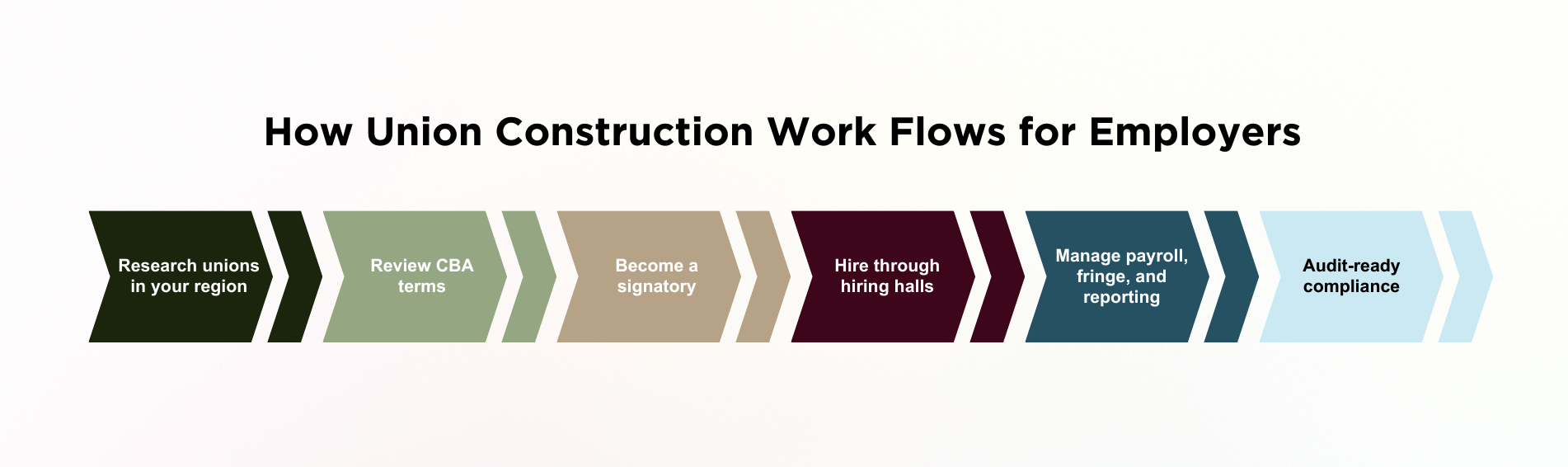
If you’re evaluating whether to take on union work, or looking to expand what you’re already doing, here are the practical next steps:
- Research the unions active in your region and the trades relevant to your project pipeline. Understanding who you’ll be working with starts long before you sign a CBA.
- Review CBA terms carefully and understand your wage, fringe, and reporting obligations before becoming a signatory. Don’t assume all CBAs work the same way, they vary significantly by trade and region.
- Invest in payroll and compliance systems that can handle union-specific complexity, especially if you’re managing multiple trades, multiple jurisdictions, or both.
- Build relationships with union representatives early. They can be valuable partners in workforce planning, and a good working relationship goes a long way when navigating the inevitable questions that come up on a project.
Union construction work isn’t going away, if anything, the trends are accelerating. The question isn’t really whether your company will encounter union labor, but whether you’ll be ready when it happens.
Ready to simplify union payroll and compliance?
Whether you're taking on your first union project or managing a growing portfolio of union work. Points North can help you stay compliance and in control.