

If you manage payroll for union construction projects, you've almost certainly encountered a collective bargaining agreement. But if you've ever searched for a clear explanation of what a CBA actually is and how it affects your day-to-day compliance work, you've probably found a lot of content about the NBA, the NFL, or generic HR overviews that don't speak to the realities of construction.
This article is written specifically for contractors and compliance teams working on union projects. A collective bargaining agreement is the document that dictates the wage rates, fringe benefit obligations, overtime rules, and jurisdictional requirements that flow directly into your payroll. Getting the details wrong doesn't just create headaches, it creates real compliance risk.
Below, we'll walk through what a CBA is, what's inside one that matters for your payroll, how CBAs interact with prevailing wage and Davis-Bacon requirements, and how to manage CBA compliance when you're juggling multiple projects and unions at once. If you're new to union payroll, our Union Payroll 101: A Contractor's Guide to Processing & Compliance is a good starting point before diving in here.
What Is a Collective Bargaining Agreement?
A collective bargaining agreement (CBA) is a legally binding contract negotiated between a labor union and an employer, or in construction, often a group of employers through a multi-employer association. The agreement establishes the terms and conditions of employment for the workers that union represents, covering everything from wages and benefits to working conditions and dispute resolution.
The legal foundation for collective bargaining in the United States comes from the National Labor Relations Act (NLRA), passed in 1935, which protects workers' right to organize and bargain collectively through representatives of their choosing.
CBAs typically last anywhere from one to five years, after which the parties renegotiate and members vote to ratify a new agreement. For contractors, the key thing to understand is this: the CBA is the source document that defines what you owe union workers. It's where wage scales, benefit fund contributions, and working condition requirements originate, and it's what auditors and union representatives will reference if questions arise about your compliance.
CBA vs. CDA: What's the Difference?
One point of confusion worth clearing up: a CBA and a CDA are not the same thing. A CBA (Collective Bargaining Agreement) is a negotiated labor contract between a union and an employer. A CDA (Community Development Agreement) is a project-specific agreement typically tied to a development project's community impact commitments, such as local hiring targets or community benefit provisions.
It's also helpful to understand how CBAs relate to other common agreements in union construction. A Master Labor Agreement (MLA) is a broad CBA that covers an entire trade within a geographic area, while a Project Labor Agreement (PLA) is a pre-hire agreement that establishes labor terms for a specific construction project. Both may reference or incorporate CBA terms, but they serve different purposes. If you're working on projects that involve home-and-away logic or reciprocal transfer agreements between jurisdictions, understanding how these agreements layer together becomes especially important.
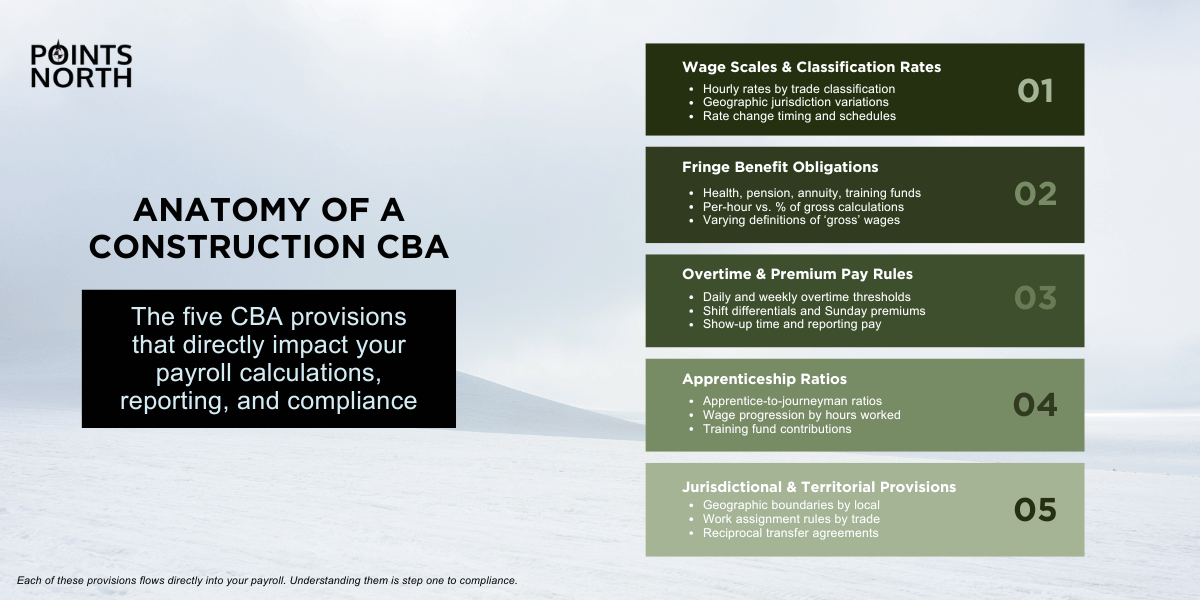
What's Inside a Construction CBA? Key Provisions That Affect Your Payroll
Not every section of a CBA carries equal weight for your payroll and compliance team. Some provisions are primarily about union governance or grievance procedures. The sections below are the ones that directly impact what you calculate, report, and pay.
Wage Scales and Classification Rates
CBAs define hourly wage rates by trade classification: journeyman, apprentice, foreman, general foreman, and so on. These aren't universal rates. They often vary by geographic jurisdiction within the same union, meaning a carpenter working under the same international union could have a different rate depending on which local's territory the project falls in.
Rate change timing adds another layer. Some CBAs schedule annual increases on a fixed date, others tie increases to contract anniversary dates, and some trigger adjustments at specific contract milestones. If you're managing payroll across multiple projects, keeping track of when rates change and for which classifications is a constant operational requirement. For a deeper look at how to navigate rate sourcing and management, see our guide on How to Find and Manage Union Pay Scales for Your Projects.
Fringe Benefit Obligations
CBAs specify required employer contributions to union benefit funds, which typically include health and welfare, pension, annuity, training and apprenticeship funds, vacation funds, and supplemental dues or assessments.
How these contributions are calculated varies significantly from one CBA to the next. Some agreements set fringe contributions as a flat dollar amount per hour worked. Others calculate them as a percentage of gross wages, and this is where things get complicated. Even the per-hour method isn't always as simple as it sounds: some CBAs apply a straight hourly fringe amount for certain types of hours only, while others require overtime calculations to be applied to the fringe rates themselves. That distinction alone can meaningfully change your total fringe obligation on any week with overtime hours.
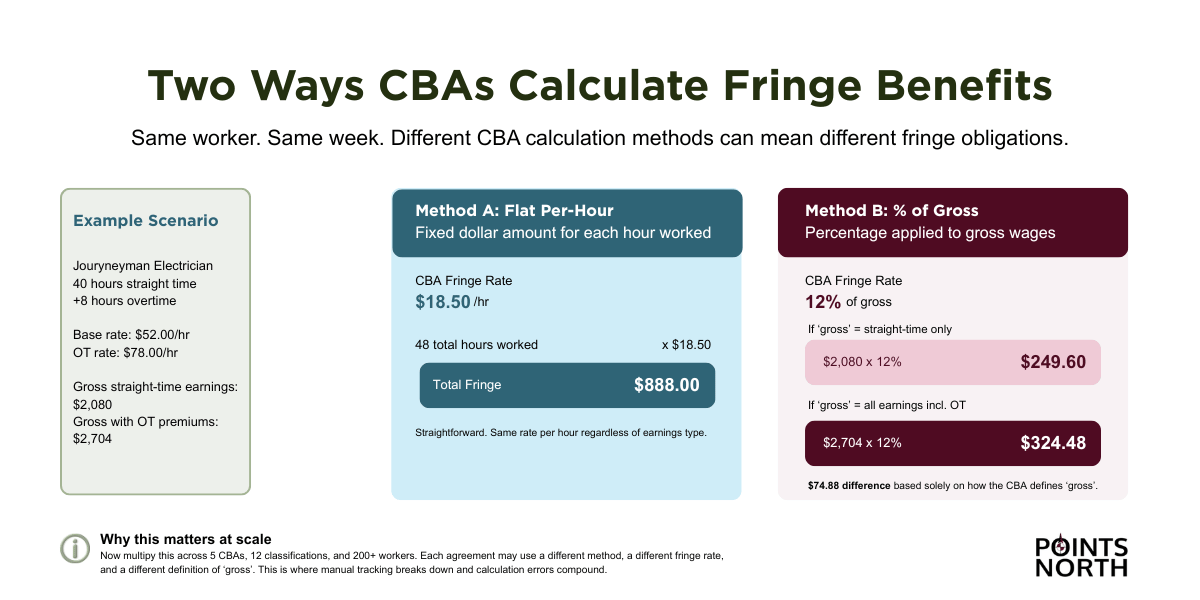
The definition of "gross" is not consistent across CBAs either. Some include only straight-time earnings, while others factor in overtime premiums, show-up pay, or other supplemental earnings. When you're managing multiple agreements, each with its own definition of what counts toward the gross calculation, accurately computing fringe obligations becomes one of the most error-prone areas of union payroll compliance.
On top of that, the fringe rates required by the CBA may differ from the fringe rates listed in a prevailing wage determination for the same classification and area. Contractors working on government-funded projects need to track and satisfy both sets of requirements. For more on how fringe benefits work in the context of certified payroll, see our Easy Explanation for Fringe Benefits.
Overtime and Premium Pay Rules
Federal law under the Fair Labor Standards Act (FLSA) sets a floor of one-and-a-half times the regular rate for hours worked beyond 40 in a week. CBAs frequently go further. A CBA might specify double-time pay for Sunday work, premium rates for night shifts, or daily overtime thresholds (such as time-and-a-half after 8 hours in a single day, regardless of weekly totals).
Holiday schedules, paid time off provisions, and show-up or reporting pay requirements, where a worker who reports to a job site is guaranteed a minimum number of paid hours even if work is canceled, are also commonly defined in the CBA and can affect your payroll calculations.
Apprenticeship Ratios and Requirements
Most construction CBAs define apprentice-to-journeyman ratios that must be maintained on a project. They also establish apprentice wage scales, which are typically structured as a percentage of the journeyman rate and increase on a scheduled progression as the apprentice gains hours and completes training milestones.
Training fund contributions are usually required for every apprentice hour worked, and the rates for those contributions are specified in the CBA. Miscalculating apprentice rates or misapplying the progression schedule can result in underpayment and compliance issues.
Jurisdictional and Territorial Provisions
CBAs define the geographic jurisdiction of the local union, essentially establishing which local covers which territory. This matters because wage rates, fringe contribution amounts, and working condition rules can change at the jurisdictional boundary, even for the same trade.
Work assignment provisions determine which trade has the right to perform specific types of work, and jurisdictional disputes between trades are a well-known source of project delays and grievances. For contractors with workers who travel between jurisdictions, reciprocal transfer agreements govern how benefit fund contributions are handled when a worker leaves their home local's territory.
How CBAs Interact with Prevailing Wage and Davis-Bacon Requirements
On federally funded or assisted construction projects, contractors must comply with both the applicable CBA and the prevailing wage determination issued under the Davis-Bacon Act. These two sets of requirements don't always align, and understanding where they overlap and where they diverge is essential for accurate payroll.
Here's how the relationship works in practice:
- Davis-Bacon wage determinations are published by the U.S. Department of Labor and establish the minimum wage and fringe benefit rates for each classification of worker in a given geographic area and type of construction. These determinations are often informed by CBA rates in heavily unionized areas, but they are not identical to any specific CBA.
- The "higher rate" rule applies. When the CBA rate for a classification exceeds the prevailing wage, the CBA rate governs. When the prevailing wage exceeds the CBA rate, the prevailing wage governs. Contractors must compare and pay whichever is higher for each component.
- Fringe benefit reconciliation is where it gets complicated. The CBA may require contributions to specific union funds at specific rates, while the Davis-Bacon determination lists a separate total fringe obligation. Both must be satisfied independently, and documenting that each requirement has been met is critical.
- This dual-compliance layer is one of the biggest payroll complexity drivers for union contractors working on government projects, particularly when managing multiple projects across different jurisdictions simultaneously.
Explore reporting requirements by state in our State-by-State Certified Payroll Reporting guide.
Managing CBA Compliance Across Multiple Projects
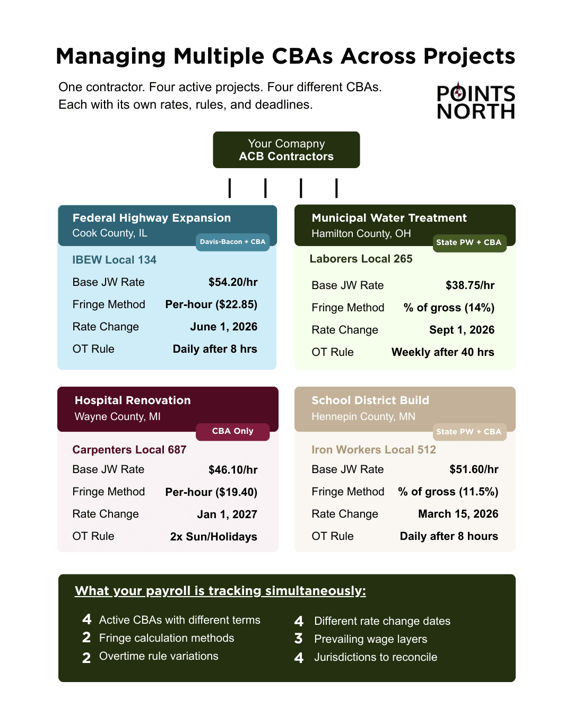 For a contractor working a single project under a single CBA, compliance is manageable. The challenge grows significantly when you're operating across multiple jurisdictions, unions, and project types simultaneously.
Common CBA Compliance Challenges
The most frequent compliance challenges include tracking rate changes across multiple active CBAs at the same time, ensuring the correct classification and corresponding rate are applied per CBA and per project, reconciling CBA fringe obligations with prevailing wage fringe requirements on government-funded work, and managing historical corrections when rate changes need to be applied retroactively. Retro pay situations, where a new CBA is ratified with an effective date that predates the ratification, require recalculating and reissuing payments for work already completed, which can affect dozens or hundreds of employees across multiple projects.
How Technology Simplifies CBA Rate Management
Managing CBA compliance manually, through spreadsheets, PDF contract files, and rate tables maintained by hand, introduces risk at every step. A missed rate change, a miscategorized classification, or an outdated fringe calculation can cascade into underpayments, audit findings, and strained union relationships.
Modern compliance tools can help by centralizing rate data from multiple CBAs in one system, flagging upcoming rate changes before they take effect, and automating the application of correct rates to payroll based on project, jurisdiction, and classification. Points North's approach to union payroll compliance is built around reducing this manual burden so contractors can focus on the work, not the paperwork.
Managing rates across multiple CBAs? See how Points North simplifies union payroll compliance.
Key Takeaways for Contractors
A collective bargaining agreement is the foundational document governing your obligations to union workers, and understanding what's in it and how it affects your payroll isn't optional. The provisions that matter most for your compliance team are wage scales and classification rates, fringe benefit obligations and how they're calculated, overtime and premium pay rules, apprenticeship ratios and progressions, and jurisdictional boundaries.
On prevailing wage projects, remember that you're complying with both the CBA and government wage determinations, and the higher rate for each component applies. As your organization scales across projects and jurisdictions, centralizing CBA rate management is one of the most effective ways to reduce compliance risk and keep payroll accurate.