

Last Updated: September 2026
When you work on government contracts, you are typically subject to Davis-Bacon and Related Acts. Under those acts, you have to pay your workers a prevailing wage. What misleads many people is that the prevailing wage is not a single number. It is a minimum hourly base pay rate plus an additional fringe benefit amount, and the two pieces work together to meet your obligation.
If you are new to bidding public works jobs, that distinction matters more than almost anything else on your certified payroll report. Get the base rate right, but miss the fringe piece, and you are out of compliance.
This guide walks through what a fringe rate actually is, what counts as a fringe benefit, and how to calculate fringe benefits for your certified payroll, including the tricky parts like overtime and cash equivalents.
Navigate This Article
- What Is a Fringe Rate?
- What Counts as a Fringe Benefit?
- What Doesn't Count Toward Your Fringe Obligation
- How to Calculate Fringe Benefits
- How to Calculate a Fringe Rate
- Fringe Benefits on Overtime
- Cash vs Benefit Contributions
- Fringe Benefit FAQs
What Is a Fringe Rate?
A fringe rate is the amount an employer provides in benefits on top of a worker's base wage. It is expressed two different ways depending on who is asking. In general accounting, a fringe benefit rate is stated as a percentage of total wages. On a prevailing wage job, the fringe rate is stated as an hourly dollar amount, and that hourly figure is the one that governs your compliance.
When you look at a wage determination for a public works project, you will see the prevailing wage broken into those two numbers: the base rate and the fringe rate.
Here is a simple way to picture it. Say a wage determination lists $30.00 as the base rate and $8.50 as the fringe rate. The full prevailing wage obligation for that classification is $38.50 per hour. You can satisfy the $8.50 fringe portion by providing bona fide benefits worth that much per hour, by paying it as cash, or by some combination of the two.
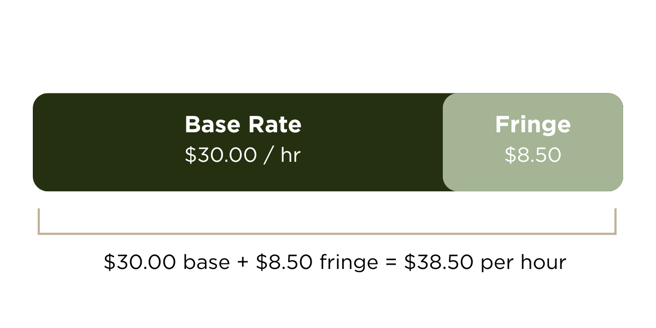
In plain language, it is the value of benefits, expressed by the hour, that you are required to provide. Sometimes you will hear it described as "salary and fringe," which simply means the worker's total package: their wages plus the benefit value layered on top.
Fringe Rate vs. Fringe Benefit Rate
The two terms get used interchangeably, but they usually mean different things in practice.
| How it's expressed | Where you'll see it | Formula | |
|---|---|---|---|
| Fringe rate (prevailing wage) | Dollars per hour | Davis-Bacon wage determinations, certified payroll | Annual benefit cost ÷ annual hours worked |
| Fringe benefit rate (general accounting) | Percentage of wages | Budgeting, job costing, indirect rate proposals | (Total annual benefit cost ÷ total annual wages) × 100 |
If you are bidding or reporting on a Davis-Bacon job, work from the hourly figure. The percentage version is useful for estimating your total labor burden, but it is not what a compliance review will check.
What Is a Fringe Rate for Labor on Government Contracts?
On federal construction work, the fringe rate for each labor classification comes directly from the Davis-Bacon wage determination attached to your contract. It is set by the Department of Labor, varies by trade and by county, and applies to every laborer and mechanic performing covered work on the site.
Federal service and supply contracts work slightly differently. McNamara-O'Hara Service Contract Act and Walsh-Healey contracts carry their own wage determinations with their own fringe requirements, so a government contractor running both construction and service work will be managing more than one fringe standard at a time.
What Is a Typical Fringe Benefit Rate?
There is no single national figure. Fringe rates on Davis-Bacon determinations commonly fall somewhere in the range of a few dollars per hour on lighter classifications to well over $20 per hour on skilled union trades in high-cost metros. The rate varies by trade classification, by locality, and by the specific wage determination tied to your project.
You can look up the exact figure for your job on SAM.gov, which publishes every current federal wage determination by state, county, and construction type. For state-funded work, check your state labor agency instead — the rates and the rules can both differ from the federal standard.
If you are managing this across a crew and multiple classifications, that math adds up quickly. Certified Payroll Reporting and WageIQ by Points North are built to keep the fringe rate for every worker and classification straight, so you don't have to track it by hand. Explore Our Solutions.
What Counts as a Fringe Benefit?
In ordinary payroll, fringe benefits are any form of compensation an employee receives beyond their wages, health coverage, retirement contributions, paid time off, and similar. Some are taxable to the employee, some are not, and payroll systems track them separately from gross wages.
On a prevailing wage job, the term narrows considerably. A fringe benefit only counts if it satisfies part of your hourly fringe obligation under the wage determination, and the rules about what qualifies are stricter than general payroll practice. The rest of this section covers that narrower definition.
Not everything you spend on an employee counts toward your fringe obligation. The most common and most expensive mistake is claiming credit for benefits you are already required by law to provide.
What Doesn't Count Toward Your Fringe Obligation
These are legally mandated employer costs. They are part of doing business, and none of them can be used to satisfy a Davis-Bacon fringe rate:
- Social Security and Medicare (FICA) contributions
- Federal and state unemployment insurance
- Workers' compensation premiums
- Any other statutorily required contribution
General definitions of a "fringe benefit rate" routinely include payroll taxes and workers' compensation in the calculation. That is correct for job costing. It is wrong for prevailing wage compliance. If you build your fringe credit on a number that includes mandated costs, you will show a credit you cannot actually claim.
Davis-Bacon Fringe Benefits That Do Count
Benefits that count are those you provide voluntarily through a legitimate plan. These include:
- Health insurance premiums
- Pension or retirement plan contributions
- Life insurance premiums
- Disability insurance
- Vacation, holiday, and sick pay
- Apprenticeship and training funds
- Other bona fide benefit plans
- Very small or occasional perks are usually handled separately as de minimis fringe benefits, which follow their own rules.
Keep in mind that what counts as a creditable fringe contribution can vary by state. Some states (particularly on the West Coast) treat certain benefits, such as training funds, differently from the federal Davis-Bacon rules. Always validate your specific benefits against your state's prevailing wage requirements before claiming the credit.
To take credit for any of these, the benefit has to be part of a documented, legitimate program. The contributions have to be irrevocable and made solely for the employee's benefit, and you need records showing the actual cost, who is enrolled, and how you arrived at the hourly equivalent. If a benefit primarily helps you rather than the worker, it does not qualify.
Is Holiday Pay a Davis-Bacon Fringe Benefit?
Yes. Holiday pay, vacation pay, and sick leave can all count toward your fringe obligation when provided through a bona fide plan and documented properly. This is a frequent question on Davis-Bacon projects because paid time off feels different from a health premium, but the rules treat it as a creditable fringe contribution as long as you can show the cost and the hourly value.
- Holiday pay is not automatically owed. Davis-Bacon does not require you to provide paid holidays. It requires you to meet the fringe rate. If your plan includes holiday pay, you may credit its hourly value toward that rate. If it doesn't, you satisfy the obligation another way.
- You have to convert it to an hourly value. Ten paid holidays at eight hours each is 80 hours of pay. Divide that annual cost by the employee's total annual hours to get the hourly credit, the same conversion you run on every other benefit.
Hours spent on a holiday are only compensable at the prevailing wage if the worker actually performs covered work that day.
How to Calculate Fringe Benefits
The core calculation is the same idea applied a few different ways: take what a benefit costs and convert it into an hourly value you can compare against the required fringe rate.
The Basic Fringe Benefit Calculation
At its simplest, you take the annual cost of a non-required benefit and divide it by the total hours the employee works in a year. That gives you the hourly equivalent of the benefit.
Formula: Annual benefit cost ÷ annual hours worked = hourly fringe rate.
Example: A health plan costing $6,240 per year for a worker who logs 2,080 hours comes to $3.00 per hour in fringe credit.
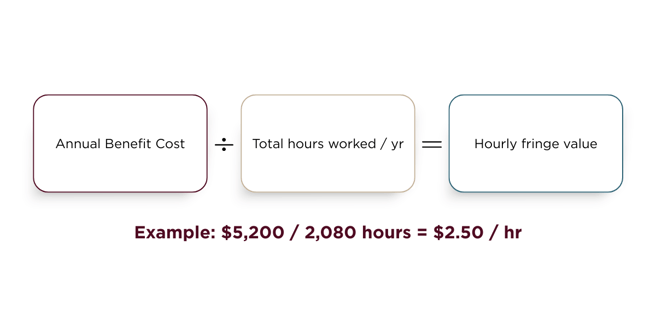
A common shortcut is to divide by 2,080 hours (40 hours per week across 52 weeks). That works well for full-time workers who actually log full-time hours all year. Where it gets tricky is part-time workers, seasonal crews, or anyone whose hours come in below that assumption. When the 2,080 number doesn't match reality, you end up reconciling at year-end and often owe cash to make up the gap.
Some benefits, like a flat monthly health premium, are easier to set as a fixed per-paycheck amount. Others convert more cleanly to an hourly rate. WageIQ handles this automatically by calculating the hourly equivalent on every benefit except flat monthly amounts, so the math holds up whether a worker logs 2,080 hours or far fewer. You can still run the annualized calculation outside the system if that fits your workforce.
How to Calculate a Fringe Rate as a Percentage
If you are budgeting labor burden rather than filing certified payroll, you may want the fringe rate expressed as a percentage of wages instead of an hourly figure.
Formula: (Total annual benefit cost ÷ total annual wages) * 100 = fringe rate percentage.
Example: $12,000 in annual benefits against $60,000 in annual wages is a 20% fringe rate.
Use this for estimating and job costing. Use the hourly figure for compliance; a certified payroll report is checked against dollars per hour, not percentages.
Calculating Fringe Benefit Credits
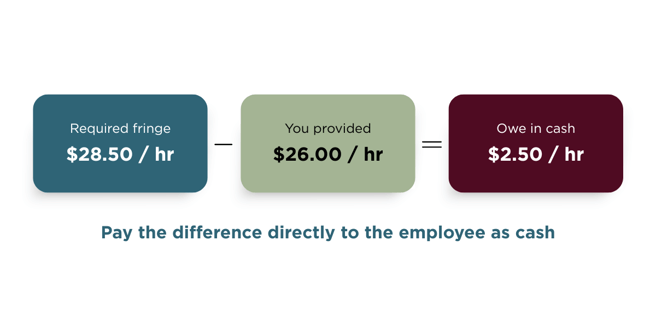 To figure out your fringe benefit credits, follow these steps:
- Determine the annual fringe amount that should be credited to each employee, based on the fringe rate from the prevailing wage determination for their classification.
- Divide the benefit cost by the hours worked to get the hourly amount of the fringe benefit. Many contractors use 2,080 hours (40 hours per week across 52 weeks) as a baseline, but adjust to actual hours when workers are part-time or variable.
- Subtract that hourly amount from the required fringe rate to find your fringe benefit credit.
- If there is any remaining difference, pay it to the employee as cash, recorded as taxable wages on their paycheck. Keep in mind that some perks count as taxable fringe benefits while others are tax-free, which affects how you report them.
The calculation has to be done separately for each employee, since enrollment, hours, and actual benefit costs vary from one worker to the next.
Calculating Fringe Benefits on Overtime
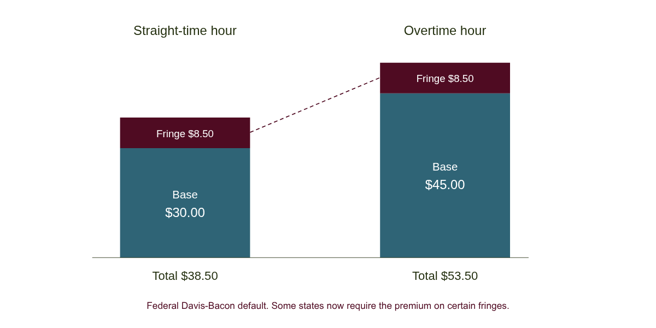
Overtime works a little differently, and it is a common spot for errors. Under federal Davis-Bacon rules, when an employee works overtime you pay time-and-a-half on the base wage, but the fringe benefit stays at the straight-time hourly rate. There is no overtime premium on the fringe portion at the federal level.
Using the earlier example, if the prevailing wage is $30.00 base plus $8.50 fringe, an overtime hour becomes $45.00 in base pay ($30.00 x 1.5) plus the same $8.50 in fringe. Record fringe consistently, whether you pay it as cash or credit it through actual benefit programs, and make sure the credited amount still meets the required hourly rate.
Note: State rules are starting to diverge here. New Jersey recently changed its prevailing wage rules to require the overtime premium on certain fringe contributions, and a small number of other states are moving in the same direction. If you work on state prevailing wage projects, check the current rules in each state where you operate. The federal default is no longer a safe assumption everywhere. Looking for software to help you navigate state regulations? WageIQ allows you to set fringes that calculate differently by state, helping you handle the variability as part of your process and make compliance across states easier.
Cash vs. Benefit Contributions
When a worker does not receive benefits in kind, you make up the difference with a fringe payment in cash, the hourly shortfall between what your benefits are worth and what the wage determination requires.
Pension plans come with a wrinkle around vesting. Immediate vesting guarantees the worker owns 100% of the benefit right away. If vesting is not immediate, the employee earns credit at an annual rate based on the prior year's hours.
If an employee leaves before receiving the full fringe benefit, you have to pay out the remaining amount in cash at termination. And any time you pay fringe as cash in lieu of benefits, that money has to go directly to the employee. It cannot be held in a company account or used to offset other wage obligations.
How to Record a Fringe Payment in Cash
A cash fringe payment is taxable wages. It runs through payroll, appears on the employee's pay stub, and is subject to withholding like any other wage.
On the certified payroll report, cash fringe typically goes in the fringe column rather than being folded into the base rate. Keeping the two separate makes it easier for a reviewer to confirm you met both halves of the prevailing wage obligation. That said, some payroll systems can't break the two apart, so cash fringe ends up rolled into the employee's base rate. That's an accepted approach when your system requires it, and it's one of the things CPR pre-payroll handles automatically. The important thing is that the total wage meets or exceeds the base plus fringe requirement, however your system reports it.
Record the payment every pay period it applies to, not as a lump-sum true-up at year end, unless your state explicitly permits reconciliation.
Explore More prevailing wage fringe FAQs
Get a Custom Certified Payroll Solution That Fits Your Needs
Thousands of contractors across the country rely on Certified Payroll Reporting and WageIQ, powered by Points North, to simplify their prevailing wage reporting. Tracking fringe rates, credits, and cash equivalents by hand is exactly the kind of work our software was built to take off your plate. Contact us to join them and stop worrying about calculating fringe benefits.