
State ACA Reporting Requirements: A Guide to State Individual Mandates
Last Updated: June 2026
Affordable Care Act (ACA) reporting requirements do not stop at the federal level. A handful of states have passed their own individual mandates, and each one adds a separate reporting obligation on top of the 1094-C and 1095-C forms employers already file with the IRS.
If your business has as little as one employee filing taxes in one of these states, you may be required to comply with that state's reporting rules. For HR and finance teams managing coverage across state lines, that means tracking different forms, different portals, and different deadlines, all at once.
This guide breaks down which states require ACA reporting, what each one expects from employers, and when filings are due. Use the navigation below to jump to your state, or read straight through for the full picture.
What Is a State Individual Mandate?
A state individual mandate is a law that requires residents to maintain qualifying health coverage, often called minimum essential coverage (MEC), or pay a penalty when they file their state income taxes. To make those mandates enforceable, each state also asks employers and other coverage providers to report who was covered during the year.
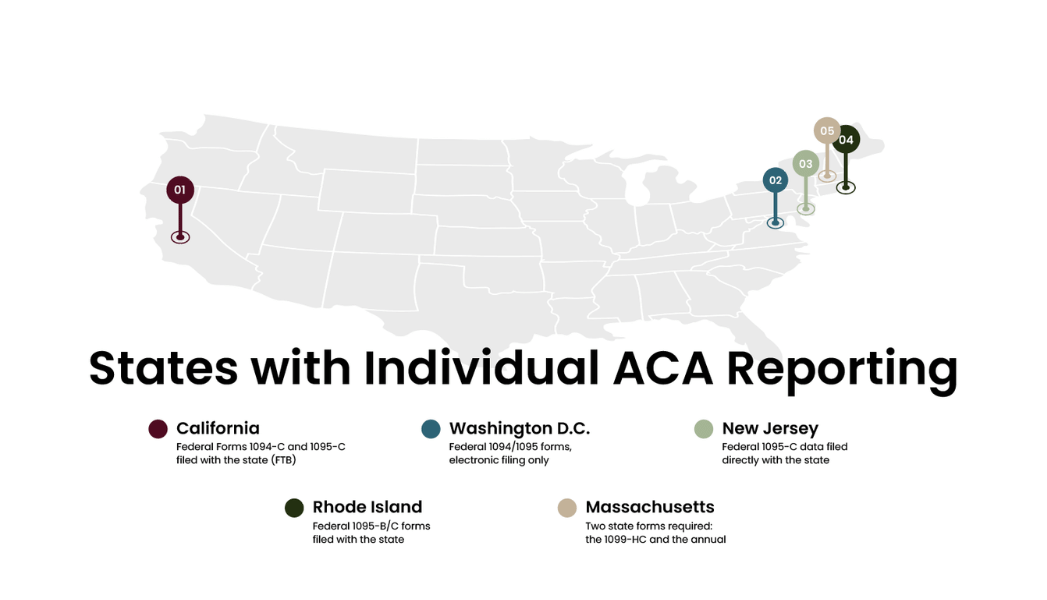
These mandates exist because of a change at the federal level. When the federal individual mandate penalty was reduced to zero dollars in 2019, several states created their own mandates to keep coverage rates stable in their markets. California, Massachusetts, New Jersey, Rhode Island, and Washington D.C. each followed that path, and each built an employer reporting requirement alongside it.
For employers, the trigger is residency, not headquarters location. If you provide coverage to even one employee who lives in a mandate state, you generally have a reporting obligation there, whether or not your company is based in that state.
State ACA Reporting vs. Federal ACA Reporting
Federal ACA reporting still applies everywhere. Applicable Large Employers (ALEs) continue to file Forms 1094-C and 1095-C with the IRS. Non-ALE employers, who offer a self-insured health care plan, are also required to file 1094-B and 1095-B forms with the IRS. State reporting is an additional, separate step that applies only in mandate states.
The way states collect that information varies, and this is where employers most often get tripped up:
- Some states accept the same federal 1095-C and 1095-B forms you already file with the IRS, simply routed to a state portal. New Jersey, Rhode Island, Washington D.C., and California work this way.
- One state, Massachusetts, uses its own form, the MA 1099-HC, in addition to a separate annual employer filing called the HIRD.
There is also a recent wrinkle worth knowing. A late-2024 federal change now allows employers to furnish Form 1095-C to individuals by request only, rather than mailing it to everyone. That federal relief does not override state rules. California, New Jersey, Washington D.C., and Rhode Island still require employers to furnish forms to residents on the state's schedule, so the federal shortcut does not get you off the hook at the state level.
Which States Require ACA Reporting?
Five jurisdictions currently require employer-level ACA reporting under an individual mandate. The table below summarizes who must file, the forms involved, the state filing deadline for the 2025 tax year, the penalty, and the filing portal.
| State | Who Must File | Forms Required | State Filing Deadline (TY2025) | Penalty | Filing Portal |
|---|---|---|---|---|---|
| California | ALEs and self-insured employers of any size covering CA residents; carriers file 1095-B | Federal 1094-C / 1095-C (or 1094-B / 1095-B) | March 31, 2026, automatic extension to May 31, 2026 | $50 per individual if filed after May 31 (FTB) | California Franchise Tax Board (FTB), electronic |
| Massachusetts | Employers with a self-insured plan; HIRD required if 6+ MA employees | MA 1099-HC (state form) plus annual HIRD filing | 1099-HC furnished by Feb 2, 2026; HIRD window Nov 15 to Dec 15 | MA individual tax penalty; employer exposure for HIRD non-filing | MassTaxConnect |
| New Jersey | ALEs and any employer with NJ-resident employees; self-insured file 1095-B | Federal 1094-C / 1095-C (or 1095-B) | March 31, 2026 | $50 per individual | NJ DORES (MFT SecureTransport), electronic only |
| Rhode Island | ALEs and employers covering RI residents | Federal 1094 / 1095-B/C | March 31, 2026 | RI individual tax penalty | RI Division of Taxation portal, electronic only |
| Washington D.C. | ALEs and coverage providers for DC residents | Federal 1094 / 1095-B/C | April 30, 2026 | DC individual tax penalty | MyTax.DC.gov, electronic only |
Report Minimum Essential Coverage to the FTB in California
California's individual mandate took effect January 1, 2020, and requires residents to maintain minimum essential coverage or pay a state penalty. Employers report that coverage to the California Franchise Tax Board (FTB) using the same federal 1094 and 1095 forms they file with the IRS. ALEs file the C-series forms, and self-insured employers of any size file the B-series for their covered California residents.
The state filing deadline is March 31, but California grants an automatic extension to May 31 with no request required, and it does not assess penalties for filings completed by that date. As the largest mandate state by employer base, California is also the one where the electronic filing threshold now matters most: it dropped to 10 returns, so nearly every ALE must file digitally.
File the 1099-HC and HIRD Forms in Massachusetts
Massachusetts runs the oldest state coverage mandate in the country, and it works differently from every other state on this list. Instead of accepting the federal 1095 forms, Massachusetts uses its own form, the MA 1099-HC, which reports minimum creditable coverage (a stricter standard than federal MEC). For fully insured plans, the carrier typically files the 1099-HC. For self-insured plans, the employer is responsible.
Massachusetts also requires a second, separate filing: the Health Insurance Responsibility Disclosure, or HIRD. Any employer with six or more employees in Massachusetts must complete the HIRD each year during the November 15 to December 15 window. Both the 1099-HC and the HIRD are handled through the MassTaxConnect portal.
File 1095-C Data Directly with the State in New Jersey
New Jersey's Health Insurance Market Preservation Act created the state's individual mandate, effective for the 2019 tax year. Employers meet the requirement by filing the same federal 1095-C data (or 1095-B for self-insured coverage) directly with the New Jersey Division of Taxation. The obligation reaches any employer with even one employee who is a New Jersey resident, including part-year residents.
Filing is electronic only, submitted through the Division of Revenue and Enterprise Services (DORES) secure transport system, with no paper option. The state filing deadline is March 31, and New Jersey maintains its own furnishing rule, so residents must receive their forms regardless of the federal furnish-by-request change.
Meet Division of Taxation Filing Rules in Rhode Island
Rhode Island's individual mandate took effect January 1, 2020, and applies to residents, their spouses or domestic partners, and dependents. Employers and carriers that provide coverage to Rhode Island residents report it to the Rhode Island Division of Taxation using the federal 1095-B and 1095-C forms already filed with the IRS.
Rhode Island accepts those federal forms through its Division of Taxation portal, and filing is electronic only. The state filing deadline is March 31, and Rhode Island has aligned its schedule with the federal ACA deadlines on a permanent basis, which makes its timing easier to plan around than it once was.
File Electronically Through MyTax DC in Washington D.C.
The District of Columbia individual mandate has been in effect since 2019 and requires most DC residents to carry minimum essential coverage or pay a penalty. Employers and coverage providers report to the DC Office of Tax and Revenue (OTR) using the federal 1094 and 1095-B/C forms.
Washington D.C. stands out in two ways. First, filing is electronic only, submitted in bulk through the MyTax.DC.gov portal, with no paper accepted. Second, D.C. carries the latest deadline of any mandate jurisdiction: reports are due April 30, which is 30 days after the federal filing deadline. Filers who do not already have a MyTax.DC.gov login need to register before they can submit.
What Happens If You Miss a State ACA Deadline?
State individual mandates create two different kinds of penalty, and it helps to keep them separate. The first falls on residents, who can owe a penalty on their state tax return when they go without qualifying coverage. The second falls on employers, who can face a filing penalty for failing to report coverage on time or accurately.
Employer filing penalties vary by state, and some are stricter than others. Each state guide below covers its specific penalty, who it applies to, and how to stay clear of it.
For employers, though, the harder problem is rarely one missed form. It is the compounding effort of tracking different deadlines, portals, and form types across a workforce that may span several mandate states at once. That is where many teams decide the manual approach is no longer worth the exposure.
The Future of State ACA Reporting
State-level reporting is still expanding. Additional states have studied or proposed individual mandates in recent years, and federal reporting rules continue to shift, including the recent move to furnish-by-request at the federal level. Because state mandates operate independently of those federal changes, employers should expect state requirements to persist and potentially grow, even as federal reporting evolves.
The takeaway for compliance teams: build a process that can absorb a new state without starting over. Treating multi-state ACA reporting as an ongoing program, rather than a once-a-year scramble, is the most reliable way to stay ahead of the next mandate.
Frequently Asked Questions
Five jurisdictions require employer-level ACA reporting under a state individual mandate: California, Massachusetts, New Jersey, Rhode Island, and Washington D.C. Each requires employers to report coverage for their residents in addition to federal IRS filing.
California, Massachusetts, New Jersey, Rhode Island, and Washington D.C. currently have active individual mandates that include an employer reporting requirement. Vermont has a mandate but does not require a separate employer filing.
A state individual mandate is a law requiring residents to maintain qualifying health coverage or pay a penalty on their state income tax return. States created these mandates after the federal penalty was reduced to zero in 2019, and they paired them with employer reporting requirements.
In a mandate state, yes. Federal filing with the IRS does not satisfy a state's separate reporting requirement. Most mandate states accept the same federal 1095 forms, but they must be submitted to the state's own portal by the state's deadline. Massachusetts is the exception and requires its own MA 1099-HC form.
California and New Jersey can assess a penalty of $50 per individual for failing to file required returns. Other mandate states enforce primarily through the individual's state tax penalty, but all expect employers to file accurate returns on time. Confirm current penalty amounts with each state authority, since they can change.
Often, yes. In several mandate states, providing coverage to even one resident employee creates a reporting obligation. The trigger is generally where your employees live, not where your company is headquartered.
Simplify Multi-State ACA Reporting
Need help understanding state ACA reporting requirements?
Managing different forms, portals, and deadlines across multiple mandate states is exactly the kind of work ACA Reporter by Points North is built to take off your plate. From 1095-C generation to state-specific filing, ACA Reporter helps your team stay accurate and audit-ready across every state you operate in.