
Rhode Island ACA Reporting Requirements: What Employers Need to File
Last Updated: July 2026
Rhode Island is the smallest state in the country, but its individual mandate casts a wide net: one Rhode Island resident on your payroll is enough to pull you into a state filing, wherever your company is based. The mandate has run through the Rhode Island Division of Taxation since January 2020, and it did not disappear when the federal penalty went to zero. It still stands, and it adds a reporting step on top of your federal Form 1095-C work.
Here is the part that makes Rhode Island easier than most: the Division accepts the same federal 1094 and 1095 forms you already file with the IRS. There is no state-specific form like the one Massachusetts requires, so the task is sending your existing data to a second destination rather than building something new.
This guide covers who must comply, what Rhode Island asks for, how and when to file through the Division's portal, and where your penalty exposure lies.
Not in Rhode Island? Our State-Level ACA Reporting Guide covers all states with individual ACA mandates.
Does Rhode Island require state ACA reporting?
Yes. Rhode Island requires employers and other coverage providers to report health coverage to the Rhode Island Division of Taxation under the state individual mandate.
Rhode Island's health insurance mandate was signed into law on July 5, 2019, and applies to coverage months starting January 1, 2020. Under it, residents must carry minimum essential coverage or make a shared responsibility payment on their state income tax return. Rhode Island enacted the mandate after the federal penalty fell to $0, choosing to keep a state-level coverage incentive on the books, and it assigned administration to the Division of Taxation.
To support the mandate, Rhode Island imposes a reporting requirement on every entity that provides minimum essential coverage to a resident during the calendar year. This mirrors the federal reporting requirement under Internal Revenue Code Section 6055. For employers, this is an additional state filing, not a substitute for anything federal. Your Form 1095-C still goes to the IRS on its usual schedule, and a company with Rhode Island staff owes both.
Still nailing down your federal obligation? Our guide on which employers need to complete ACA filing is the place to start.
Who must comply with Rhode Island ACA reporting?
The obligation reaches any employer or other sponsor of an employment-based health plan that offers minimum essential coverage to a Rhode Island resident. In practice, that means most companies with Rhode Island employees on their health plan have something to file or confirm.
One point that surprises multi-state employers: your own location does not matter. An out-of-state employer that provides coverage to a Rhode Island resident is subject to the requirement. What triggers the obligation is where your employee lives, not where your company is headquartered. This makes accurate residency tracking a core part of compliance, especially for a distributed or remote workforce.
Who submits the forms depends on how your plan is structured.
- Fully-insured plans: Your insurance carrier generally files the 1095-B and reports coverage for your Rhode Island enrollees. Your responsibility is to confirm the carrier is handling the Rhode Island filing, not to assume it.
- Self-insured and level-funded plans: You are directly responsible for filing and for furnishing statements to your Rhode Island employees. There is no carrier standing between you and the Division of Taxation.
The broader statute also assigns reporting duties to the state Medicaid agency and to licensed carriers for the coverage they provide, but for most employers the practical question is simply this: are your Rhode Island residents covered under a plan where you, rather than a carrier, hold the filing obligation?

Not certain your Rhode Island filing is fully covered?
A March 2 furnishing date, a March 31 filing date, and the question of whether you or your carrier submits to the Division are three easy things to lose track of.
Give us a few details about your team, and we'll show you how ACA Reporter can help your team stay ACA compliant in Rhode Island.
Which forms does Rhode Island accept?
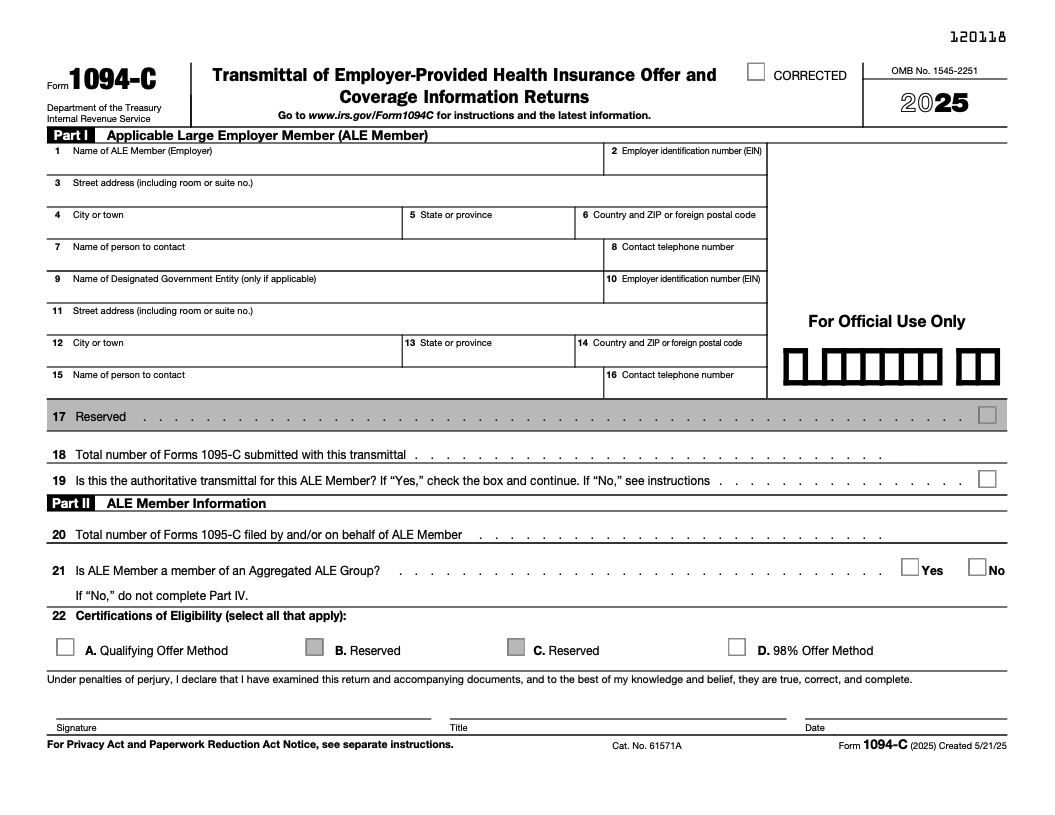
The federal forms are sufficient to meet the Rhode Island reporting requirement. There is no Rhode Island version of the form to learn, build, or map data into.
The forms the Division of Taxation accepts are the same federal returns you already produce:
- Form 1094-C and Form 1095-C for applicable large employers.
- Form 1094-B and Form 1095-B for coverage reported by insurers and smaller self-insured providers.
Rhode Island has also signaled real flexibility on format. The Division has stated it will accept any form or file format sufficient to satisfy the requirements of R.I. General Laws Section 44-30-102(d). Those requirements come down to a short list of data points: the name, address, and taxpayer identification number of the primary insured, the name and TIN of each other individual covered under the policy, and the months during which each person had minimum essential coverage.
Rhode Island still requires you to furnish forms
At the federal level, employers may now post a notice telling employees they can request a 1095-C, rather than automatically mailing the form to everyone. Rhode Island has not adopted that relief. The state still requires you to furnish 1095-B and 1095-C statements to your Rhode Island residents.
In other words, meeting the new federal notice-only standard does not satisfy Rhode Island. If a Rhode Island resident on your plan does not receive a statement, you can be compliant federally and out of compliance at the state level at the same time. Employers with a light federal furnishing process should build a Rhode Island exception into their workflow.
How and when to file with the Rhode Island Division of Taxation
Rhode Island reporting is handled through the Division of Taxation's Taxpayer Portal. Employers submit their filing in the Individual Mandate Reporting section of the portal, where you upload your file or files containing the federal 1095 data. This is the state's designated channel for the mandate, and it is separate from your federal transmission to the IRS.
Rhode Island runs two deadlines each year, and both are permanent, meaning you can plan around the same dates annually.
- Furnish to individuals by March 2. You must distribute IRS Forms 1095-B or 1095-C to your Rhode Island plan participants by March 2 each year. If March 2 falls on a weekend or a holiday, the deadline moves to the next business day.
- File with the Division by March 31. You must submit the 1095-B or 1095-C forms to the Rhode Island Division of Taxation by March 31.
Rhode Island permanently set these dates to align with the IRS's permanent ACA filing deadline, which simplifies planning for employers juggling federal and state calendars.
The Rhode Island Individual Mandate
The mandate is easy for an employer to file away and forget, because it is not really your obligation. It rests on your employees and is resolved on their Rhode Island return, not in your reporting. What ties the two together is your submission to the Division of Taxation, which is how the state checks that residents held coverage. That connection is worth understanding, so here is what your employees are responsible for.
What is the Rhode Island individual mandate?
Rhode Island's individual mandate, enacted on July 5, 2019 and effective for months beginning January 1, 2020, requires Rhode Island residents to maintain minimum essential coverage for themselves and their dependents throughout the year, or make a shared responsibility payment when they file their state income tax return. It is the reason your Rhode Island reporting exists: the coverage data you send to the Division of Taxation is what the state uses to confirm that residents met the requirement. Rhode Island modeled its mandate in part on the federal ACA requirement that the state penalty was built to replace.
Your filing and the mandate are two separate things. The mandate has nothing to do with your plan or your employer duties; it works at the individual level, setting out what each resident must do to remain compliant.
Who does the individual mandate apply to?
The mandate applies to Rhode Island residents and the dependents they claim on their state return. A few details that matter for employers:
- Full-year and part-year residents are both subject to it, though part-year residents are only required to maintain coverage for the months they were Rhode Island residents, which matters for employees who moved into or out of the state during the year
- A remote employee who lives in Rhode Island falls under the mandate, no matter where your company operates
- Residents count on the coverage you report to the Division to document that they were insured and steer clear of the payment
How residents satisfy and report it
Residents meet the mandate by maintaining qualifying coverage for every month of the year and reconciling it on their Rhode Island personal income tax return, Form RI-1040 or RI-1040NR, generally due April 15. Those covered for the full year simply check the health coverage box; those who were not, or who had a gap, complete Form IND-HEALTH and the Shared Responsibility Worksheet to calculate what they owe or to claim an exemption such as unaffordable coverage, a short coverage gap, or hardship (some exemptions run through HealthSource RI instead).
The 1095 forms you distribute and file give them the proof behind those entries, but the mandate itself never loops back to you as the employer; the resident squares it directly with the Division of Taxation on their own return. You can find the state's guidance on the Rhode Island Health Insurance Mandate page.
Rhode Island ACA Reporting Penalties
Rhode Island keeps the requirement simple on paper, since you reuse the federal forms, but the penalty exposure sits in two very different places, and only one of them carries a clear dollar figure. Here is the quick version:
- The individual penalty: Rhode Island residents who go without coverage owe a shared responsibility payment on their state return, calculated as the greater of a percentage of income above the state filing threshold or a flat dollar amount per adult and child, and capped at the average bronze plan cost that HealthSource RI sets. HealthSource RI resets the bronze plan cap each year, so residents confirm the current figures on the Rhode Island Health Insurance Mandate page at filing time
- The employer side: Rhode Island reviews failures to furnish or file on a case-by-case basis and has not set a fixed per-form fine, so your exposure is compliance and audit risk rather than a published penalty amount
- Your filing is what protects your employees: the 1095 data you furnish and file is how residents prove coverage and avoid the payment
With Rhode Island, the form itself is seldom the sticking point, since the data already exists for federal purposes. The work is operational: identifying every Rhode Island resident on your roster, running a separate submission to the Division on its own timeline, and keeping in mind that the state still expects furnished statements even as the federal furnishing rules have eased.
Your Rhode Island Compliance Checklist
Here is the whole obligation in one place:
- The forms: the same federal 1094/1095-B or 1094/1095-C you already file with the IRS. No state-specific form.
- The destination: the Rhode Island Division of Taxation, through the Taxpayer Portal.
- Furnish to residents: by March 2, or the next business day if that date lands on a weekend or holiday. Rhode Island still requires this even though the federal rules now allow a notice-only approach.
- File with the Division: by March 31.
- Track residency: identify which of your employees are Rhode Island residents, including remote workers, since their residency is what triggers the obligation.
- Confirm who files: for fully-insured plans, verify your carrier is handling the Rhode Island 1095-B. For self-insured plans, the responsibility is yours.
.png?width=1500&height=2000&name=Rhode%20Island%20Compliance%20Checklist%202%20(1).png "Rhode Island Compliance Checklist 2 (1)")
Frequently Asked Questions
No. Rhode Island accepts the federal 1095-B and 1095-C forms you already file with the IRS. There is no Rhode Island-specific form.
Yes. If you provide health coverage to a Rhode Island resident, you are subject to the requirement regardless of where your company is located.
No. Rhode Island has not adopted the federal notice-only approach. You must still furnish 1095-B/C statements to your Rhode Island residents.
Two deadlines apply each year. You furnish 1095-B/C statements to Rhode Island residents by March 2, and you file with the Division of Taxation by March 31. Both dates are permanent.
For the 2025 tax year, a resident without coverage owes the greater of 2.5% of modified AGI above the filing threshold or a flat amount of $57.92 per adult and $28.96 per child per month, capped at the average bronze plan amount, which HealthSource RI set at $357 per month for 2025. The flat-dollar rates and the 2.5% figure have held steady since the mandate began; the bronze plan cap is the piece that updates each year.
Simplify Rhode Island ACA Reporting with ACA Reporter
Running the same coverage data to the IRS and the Rhode Island Division of Taxation on two separate deadlines, all while tracking who on your team is a Rhode Island resident, is the sort of manual effort that burns hours and still leaves room for an expensive slip.
ACA Reporter by Points North files your Rhode Island submission and your federal 1095-C from a single workflow, so the state and federal pieces stay in sync rather than living in two processes.