
Massachusetts ACA Reporting Requirements: A 1099-HC and HIRD Guide for Employers
Last Updated: June 2026
Massachusetts was the first state in the country to require residents to carry health insurance, and that individual mandate has been in place since 2006. When the federal individual mandate penalty dropped to $0 in 2019, many employers assumed state-level health coverage reporting would quietly go away with it. In Massachusetts, the opposite happened. The state mandate is still in full force, and it imposes reporting obligations that extend beyond your federal filing.
If you employ Massachusetts residents, you have two state requirements to manage on top of your federal Form 1095-C work: the Form MA 1099-HC and the Health Insurance Responsibility Disclosure (HIRD) form. They serve different purposes, they go to different places, and they are due at opposite ends of the calendar. This guide walks through who must comply, what each form is, how and when to file, and what happens if you miss a deadline.
Not in Massachusetts? Our State-Level ACA Reporting Guide covers all states with individual ACA mandates.
Does Massachusetts require state ACA reporting?
Yes. Massachusetts has its own individual health insurance mandate, the oldest of its kind in the United States, and it operates independently of federal law. The federal penalty for going without coverage was reduced to zero in 2019, but that change did not touch the Massachusetts mandate or the reporting that supports it.
For employers, the state requirement shows up as two distinct filings:
- Form MA 1099-HC, which documents that a Massachusetts resident had qualifying coverage during the year
- The HIRD form, which reports information about the health plan you offer
Neither one replaces your federal reporting. If you are an Applicable Large Employer, you still file Form 1095-C with the IRS as usual. The Massachusetts forms are additional obligations layered on top of that federal work. For a refresher on the federal side, see Which Employers Need to Complete ACA Filing. For the full picture of how state mandates fit together, start at our State-Level ACA Reporting hub.
Who must comply with Massachusetts ACA reporting?
The short answer is any employer with employees who are Massachusetts residents. The specifics depend on which form you are looking at and how your plan is structured.
For the Form MA 1099-HC, the responsibility splits based on how your coverage is funded:
- Fully insured plans: your insurance carrier usually issues the 1099-HC to covered employees and files it with the state. If your carrier does not do this, the obligation falls back to you, so it is worth confirming in writing who is handling it before filing season.
- Self-insured plans: you are responsible for issuing the form to employees and filing it with the state yourself.
The HIRD form uses a different test entirely. You must file it if you had six or more Massachusetts employees in any month during the prior 12 months, counted across all employment categories, including full-time, part-time, and temporary workers. This applies even if you do not offer a group health plan at all. Out-of-state employers are not off the hook either: if you have workers performing their jobs in Massachusetts, you can be responsible for both requirements.

Not sure you are filing everything Massachusetts requires?
Between Form MA 1099-HC, the HIRD form, and your federal 1095-C filing, it is easy to lose track of what is due and when. Tell us a little about your team, and we will help you confirm exactly what your Massachusetts obligations look like, so nothing slips through before a deadline.
What is Form MA 1099-HC?
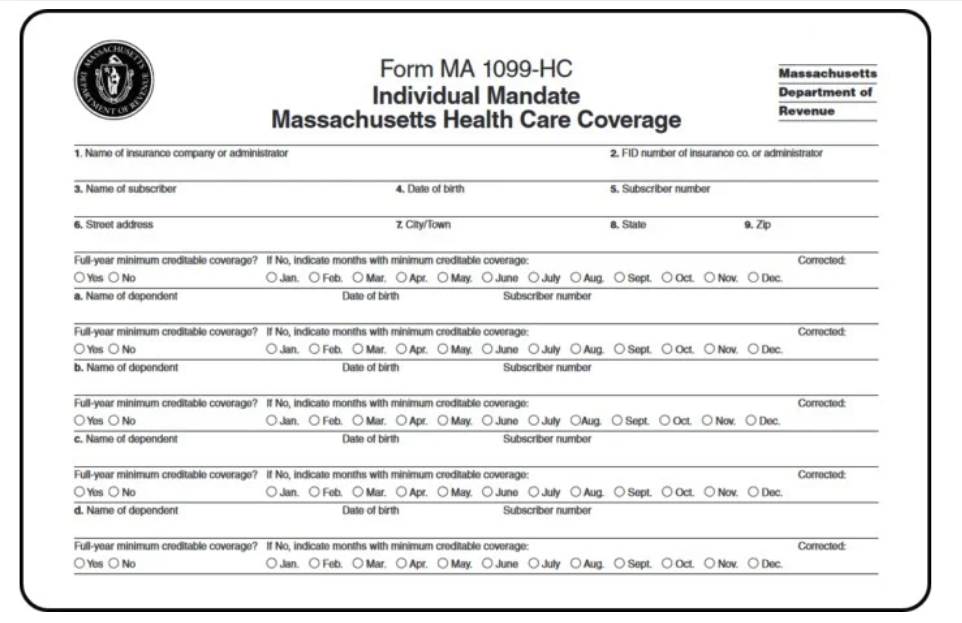
Form MA 1099-HC is a Massachusetts-specific document that shows whether a resident had Minimum Creditable Coverage (MCC), the state's standard for qualifying health insurance, during the tax year. Employees use the information on it to complete Schedule HC when they file their state income tax return, which is how they demonstrate compliance with the individual mandate.
The form is issued by the carrier for fully insured plans and by the employer for self-insured plans. It lists the responsible carrier, the primary subscriber, and the specific months of coverage. Coverage is counted using a 15-day rule, meaning a person is treated as covered for a month if they had qualifying coverage for at least 15 days of it. There is no single standardized layout, so the exact look of the form can vary by carrier, but the required information stays consistent.
MA 1099-HC vs 1095-C: what is the difference?
This is one of the most common points of confusion, so it is worth stating plainly. The two forms look similar and both relate to health coverage, but they answer to different governments and different rules:
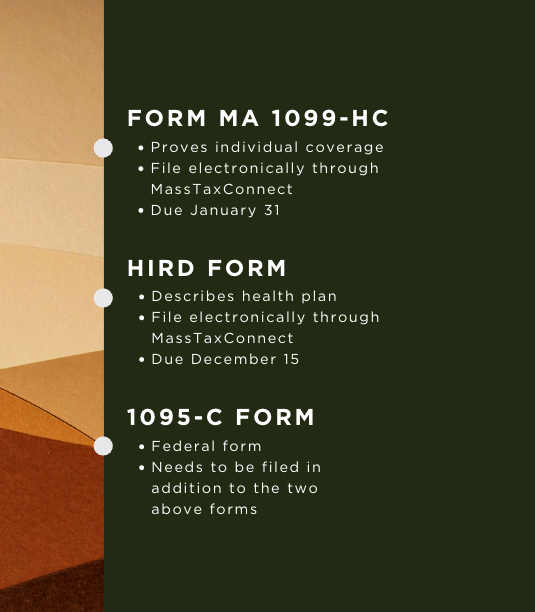
- Form MA 1099-HC is a Massachusetts state form. It proves a resident had Minimum Creditable Coverage under the state individual mandate.
- Form 1095-C is a federal form. It documents an Applicable Large Employer's offer of coverage to full-time employees under the Affordable Care Act.
The most important takeaway: a federal Form 1095-B or 1095-C cannot stand in for the 1099-HC. Massachusetts does not accept the federal forms in place of its own, so you need both.
How and when to file Form MA 1099-HC
Massachusetts requires the 1099-HC to be filed electronically. There is no paper option, no matter how few forms you are submitting. Filing is done through MassTaxConnect, either as a properly formatted XML bulk file or manually for smaller volumes.
There are two separate deadlines to track:
- January 31, to your employees: provide the 1099-HC to your covered Massachusetts employees. If January 31 falls on a weekend, this date will shift into early February on the next business day.
- March 31, to the state: file the 1099-HC with the Massachusetts Department of Revenue electronically through MassTaxConnect.
To complete the form, you will need:
- The name and Federal Tax ID of the carrier or administrator responsible for the coverage
- The primary subscriber's details, including name, subscriber number, date of birth, and address
- The months during which Minimum Creditable Coverage was in place
You can review the state's official requirements on the Mass.gov Form 1099-HC page.
The Massachusetts HIRD Form
The HIRD form is the requirement employers most often overlook, partly because it has nothing to do with your federal filing and arrives on a completely different schedule.
What is the Health Insurance Responsibility Disclosure (HIRD) form?
The Health Insurance Responsibility Disclosure form collects employer-level information about the health insurance you offer. It is administered jointly by MassHealth and the Department of Revenue, and its purpose is to help the state identify employees who may have access to employer-sponsored insurance and could qualify for the MassHealth Premium Assistance Program.
Unlike the 1099-HC, the HIRD form is not about any individual employee's coverage. It describes your plan: details such as eligibility rules, employee premium contributions, deductibles, and out-of-pocket maximums.
Who has to file the HIRD form?
You must file the HIRD form if you had six or more Massachusetts employees in any month of the prior 12 months. A few details that catch employers off guard:
- All employment categories count toward the six-employee threshold, including part-time and temporary staff
- You must file even if you offer no group health insurance
- Out-of-state employers with employees working in Massachusetts are included
HIRD deadline and how to file
Like the 1099-HC, the HIRD form is electronic only and is filed through MassTaxConnect, specifically from your withholding tax account. The filing window typically opens in mid-November and closes on December 15. (The exact open date is set each year once the state publishes the form, so confirm it before the season starts.)
One helpful distinction: the HIRD form asks only for employer-level plan information. You should not include any employee personally identifiable information on it. You can find the state's guidance on the Mass.gov HIRD FAQs page.
Massachusetts ACA Reporting Penalties
Massachusetts attaches penalties to both the employer filing and the underlying individual mandate. It helps to keep them separate, because they fall on different people.
Employer penalty for failing to file Form MA 1099-HC
An employer or carrier that fails to issue Form MA 1099-HC can be penalized $50 per individual who should have received one, up to a maximum of $50,000 per year. Because the penalty is assessed per person, the exposure adds up quickly across a workforce of any real size.
The resident individual mandate penalty
This penalty falls on the resident rather than the employer, but it is worth understanding because your employees depend on an accurate and timely 1099-HC to avoid it. A resident who is deemed able to afford coverage but goes without it may owe a penalty on their state tax return.
The amount is income-based and capped at 50% of the lowest-cost monthly premium the person could have purchased through the Health Connector. Residents with household income at or below 150% of the Federal Poverty Level owe nothing, and a coverage gap of 63 days or less does not trigger a penalty. The Department of Revenue sets the exact schedule each year, so confirm the current figures against the latest Technical Information Release before relying on them. Residents report all of this on Schedule HC.
Your Massachusetts Compliance Checklist
Massachusetts asks more of employers than most states, and the deadlines are easy to mix up. Here is the quick version:
- Form MA 1099-HC, to employees: furnish by January 31
- Form MA 1099-HC, to the state: file with the Massachusetts DOR by March 31
- HIRD form: file through MassTaxConnect by December 15
- Federal Form 1095-C: separate from all of the above, and still required
The real challenge is rarely a single form. It is tracking several Massachusetts deadlines across the year, through the same portal but at different times, while keeping your federal reporting on schedule. If you employ people in more than one mandate state, that complexity multiplies fast.
Our guides for Rhode Island, New Jersey, California, and Washington D.C. cover each of their requirements, and the State-Level ACA Reporting hub ties them together.
Frequently Asked Questions
Yes. Massachusetts has an individual health insurance mandate that predates and operates independently of federal law. Employers with Massachusetts employees must file Form MA 1099-HC and, if they meet the size threshold, the HIRD form.
Form MA 1099-HC is a Massachusetts state form proving an individual had Minimum Creditable Coverage. Form 1095-C is a federal form documenting an employer's offer of coverage. A federal form cannot substitute for the 1099-HC, so Massachusetts requires both.
Any employer with six or more Massachusetts employees in any month of the prior 12 months, even if the employer offers no group health plan.
There are two deadlines. Provide the form to employees by January 31 (next business day if January 31 falls on a weekend) , and file it with the Massachusetts Department of Revenue by March 31.
An employer that fails to issue Form MA 1099-HC can be penalized $50 per individual, up to $50,000 per year. The separate individual mandate penalty falls on residents and is based on income.
Simplify Massachusetts ACA Reporting with ACA Reporter
The two-form Massachusetts requirement is exactly the kind of thing that consumes hours of manual tracking and still leaves room for a costly miss. ACA Reporter by Points North handles your 1099-HC and HIRD filings alongside your federal 1095-C reporting in a single workflow, so you are not stitching together separate processes and deadlines on your own.
If you are ready to take Massachusetts compliance off your plate, see how ACA Reporter works, request a demo.