
Washington D.C. ACA Reporting Requirements: Electronic-Only Filing Through MyTax DC
Last Updated: July 2026
The District of Columbia runs its own individual health coverage mandate, and it comes with employer reporting rules that don't look quite like anyone else's. Two things set D.C. apart: filing is electronic-only through MyTax DC, the District does not accept paper, and the submission deadline lands later than any other mandate jurisdiction, since it's tied to 30 days after the federal deadline.
If your organization has even one employee who is a D.C. resident, this guide walks through what the District expects: who must file, how the electronic process works, when it's due, and what happens if you miss it.
Not in Washington D.C.? Our State-Level ACA Reporting Guide covers all states with individual ACA mandates.
Does Washington D.C. require state ACA reporting?
Yes. The District of Columbia enacted an individual mandate that took effect in 2019, after the federal penalty for going without coverage was reduced to zero. Under D.C. law (D.C. Code §§ 47-5101 through 47-5109), most D.C. residents must maintain minimum essential coverage (MEC) for themselves and their dependents, qualify for an exemption, or pay a penalty on their District tax return.
That mandate creates a reporting obligation for employers and other coverage providers. Any employer that provided minimum essential coverage to at least one D.C. resident during the calendar year must submit that coverage information to the D.C. Office of Tax and Revenue (OTR) — separate from, and in addition to, federal filing with the IRS.
If your organization already handles federal ACA reporting, the good news is that D.C. builds directly on the same IRS forms. The District isn't asking for a new form; it's asking you to send the same 1094/1095 data through a different channel, on a different timeline.
Who must comply with Washington D.C. ACA reporting?
D.C. reporting applies to employers and coverage providers that offered minimum essential coverage to one or more D.C. residents during the reporting year. In practice, that means:
- Applicable Large Employers (ALEs), generally those with 50 or more full-time and full-time-equivalent employees, that are required to complete federal ACA reporting and provided coverage to at least one D.C. resident.
- Self-insured employers of any size that provided MEC to a D.C. resident.
- Insurance carriers and other MEC providers covering D.C. residents.
A few points that trip employers up:
- You don't have to be based in D.C. An out-of-state employer with a single D.C.-resident employee on its health plan can still owe a District filing. Residency of the covered individual, not the location of your business, drives the obligation.
- A carrier filing doesn't excuse an employer filing. If your carrier reports on coverage, you generally still have your own, separate obligation to report as the employer.
- If you weren't required to file federally, you're generally not required to file with D.C. The District's reporting requirement tracks the federal one.
Because the trigger is a single D.C.-resident employee, multi-state employers should confirm residency across their workforce rather than assume D.C. doesn't apply.

Wondering whether your D.C. filing is compliant?
Between the federal 1094/1095 returns, the electronic-only upload to MyTax DC, and a deadline that shifts with the federal calendar, a piece is easy to miss. ACA Reporter by Points North helps you manage compliance easily and efficiently.
The Individual Mandate and the Forms Behind It
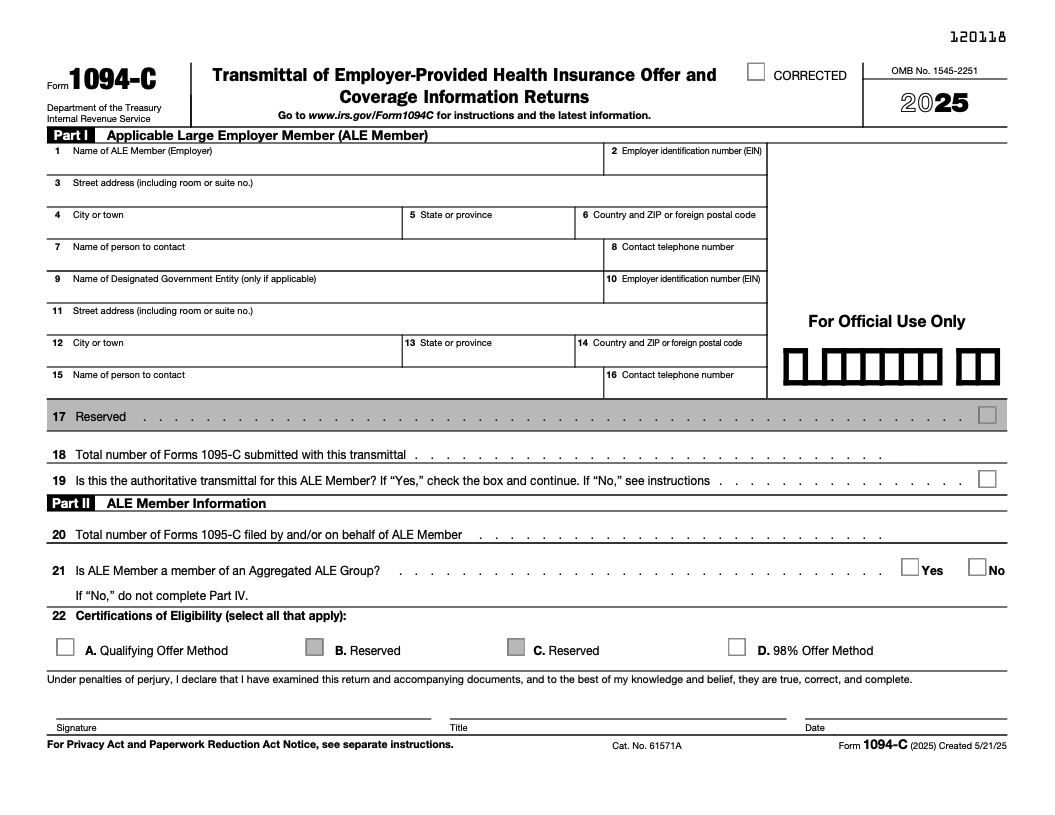
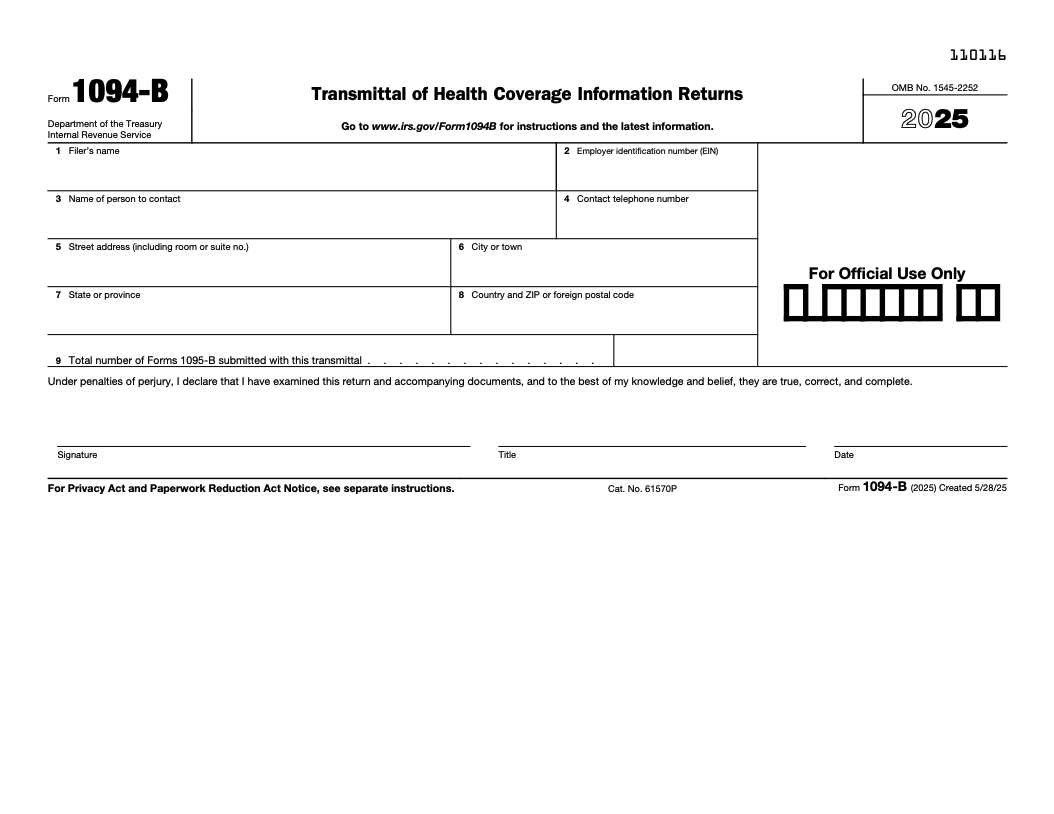
The District's individual mandate mirrors the federal ACA framework, using the same definition of minimum essential coverage. To satisfy the reporting piece, employers submit the same information returns they already prepare for the IRS:
- Fully insured and self-insured ALEs: Forms 1094-C and 1095-C
- Insurers and other MEC providers: Forms 1094-B and 1095-B
D.C. accepts copies of the federal forms, so you're not filling out a District-specific version. Employers may submit data for their D.C. residents, and the returns carry the same coverage detail the IRS forms contain.
Electronic-Only Filing Through MyTax DC
This is where D.C. diverges most sharply from other jurisdictions. The District does not accept paper filings, and it does not accept submissions through outside web services. All information returns must be uploaded through the District's own portal at MyTax.DC.gov, using OTR's prescribed layouts and file formats. Specifically:
- Files must be submitted through a MyTax.DC.gov account. Employers that withheld and paid D.C. wage taxes generally already have a logon. Filers who don't have an account (including bulk filers who aren't D.C. taxpayers) must register for one before they can file.
- Returns are uploaded in a pipe-delimited text (.txt) format following OTR's specifications, not Excel, XML, or ZIP.
- Filers can submit manually or via bulk upload, and files must pass the portal's validation checks before they're accepted. Very large files (250MB or more) are rejected and must be split into multiple submissions.
The practical takeaway: D.C. filing isn't a matter of mailing a stack of forms. It's a formatted electronic upload, and getting the file specification right matters as much as getting the data right.
The Deadline, the Latest of All the Mandates
D.C. sets its filing deadline as 30 days after the federal deadline for submitting 1095-B/1095-C forms, including any IRS extensions. Because the federal electronic filing deadline falls at the end of March, D.C.'s deadline lands roughly a month later, around April 30 for the prior tax year.
That mechanic makes D.C.'s deadline the latest among the state-level mandates, later than California and New Jersey (end of March) and later than Massachusetts and Rhode Island. It's a small mercy for busy compliance teams, but it also means D.C. is easy to let slip to the bottom of the pile and forget. Because the date floats with the federal deadline each year, confirm it against current OTR guidance rather than assuming a fixed date.
Employers must furnish a completed 1095-B or 1095-C form to residents whose information appears on the returns. Employers who already furnish these forms to employees under their federal ACA obligation are generally treated as having satisfied the District's furnishing requirement, so for most employers, this doesn't create a second distribution of forms.
The Washington D.C. Individual Mandate
It is easy to treat the individual mandate as someone else's problem, and in a sense, it is. The requirement falls on your D.C.-resident employees, and they settle it on their own District return, not through your filing. But your upload to MyTax DC is what lets the District verify their coverage, so it pays to understand what your employees are accountable for.
What is the Washington D.C. individual mandate?
Effective in 2019, after the federal coverage penalty dropped to $0, the District's individual mandate requires most D.C. residents to carry minimum essential coverage (MEC). It's modeled on the original federal ACA mandate and uses the same MEC definitions, and it's codified at D.C. Code §§ 47-5101 to 47-5109.
Who does the individual mandate apply to?
Most D.C. residents, along with their dependents, must maintain qualifying coverage for at least nine months of the year.
Some residents qualify for exemptions, such as those based on affordability or hardship. This is a resident-facing rule, separate from the employer reporting obligation.
How residents satisfy and report it.
Residents satisfy the mandate by holding MEC through an employer plan, the marketplace, Medicaid, Medicare, or another qualifying source. They report it on their D.C. individual income tax return (Form D-40) by attesting to coverage.
Residents without coverage and without an exemption calculate and pay the penalty on the D-40. Employees keep the Form 1095-B or 1095-C they receive as proof of coverage; they don't file it themselves.
Washington D.C. ACA Reporting Penalties
Here's where D.C. is genuinely different, and worth being precise about.
On the individual side, D.C. residents who go without minimum essential coverage (and don't qualify for an exemption) face a penalty on their District tax return. For the 2025 tax year, that individual penalty can run as high as roughly $1,961 per adult and $900 per dependent, depending on household size and income.
On the employer side, the picture is less defined. The District has not published a specific dollar penalty for employers that fail to file or furnish the required returns. That absence is not an invitation to skip filing. The reporting obligation is still a legal requirement, and non-compliance leaves your organization exposed if the District's enforcement posture changes. It simply means D.C. hasn't attached a published per-form fine the way, for example, California has.
The reputational and administrative risk is real even where a headline penalty isn't. Late or malformed electronic submissions can be rejected outright by the MyTax DC portal, which can push a filing past the deadline while you troubleshoot the file format, so treating the deadline as a hard target, with buffer, is the safer approach.
Your Washington D.C. Compliance Checklist
Here is the whole obligation in one place:
- Confirm you have covered D.C. residents. Identify any employee who was a D.C. resident and received MEC during the reporting year.
- Confirm your filing obligation. If you're required to file federally and covered a D.C. resident, you almost certainly owe a D.C. filing.
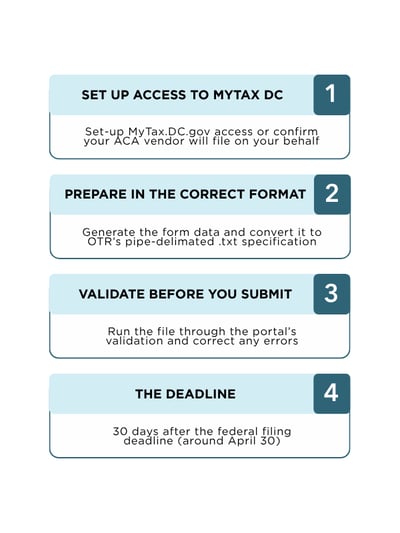
- Set up MyTax.DC.gov access. Verify your logon (or register), or confirm your ACA vendor will file on your behalf.
- Prepare forms in the correct format. Generate 1094/1095-B or -C data and convert it to OTR's pipe-delimited .txt specification.
- Validate before you submit. Run the file through the portal's validation and correct any errors; split files at or over 250MB.
- Furnish statements to D.C. residents. Confirm your federal 1095-B/C furnishing covers this requirement.
- The deadline. Mark 30 days after the federal filing deadline (around April 30) and confirm the exact date against current OTR guidance.
- Keep confirmation records. Save the portal's submission confirmation for your files.
Frequently Asked Questions
Yes. D.C. enacted an individual mandate effective in 2019 requiring most residents to carry minimum essential coverage or pay a penalty on their District tax return.
No. The District does not accept paper filings or submissions through third-party web services. All returns must be uploaded electronically through MyTax.DC.gov in the prescribed format.
D.C. accepts the same data on the federal forms you already prepare. Forms 1094-C and 1095-C from applicable large employers, or 1094-B and 1095-B from insurers and other MEC providers. There is no District-specific coverage form; OTR reads the same returns the IRS does.
Thirty days after the federal 1095-B/C filing deadline, including any IRS extensions, which typically lands around April 30 for the prior tax year (April 30, 2026 for tax year 2025). This makes it the latest deadline among the state mandates.
Possibly. Covering even one D.C.-resident employee can trigger a District filing, even if your business sits entirely outside the District.
The District has not published a specific employer penalty for failure to file or furnish. The obligation is still required by law, and the individual mandate carries a substantial penalty for residents without coverage.
Simplify Washington D.C. ACA Reporting with ACA Reporter
Washington D.C.'s electronic-only requirement is exactly the kind of detail that turns a routine filing into a scramble. The wrong file format, a missing MyTax DC login, or a validation error can stall a submission right up against the deadline.
ACA Reporter generates your 1094/1095 forms and handles automated electronic submission to MyTax DC in the format the District requires, alongside your federal filing and any other state mandates you're subject to, all from one data set.
If you are ready to take Washington D.C. compliance off your plate, fill out the form to talk to an expert from Points North.