

Last Updated: September 2026
Navigate this article:
- How 2027 Compares to Previous Years
- Higher Premium Adjustment Percentage
- Increased Out-of-Pocket Maximums
- Employer Mandate Penalties Increase Significantly
- Higher Health Plan Affordability Threshold
- Safe Harbor Calculations for 2027
- What's Different About 2027
- Using the 2027 Notice of Benefit and Payment Parameters
- Make Compliance Easy with ACA Reporter
The IRS announced the 2027 ACA affordability percentage will increase to 10.22%, up from 9.96% in 2026, the first time the threshold has ever exceeded 10%. This change, along with sharply higher employer penalty amounts and out-of-pocket maximums, directly impacts how Applicable Large Employers (ALEs) structure their health benefits for 2027.
Every year, the Department of Health and Human Services (HHS) and the Centers for Medicare and Medicaid Services (CMS) update the ACA benefit and payment parameters through the Notice of Benefit and Payment Parameters (NBPP). The employer shared responsibility penalties, released between January and July 2026, include several critical changes that applicable large employers (ALEs) with 50 or more FTEs must understand to maintain ACA compliance and avoid costly penalties.
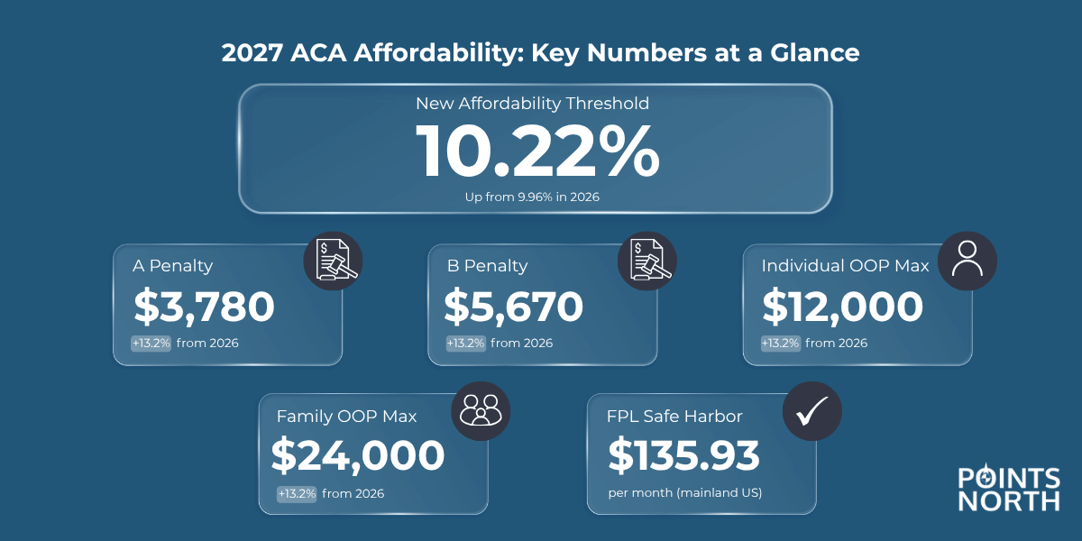
Key Numbers at a Glance
- New Affordability Threshold: 10.22%, up from 9.96% in 2026
- A Penalty: $3,780, up 13.2% from 2026
- B Penalty: $5,670 up 13.2% from 2026
- Individual OOP Max: $12,000, up 13.2% from 2026
- Family OOP Max: $24,000 up 13.2% from 2026
- FPL Safe Harbor: $135.92 per month (CONUS)
If your company needs to comply with the ACA, you need to know what to expect in 2027. Learn more here about the 2027 Notice of Benefit and Payment Parameters and how it may affect you.
How 2027 Affordability Percentage Compares to Previous Years
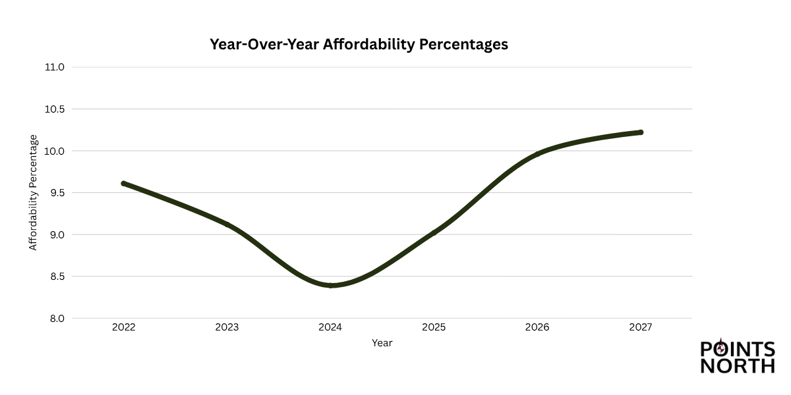
The 2027 affordability threshold of 10.22% represents a significant shift from recent trends:
- 2024: 8.39% (lowest in recent history)
- 2025: 9.02% (beginning to rise again)
- 2026: 9.96% (returning closer to pre-2024 levels)
- 2027: 10.22% (highest since the employer mandate took effect)
This increase reflects HHS's revised premium growth measure, which now captures individual market premium increases in addition to employer-sponsored insurance. For employers, a higher percentage means slightly more room to set employee contribution amounts while staying compliant.
Higher Premium Adjustment Percentage
One component of the 2027 Notice of Benefit and Payment Parameters that directly affects employers is the premium adjustment percentage.
The premium adjustment percentage determines the out-of-pocket maximums for health plans. It also affects:
- Required contribution percentage to determine eligibility for some exemptions
- Amount of employer shared responsibility penalties
The Premium Adjustment Percentage for 2027 is 1.8916224814, representing an increase in employer-sponsored insurance premiums of approximately 89.2% over the period from 2013 to 2026. That is roughly 18% higher than the 2026 figure of 1.60, and it is what drives both the out-of-pocket maximum and the penalty increases described below.
Increased Out-of-Pocket Maximums
The out-of-pocket maximum is the highest amount an employer with a sponsored group health plan can impose on enrollees. The new maximums for 2027 are:
- $12,000 for individual coverage
- $24,000 for family coverage
This is an increase of 13.2% from 2026 limits ($10,600 individual / $21,200 family). Note that the ACA's self-only limit applies to each individual regardless of coverage tier; if your family out-of-pocket maximum exceeds $12,000, the plan must embed an individual limit at $12,000.
These limits apply to all non-grandfathered plans, including self-insured, level-funded, and fully insured plans of any size. They are separate from the IRS limits that apply to HSA-qualified high-deductible health plans.
Employer Mandate Penalties Increase Significantly
The employer mandate penalty amounts have been confirmed for 2027 with substantial increases for the second straight year.
The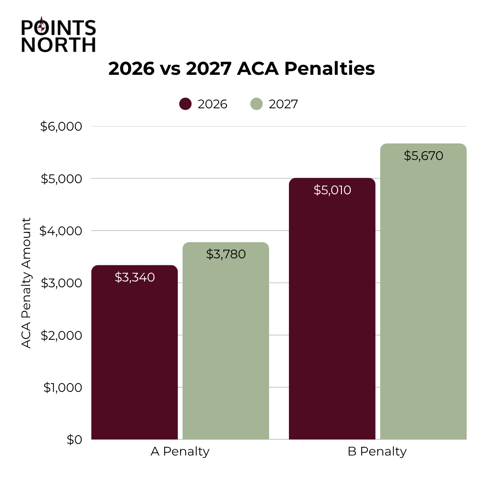 penalties are:
- $3,780 annually ($315.00/month) for the "A Penalty"
- $5,670 annually ($472.50/month) for the "B Penalty"
These represent a 13.2% increase from 2026 penalty amounts.
The lower A Penalty applies to applicable employers who don't offer minimum essential coverage to at least 95% of full-time employees and their dependent children (up to age 26). It is multiplied by the employer's total full-time employee count minus the first 30.
The higher B Penalty applies to employers who:
- Offer minimum essential coverage that isn't affordable under the 10.22% threshold, or
- Offer minimum essential coverage that doesn't provide minimum value (at least 60% actuarial value)
The penalty only applies if at least one full-time employee receives the premium tax credit for buying coverage through the Health Insurance Marketplace. The IRS continues to enforce these provisions through Letter 226-J assessments and Letter 5699 non-filer notices, so ensuring your health plans meet ACA affordability and reporting requirements is more critical than ever.
Higher Health Plan Affordability Threshold
Related to the out-of-pocket maximum and employer penalty amounts is the health plan affordability threshold. The affordability threshold determines whether the health plan with the lowest premium you offer meets the criteria of affordability.
The IRS announced that the affordability threshold for 2027 will be 10.22% of an employee's household income. This is an increase from the 2026 limit of 9.96%.
One important timing note: the affordability percentage applies to plan years beginning in the calendar year. An ALE with a July–June plan year would use 9.96% for the plan year beginning July 2026, and 10.22% for the plan year beginning July 2027, not a mid-year switch.
Safe Harbor Calculations for 2027
.png?width=703&height=352&name=Federal%20Poverty%20Line%20Safe%20Harbor%20for%202027%20(1).png)
Because employers typically don't have access to employees' household income details, the IRS provides three safe harbor methods:
Federal Poverty Line (FPL) Safe Harbor: For plan years beginning January 1, 2027, using the 2026 mainland FPL of $15,960, the maximum monthly employee contribution is $135.93 (10.22% × $15,960 ÷ 12 months). Employers may use the FPL guidelines in effect within six months before the first day of the plan year, so plan years starting in the second half of 2027 will use the 2027 FPL figures once HHS releases them.
Rate of Pay Safe Harbor: Calculate 10.22% of the employee's monthly wages (hourly rate × 130 hours).
W-2 Safe Harbor: Calculate 10.22% of the employee's W-2, box 1 wages for the calendar year.
What's Different About the ACA Affordability Threshold in 2027?
Life After the Enhanced Premium Tax Credits
The enhanced premium tax credits expired on December 31, 2025. Unlike last year, when expiration was still a projection, employers now have a full plan year of data on what that means.
The effects visible so far:
- Marketplace enrollment contracted sharply. Average monthly effectuated enrollment is tracking toward roughly 17.5 million in 2026, down from 22.3 million in 2025.
- Premiums continue to climb. CBO projected gross benchmark premiums would rise an additional 7.7% in 2027 as healthier enrollees exit the risk pool.
- Employer coverage is comparatively more attractive. With smaller subsidies available, employees who might previously have opted for Marketplace coverage are more likely to enroll in employer plans.
For ALEs, the practical implication cuts two ways. Fewer employees qualifying for premium tax credits means fewer potential penalty triggers. But employers offering individual coverage HRAs (ICHRAs) may need to increase contributions to keep those arrangements affordable now that Marketplace premiums are higher.
Marketplace Changes Affecting 2027
Two structural changes in the 2027 payment notice are worth noting for employers who track the individual market:
- Bronze plan flexibility. Beginning in plan year 2027, bronze plans in the individual market may exceed the statutory out-of-pocket cap by up to 130%.
- Shorter open enrollment periods. Many states move to compressed open enrollment windows starting in 2027, which affects the timing of employee decisions about coverage.
Nondiscrimination Policy for Health Plan Design
CMS has maintained its clarified nondiscrimination policy for 2026. The policy specifies that benefit limits and plan coverage requirements must be based on clinical evidence. This is meant to combat plan designs that are presumptively discriminatory.
Discrimination on the basis of sexual orientation or gender identity remains a particular concern for HHS. The agency continues to address discrimination in health coverage based on sex under section 1557 of the ACA, ensuring these policies remain consistent with evolving civil rights protections.
Using the 2027 Notice of Benefit and Payment Parameters
The 2027 Notice of Benefit and Payment Parameters from HHS and CMS contains several significant changes that will affect applicable employers.
These changes will impact:
- Plan affordability calculations with the 10.22% threshold
- Employee contribution limits based on updated out-of-pocket maximums of $12,000 and $24,000
- Penalty exposure with increased penalty amounts ($3,780 and $5,670)
- Compliance strategies in a post-enhanced-subsidy Marketplace
For employers, the key takeaway is clear: the 2027 parameters require attention before open enrollment. With penalty amounts up more than 13% and the affordability threshold above 10% for the first time, now is the time to review your health plan offerings and confirm your safe harbor approach.
ACA Compliance Doesn't Have to Be Complicated

Navigating the 2027 ACA affordability percentage and updated compliance requirements doesn't have to be overwhelming. ACA Reporter from Points North is an intuitive, all-in-one ACA reporting solution with all the updated regulations for IRS and state filing and tracking rules built in.
With ACA Reporter, you can:
- Automatically calculate affordability using the current 10.22% threshold and all three safe harbor methods
- Monitor compliance in real-time with alerts when employees approach affordability limits
- Generate accurate 1095-C forms with updated 2027 penalty amounts and thresholds
- Track employee eligibility across complex scenarios like variable hours and multiple locations
- File electronically with the IRS with built-in validation to prevent costly errors
- Access comprehensive reporting to make informed decisions on coverage offerings
Our software automatically incorporates the latest ACA regulations, so you don't have to worry about manually updating calculations every year. Contact Points North today to schedule a free demo using the form below. Let us show you how the right ACA solution can help you stay up-to-date and compliant with 2027 requirements more easily.
Frequently Asked Questions and the ACA Affordability Percentage