

Last Updated: October 2026
Construction runs on subcontractors, specialty crews, and rented equipment, and every one of those payments raises the same year-end question: who gets a 1099?
The rules also changed in 2026. The 1099 threshold for 2026 is $2,000, up from the $600 limit that applied for decades. That means fewer forms for small payments, but it doesn’t change who you report, how you report them, or what happens when a 1099 worker shows up on a prevailing wage job.
Here are the 1099 requirements construction companies need to know for forms filed in early 2027.
Table of Contents
- What Is 1099 Reporting?
- Why 1099 Reporting Matters in Construction
- The 1099 Threshold for 2026
- 1099-NEC vs. 1099-MISC
- Who Gets a 1099 in Construction?
- 1099 Filing Deadlines for 2027
- How to Issue a 1099 to a Contractor
- 1099 Workers on Prevailing Wage Projects
- Common 1099 Mistakes in Construction
- Best Practices for 1099 Compliance
- 1099 Penalties
- Frequently Asked Questions
What is 1099 Reporting?
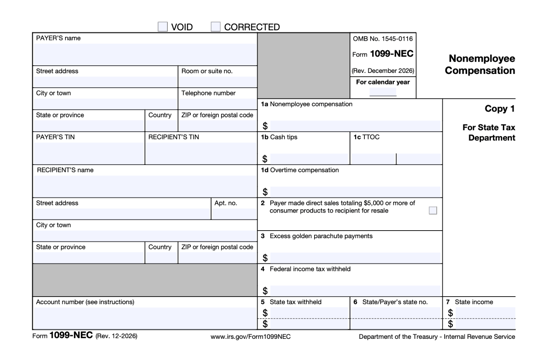
1099 reporting is the process of filing IRS information returns for payments your business makes to non-employees. For each reportable payee, you send one copy of the form to the recipient and file another with the IRS, so the income shows up on both sides.
It’s the non-employee counterpart to the W-2. Your employees have payroll tax withholding on every check. Independent contractors and subcontractors handle their own taxes, so a 1099 is often the IRS’s only record of what you paid them.
Sample 1099-NEC for a construction subcontractor
Here’s what a typical form looks like for a drywall subcontractor paid $18,450 across three projects in 2026. Note that on the 2026 form, filed in 2027, non-employee compensation moves from Box 1 to Box 1a.
|
Form field |
Example entry |
|
Payer |
Sample Electric Inc., name, address and EIN |
|
Recipient |
Example Drywall LLC (single-member LLC), name, address and TIN from Form W-9 |
|
Box 1a: Non-employee compenstation |
$18,450 (labor and materials billed together) |
|
Box 4: Federal income tax withheld |
$0 (no backup withholding required) |
|
State boxes (5-7) |
Completed if the state requires 1099 reporting |
Why 1099 Reporting Matters in Construction
Construction relies on non-employee labor more than most industries, and payments to one subcontractor often span several jobs and invoices. That makes 1099s easy to miss and expensive to fix: penalties apply per form, and the same records support you in a worker classification review.
The 1099 Threshold for 2026
For payments made in 2026, the 1099 threshold is $2,000 per payee for the calendar year. The One Big Beautiful Bill Act raised the 1099-NEC threshold and most 1099-MISC thresholds from $600 for payments made after December 31, 2025. The IRS says the 1099 limit may be adjusted for inflation starting in 2027.
- Payments made in 2025 (filed in early 2026): $600 threshold.
- Payments made in 2026 (filed in early 2027): $2,000 threshold.
- Totals count, not single payments. Four $600 payments to the same subcontractor add up to $2,400, which requires a 1099-NEC.
- Backup withholding is the exception. If you withheld on a payment because the payee didn’t provide a valid TIN, you file a 1099 even when the total is under $2,000.
1099-NEC vs. 1099-MISC: Which Form Construction Companies Use
Use Form 1099-NEC for payments for services and Form 1099-MISC for other business payments, such as rent. In construction, most 1099s are 1099-NECs, because most payments are for subcontracted labor. The 1099-MISC vs. 1099-NEC choice usually comes down to whether the payment was for someone’s work or for the use of something.
|
|
Form 1099-NEC |
Form 1099-MISC |
|
What it reports |
Non-employee compensation for services |
Rents, prizes, attorney gross proceeds, medical payments, and other income |
|
Construction examples |
Subcontractor labor, labor plus materials, architects, engineers, or attorney fees |
Bare equipment rental, office, or yard rent |
|
2026 threshold |
$2,000 |
$2,000 for most boxes (royalties remain $10) |
|
Due to the IRS |
January 31 (paper or electronic) |
February 28 on paper, March 31 electronically |
Who Gets a 1099 in Construction?
Generally, any non-employee you paid $2,000 or more for services gets a 1099, unless they’re a corporation. That includes independent contractors, sole proprietors, partnerships, and most LLCs. Who needs a 1099 depends on the payee’s tax status, which is why the W-9 matters.
Who’s exempt: corporations and LLCs
- Corporations: Payments to C corporations and S corporations are generally exempt from 1099 reporting.
- LLCs: Whether you send a 1099 to an LLC depends on how it’s taxed. Single-member LLCs and LLCs taxed as partnerships get one; LLCs taxed as corporations don’t. Check the W-9’s tax classification box.
- Exceptions: Attorneys and medical providers get a 1099 even when incorporated.
- Merchandise: Payments purely for goods, such as lumber from a yard or materials from a supplier, aren’t reportable.
- Card payments: Payments by credit card or third-party payment network are reported by the processor on Form 1099-K, not by you.
Common 1099 subcontractor situations
- Labor and materials on one invoice: When materials are part of a service, report the full amount in Box 1a of the 1099-NEC. Don’t subtract the materials.
- Equipment rental with an operator: This is generally treated as a payment for services and reported on the 1099-NEC. A bare equipment rental without an operator is rent, reported on the 1099-MISC. Confirm the treatment with your tax advisor.
- Multiple projects: The threshold applies to the annual total across all jobs, not per project.
1099 Reporting Requirements and Filing Deadlines for 2027
When is a 1099 required? A 1099 is due by January 31 of the year following the year in which you made the payments. When a due date falls on a weekend, it moves to the next business day, and several 2027 deadlines do:
|
Form |
To Recipient |
Form 1099-NEC |
Form 1099-MISC |
|
1099-NEC |
February 1, 2027 |
February 1, 2027 |
February 1, 2027 |
|
1099-MISC |
February 1, 2027 |
March 1, 2027 |
March 31, 2027 |
If you file 10 or more information returns in total, including W-2s and 1099s combined, you must file electronically. Starting January 1, 2027, the IRS’s free Information Returns Intake System (IRIS) is the only IRS system for e-filing 1099s. The older FIRE system closes after November 19, 2026, so if your payroll provider or accountant filed through FIRE, confirm they’ve moved to IRIS. Check your state as well; many states require their own copy of the 1099.
How to Issue a 1099 to a Contractor
Accurate 1099s start when you hire a contractor, not in January. These steps follow the IRS instructions for Forms 1099-MISC and 1099-NEC.
- Collect a W-9 before the first payment. The W-9 gives you the contractor’s legal name, address, taxpayer identification number (TIN), and tax classification. The 1099 you file at year-end is built from it.
- Verify the TIN. Use IRS TIN Matching through e-Services before you file. Name and TIN mismatches are a top cause of IRS notices.
- Withhold if you have to. If a payee doesn’t provide a TIN or the IRS notifies you it’s incorrect, you’re required to apply backup withholding at 24%.
- Track payments by payee all year, coded by form type.
- Reconcile, file, and furnish. Check totals against your general ledger, then send recipient copies and file with the IRS by the deadline.
1099 Workers on Prevailing Wage Projects
A 1099 changes how you report a worker’s pay to the IRS. It doesn’t change what you owe them on a federal or state prevailing wage job. Under the Davis-Bacon Act, laborers and mechanics working on the site must be paid prevailing wages regardless of any contractual relationship between the contractor and the worker.
In practice, that means:
- Individual 1099 workers you pay directly must receive at least the prevailing wage and fringe for their classification and appear on your certified payroll, just like your W-2 crew.
- Subcontracting companies with their own employees submit their own certified payroll. As the prime, you’re still responsible for collecting it and making sure your workers are paid correctly. The rules on prevailing wage for subcontractors apply all the way down the tier.
- A 1099 won’t protect you in an investigation. Treating covered workers as contractors to avoid prevailing wage and fringe obligations is a common finding, and the cost of Davis-Bacon violations includes back wages, withheld contract payments, and possible debarment.
New to public works? Here’s what certified payroll is and how certified payroll reporting requirements apply to every worker on the job.
WageIQ stores the applicable prevailing wage rates for every classification on your project and calculates correct wages and fringe before payroll runs. See how WageIQ works.
Common 1099 Mistakes in Construction
- Misclassifying workers. If you control how, when, and where someone works, they’re likely an employee, whatever their paperwork says. The IRS independent contractor test looks at behavioral control, financial control, and the relationship. Worker misclassification penalties include back payroll taxes and interest, and it can change your headcount for ACA employer status.
- Paying in cash and skipping the paperwork. Cash payments are still reportable, and paying crews under the table creates tax exposure for both sides.
- Subtracting materials. Reporting only the labor portion of a labor-and-materials invoice understates Box 1a.
- Using the wrong form. Putting subcontractor labor on a 1099-MISC, or bare equipment rent on a 1099-NEC.
- Not adding up payments across projects. A sub paid $1,500 on one job and $1,200 on another crosses the $2,000 threshold.
Best Practices for 1099 Compliance
- Make a W-9 part of vendor onboarding. No W-9, no payment.
- Use your accounting system. Most construction accounting and ERP platforms can tag vendors as 1099-reportable and produce year-end totals by form, and IRIS handles e-filing at no cost.
- Run a mid-year review. Check totals by payee in July, so January isn’t the first time you look.
- Keep records for at least four years, stored digitally: W-9s, invoices, payments, and filed forms.
- Connect your 1099 and certified payroll records. On prevailing wage jobs, the hours and pay on your certified payroll should reconcile with what you pay 1099 workers. Gaps between the two are a red flag in a DOL review.
Running prevailing wage work with a mix of employees and 1099 workers? Our Managed Services team partners with you to generate certified payroll reports and manage submissions to the agencies on your projects.
1099 Penalties for Returns Due in 2027
1099 penalties apply per form, and separately for failing to file with the IRS and failing to furnish the recipient’s copy, so one missed 1099 can be penalized twice. The amounts for returns due in 2027 come from IRS Revenue Procedure 2025-32:
|
When the form is filed |
Penalty (per form) |
|
Within 30 days of the due date |
$60 |
|
31 days late through August 1 |
$130 |
|
After August 1, or not filed |
$340 |
|
Intentional disregard |
The greater of $690 or 10% of the amount that should have been reported, with no annual cap |
Annual caps apply to most late 1099 penalties. For small businesses (average gross receipts of $5 million or less), the top-tier cap is $1,397,000 a year.
Keep 1099s and Certified Payroll in Sync
1099 reporting in construction comes down to three things: collect a W-9 from every non-corporate payee, total payments by payee against the new $2,000 threshold, and file the right form by February 1, 2027. On prevailing wage jobs, there’s a fourth: make sure every laborer and mechanic you pay on a 1099 is paid the right rate and shows up on your Davis-Bacon certified payroll.
See how Points North helps contractors manage prevailing wage rates and certified payroll for every worker on the job.
Frequently Asked Questions About 1099 Reporting for Construction