

Prevailing Wage Maryland: Rates, Deadlines, and the 14-Day Clock

Last Updated: September 2026

Every covered payroll period on a Maryland public works project starts a clock. You have 14 days from the close of that period to file your certified payroll electronically with the Commissioner of Labor and Industry, and the penalty for missing it runs at $10 a day.

Before that clock starts, you need to know whether the project is covered at all. Maryland sets its threshold at $250,000, paired with a funding test that shifts depending on who is doing the contracting. If you have come across a $500,000 figure or a 50 percent state funding test, neither one matches how the law is applied today.

This guide covers which projects are covered, how the state sets county-level rates, what your filing and recordkeeping obligations look like, the county and city laws that layer on top of the state requirement, and what happens when something goes wrong.


Not working in Maryland? Our state-by-state guide to prevailing wage and certified payroll reporting covers the requirements wherever you operate.


The Basics of Maryland Prevailing Wage Law

Maryland prevailing wage law is codified at Title 17, Subtitle 2 of the State Finance and Procurement Article, sections 17-201 through 17-226. It is administered and enforced by the Prevailing Wage Unit within the Maryland Department of Labor Division of Labor and Industry.

The law sets a minimum hourly rate, including fringe benefits, for workers on covered public works projects, and that rate is a floor rather than a ceiling. "Construction" in the statute covers building, reconstructing, improving, enlarging, painting and decorating, altering, maintaining, and repairing, which means maintenance and repair work on a covered project carries the same obligations as new construction.

What Counts as "Public Work" in Maryland?

A public work is a structure or work built for public use or benefit, or paid for wholly or partly with public money. The statute names bridges, buildings, ditches, roads, alleys, waterworks, and sewage disposal plants. The Department has confirmed that public work also reaches energy infrastructure such as solar installations, broadband, and electric vehicle charging stations. "Locality" means the county where the work is performed, or all counties involved if a project spans more than one.

A few categories sit outside the definition:

  1. Capital projects funded in the annual state capital budget as a local House of Delegates or local Senate initiative work performed by a public service company under Public Service Commission order unless it is let to contract
  2. Truck drivers hauling materials to and from a worksite (though a laborer or mechanic hauling within the worksite is covered).

A political subdivision that is not otherwise covered can opt in by ordinance or resolution, with written notice to the Commissioner. Four state institutions sit outside the law entirely:

  • The University System of Maryland
  • Morgan State University
  • St. Mary’s College of Maryland
  • The Maryland Stadium Authority. 
Several comply voluntarily or run their own programs, so confirm which framework applies before bidding on institutional work.


Which Threshold Applies to Your Project?

Maryland prevailing wage law applies to a public works project, including school construction, valued at $250,000 or more, when one of the following is also true:

  • The state or a state instrumentality is the contracting body and there is any state funding for the project
  • A political subdivision is the contracting body and 25 percent or more of the construction money is state money
  • A political subdivision is the contracting body for elementary or secondary school construction and 25 percent or more of the money is state money

The law also reaches mechanical systems service contracts valued at $2,500 or more. That covers heating and air conditioning, refrigeration, plumbing, electrical, and elevator systems, including escalators and moving walkways. The threshold on that work is a fraction of the construction threshold.

Grant-funded projects depend on where the money originates, and the Prevailing Wage Unit will confirm coverage when the picture is unclear.


Decorative: Urban construction site in Maryland
Decorative: Maryland capitol building

Maryland Prevailing Wage and the Federal Davis-Bacon Act

Maryland law and the federal Davis-Bacon Act cover different projects through different machinery. Maryland is triggered at $250,000 with the funding tests above. Davis-Bacon applies to federally funded or federally assisted contracts in excess of $2,000.

When both are in play, the obligations do not stack. If a public works project carries $2,000 of federal money alongside state money, it becomes a Davis-Bacon project, the U.S. Department of Labor monitors compliance, and you do not file certified payroll records with the state at all.


How Maryland Prevailing Wage Rates Are Determined

The Commissioner of Labor and Industry sets a rate for every classification of worker in every locality. Determinations are issued separately for building and highway construction, and separately for each of Maryland’s 23 counties and Baltimore City.

The calculation works in three steps.

  1. The prevailing rate is the rate paid to 50 percent or more of the workers in that classification in that locality.
  2. If no rate reaches 50 percent, it is the rate paid to at least 40 percent of those workers.
  3. If no rate reaches 40 percent, the Commissioner calculates a weighted average.
Shift differentials, foreman premiums, and similar variations are excluded, since the goal is the base rate that prevails locally.

Maryland does not define "building" and "highway" in the statute, so the Prevailing Wage Unit generally follows Davis-Bacon guidance on scope. The Maryland highway category also picks up what Davis-Bacon treats as heavy construction, including dredging, bridges, water, sewer, and utility infrastructure.

The Annual Survey and the December 1 Determination

Rates come from a voluntary wage survey conducted each fall. It opens September 1 and closes October 31, and rates are published on or about December 1, then stay in effect for one year from issuance.

Participating is worth considering because the rates you will be bound by next year are built from whatever data comes in. You do not have to be a prevailing wage contractor to submit, but you do have to be registered in the Department's prevailing wage database. Submissions must cover work performed in the 12 months ending August 31, must identify the specific project, and cannot be averaged or aggregated across workers. Residential and out-of-state work is excluded, and every submission is subject to audit.

Finding Your County Rate

There is no single statewide Maryland prevailing wage figure. Rates vary by county, by classification, and by whether the work is building or highway, so a laborer in one county and a laborer in the county next door can be working from very different numbers.

When the survey does not produce enough data for a classification in a county, the Prevailing Wage Unit borrows from a grouping of similar localities. There are currently six groupings, which pair Baltimore City with Baltimore, Anne Arundel, Carroll, Harford, and Howard counties, and place Frederick with Montgomery and Prince George’s, among others.
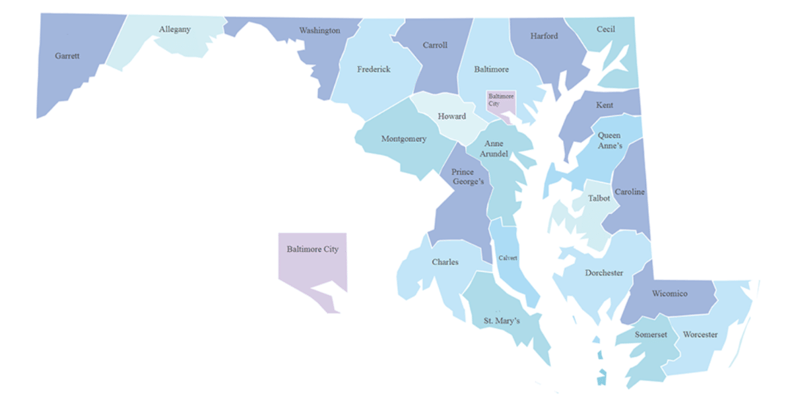
infographic shows Maryland county map

The rate in effect when work begins applies for the life of the project. A rate change published partway through does not reach back into a job already underway.

Informational rates are publicly searchable on the Department's prevailing wage portal. A project-specific determination comes from the public body, which requests it before advertising for bids. If the determination does not list a classification your scope requires, contact the unit before work starts rather than choosing the closest match. Reading a wage determination correctly is its own skill, and a misread classification becomes a compliance problem on day one.

One recent change is worth checking against any determination you are working from. Following a Circuit Court order in April 2026, the Department adjusted Heavy/Highway Laborer Group II rates effective August 1, 2026 in eight jurisdictions, including Baltimore City and Baltimore, Anne Arundel, Howard, and Prince George’s counties. Several moved substantially: the Harford County rate went from $16.00 plus $0.33 in fringe to $27.19 plus $7.31. The adjustment applies only to determinations issued on or after August 1.

Keeping Maryland Rates Straight Across Counties

Maryland issues determinations county by county and craft by craft, and the rate that applies is the one in effect the day work begins. WageIQ stores the applicable Maryland rates and surfaces your prevailing wage calculations before payroll runs. Prefer to hand off rate sourcing? Our Managed Services team builds and maintains rate tables tailored to your business and proactively monitors for rate changes.

Apprentices and the State Apprenticeship Training Fund

An apprentice can be paid below the determination rate only if that individual is employed and individually registered in a bona fide apprenticeship program registered with the Maryland Apprenticeship and Training Council and approved by the U.S. Department of Labor.

If an apprentice is not properly registered, they must be paid the applicable rate for laborers and mechanics performing that classification of work. That holds regardless of what the certified payroll lists, and regardless of the worker actual skill level.

Maryland also runs a State Apprenticeship Training Fund at section 17-602 of the State Finance and Procurement Article. Contractors and subcontractors performing work valued at $100,000 or more on a covered project contribute $0.25 per hour for each employee in each covered craft, whether or not they employ any apprentices. The contribution goes to a registered apprenticeship program, to an organization that has registered programs, or to the fund itself, and is reported through the Department's electronic certified payroll system. The contribution may count toward the fringe benefit amount, and it is not a permissible deduction from an employee's pay.

The notice requirements run downhill. If you hire a subcontractor for $100,000 or more of covered work, you owe them written notice covering the value of the work, their obligation to register with the Prevailing Wage Unit, their obligation to complete project log information, and their contribution obligation. The subcontractor provides written verification of program participation and how it will pay. Keep a copy of that notice for three years after the work is complete, and confirm your apprentice-to-journeyman ratios before work begins.


Maryland Contractor Compliance Obligations

Certified payroll statements go to the Commissioner of Labor and Industry electronically, within 14 days after the end of each payroll period. Late records carry a penalty of $10 for every calendar day they are late.
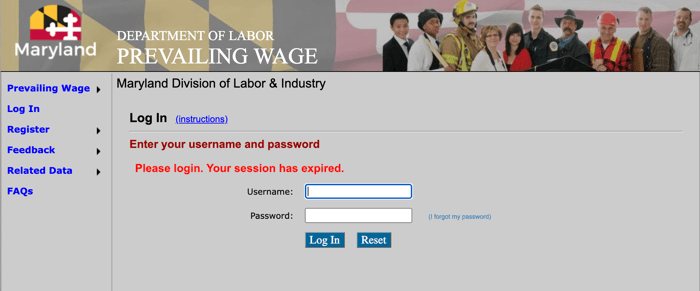
example: Maryland prevailing wage electronic portal

The statement certifies two things:

  1. That the rates paid for straight time and overtime are not less than the prevailing rate for that class of worker.
  2. And that the worker class, mechanic or laborer, reflects the work actually performed.

Registration in the Department's prevailing wage portal comes first, for contractors, subcontractors, and procurement officers alike.

The Department describes its certified payroll system as a reporting system rather than an accounting system, which means entries cannot be deleted. To fix a record, log back in and select "Amend" instead of "Certified," then enter the updated information. Every entry, amended or duplicate, stays on the record with a timestamp.

Maryland does not use WH-347 for state-funded projects; that form belongs to federal Davis-Bacon work.

Fringe benefits count toward the total prevailing wage obligation, either as irrevocable hourly contributions to a bona fide third-party plan or program, or as the hourly cost of benefits under an enforceable, financially responsible plan communicated to workers in writing. Divide the annual benefit cost by 2,080 hours per employee to get the hourly rate.

A credit taken against an excess fringe is capped at 20 percent of the applicable basic hourly wage rate. If your basic hourly rate still falls below the determination after that cap, you owe the difference in cash.

Several things that feel like benefits do not count:

  • Payments required by federal, state, or local law, including Social Security, unemployment compensation, and workers compensation
  • Paid leave under the Maryland Healthy Working Families Act and contributions under Maryland Paid Family and Medical Leave Insurance
  • Use of a company vehicle, cell phones, lodging reimbursement, and company-owned tools

Self-funded plans can be approved if the U.S. Department of Labor has already approved them. Our fringe benefit FAQs go deeper.

Maryland overtime rules on public works are stricter than the federal standard most payroll systems are configured for. Contractors and subcontractors owe no less than time and one-half for:

  • Hours worked in excess of 10 in any single calendar day
  • Hours worked in excess of 40 in a workweek
  • Work performed on Sundays and legal holidays

The daily trigger operates independently of the weekly one. A worker who puts in 12 hours on a Tuesday but only 35 across the week is still owed two hours of overtime. A worker who stays under 10 hours every day but reaches 42 for the week is also owed two hours.

Overtime is calculated on the employee regular rate of pay. If the hourly rate you actually pay is higher than the basic hourly rate in the determination, overtime is figured on the higher rate. Overtime on prevailing wage projects gets complicated quickly when several rules apply at once.

The wage determination has to be posted in a prominent and easily accessible place at the work site, and it stays posted for as long as any covered employee is working on the project.

Obligations flow through every tier of the contractor chain, and the prime contractor stays responsible for them. Where a subcontractor underpays, both are jointly and severally liable for restitution to that subcontractor employees. A public body can withhold payment while an issue is open, and a contractor can withhold from a subcontractor an amount equal to what was withheld from it. Building the requirement into your subcontracts is the cleanest protection in the contractor and subcontractor relationship.

Anyone performing construction work in Maryland also needs a license from the Clerk of the Circuit Court in the county where the work will be performed, and certain trades carry individual licensing requirements on top of that.

County and City Prevailing Wage Laws

Four Maryland jurisdictions run their own prevailing wage programs, and several are stricter than the state law.

Baltimore County applies its Prevailing Wage and Local Hiring Law to county-financed construction contracts valued over $300,000 and county-subsidized capital projects receiving assistance over $5,000,000, for contracts signed on or after July 1, 2021. Certified payroll goes to the county Compliance Monitor within 14 days of the close of the payroll period, through LCPTracker. Late records cost $10 per calendar day and underpayments cost $20 per day per worker. County overtime starts after eight hours in a day rather than ten.

Montgomery County patterns its law after Davis-Bacon and the state law, for contracts executed on or after July 1, 2009. Rates are calculated by the state, and certified payroll is due within 14 days through LCPTracker. The county law does not reach contracts under $250,000, or contracts already subject to a federal or state prevailing wage law.

Baltimore City works differently from the rest of the state. Its law sits at Article 5, Subtitle 25 of the City Code and is enforced by the City Wage Commission. City rates are determined by the Board of Estimates, whose decision is final, so the city does not simply adopt the state determination. Overtime covers Saturdays and Sundays, hours over eight per day Monday through Friday, and holidays the Board designates as overtime holidays. The city also runs a separate Living Wage for service contracts, which is a different requirement and adjusts each July 1.

Prince George’s County has a Wage Determination Board that adopts and amends county rate schedules, with Contract Compliance Officers conducting on-site inspections and worker interviews. The county maintains a separate wage requirements law for service contracts.

The same crew can be working under a different daily overtime trigger and a different rate source depending on which side of a county line the job sits.


Projects That Look Covered but Are Not

Two categories of Maryland work require prevailing wage rates without falling under the Prevailing Wage Law.

Solar energy generating systems over 1 megawatt

Section 7-714 of the Public Utilities Article requires the developer to ensure all workers are paid at least the applicable prevailing rates. These projects are not subject to the Prevailing Wage Law, no certified payroll records go to the Department, and the obligation is enforced under the Maryland Wage Payment and Collection Law instead. 

Investor-owned underground gas and electric utility construction

Section 5-305 of the Public Utilities Article requires contractors, subcontractors, and traffic control service providers to pay the rate determined by the Commissioner. As with solar, these projects fall outside the Prevailing Wage Law and no certified payroll goes to the Department.


Maryland Prevailing Wage Violations and Penalties

Maryland enforcement escalates based on what happened and what the contractor knew.

Liquidated damages for underpayment run $20 for each laborer or employee for each day that worker is paid less than the prevailing rate, or is paid the laborer rate while performing mechanic work. Where the Commissioner finds that a contractor knew or reasonably should have known of the obligation and deliberately failed or refused to pay, liquidated damages rise to $250 per worker per day.

The Commissioner weighs five factors in reaching that finding:

  • Whether the contractor has previous violations of the prevailing wage law
  • Whether the contractor refused or failed to produce certified payroll records
  • Whether the contractor refused or failed to cooperate with the investigation
  • Whether some laborers or employees were paid correctly while others were not
  • Whether there is other evidence of actual knowledge, deliberate ignorance, or reckless disregard

Records and stop work orders. A contractor or subcontractor that knowingly fails to produce records or attend a hearing during a prevailing wage investigation can be fined up to $1,000, with each day a separate offense. Violating a stop work order carries up to $5,000 per day.

Private suits. An employee paid less than the prevailing rate can file a complaint with the Commissioner and can bring an action in court. A court will award the difference between what was paid and the prevailing wage, and may award double or treble damages where it finds the employer withheld wages or fringe benefits willfully and knowingly, or with deliberate ignorance or reckless disregard.

Restitution sits on top of all of it. Because most investigations begin with a worker complaint or a routine audit, accurate records are the first line of defense.


Best Practices for Maryland Certified Payroll Compliance

A few habits keep Maryland public works projects clean from bid through closeout:

Decorative: Woman employee in office in Maryland working on certified payroll
  • Confirm both the $250,000 value and the funding test before you bid, and check whether federal dollars are in the package. Federal money moves the project into the Davis-Bacon system entirely.
  • Get the wage determination before you price the job, and cross-reference every classification your scope requires against it.
  • Remember the rate locks at the start of work, and check whether your determination predates the August 1, 2026 Heavy/Highway Laborer Group II adjustment.
  • Put the 14-day filing deadline on a calendar for every payroll period on every covered project.
  • Verify that every apprentice is individually registered with the Maryland Apprenticeship and Training Council before they appear on a covered payroll.
  • Budget the $0.25 per hour apprenticeship contribution on any covered project at $100,000 or more, for every worker in a covered craft.
  • Check whether a county or city law also applies, and which overtime trigger is stricter.

Managing Prevailing Wage on a Maryland Public Works Project?

Maryland gives you 14 days from the close of each payroll period, and late records cost $10 a day. Our Managed Services team partners with you to generate your certified payroll reports and manage submissions across every project and every county. Prefer to keep it in house? With WageIQ, the rates and forms become easily manageable by your team.


Maryland Prevailing Wage FAQs

Prevailing wage is the minimum hourly rate, including fringe benefits, that contractors and subcontractors must pay workers on covered public works projects in Maryland. The Commissioner of Labor and Industry sets the rate for each worker classification in each county, based on an annual wage survey.

No. WH-347 is the federal certified payroll form used on Davis-Bacon projects. Maryland state-funded projects are filed through the Maryland Department of Labor electronic certified payroll system instead.

Certified payroll statements must be submitted electronically to the Commissioner of Labor and Industry within 14 days after the end of each payroll period.

Late certified payroll carries a penalty of $10 for each calendar day the records are late. The penalty accrues per calendar day, not per business day, and there is no grace period after the 14-day deadline.

Informational rates are searchable by county, project type, and classification on the Maryland Department of Labor prevailing wage portal. The project-specific wage determination is requested by the public body before it advertises for bids, and you can obtain a copy from that public body or from the Prevailing Wage Unit.

Solar energy generating systems over 1 megawatt must pay the applicable prevailing wage rates under section 7-714 of the Public Utilities Article, but they are not covered by the Maryland Prevailing Wage Law and developers do not submit certified payroll records to the Department.