

Last Updated September 2026
If you work on public works or government-funded construction projects, a payroll compliance audit is a real possibility. It's not a sign that something has gone wrong; in many cases, it's simply a routine part of doing business in the prevailing wage space.
Audits can feel stressful, but for contractors doing the work right, preparation is more than half the battle. The contractors who navigate them most smoothly aren't necessarily the ones who never make mistakes. They're the ones who keep organized records, know what's expected of them, and don't have to scramble when a request arrives.
This guide walks through what triggers a certified payroll audit, what the process looks like, and the practical steps you can take to be ready before one lands on your desk.
Navigate This Article
- What Is a Certified Payroll Audit?
- What Triggers a Certified Payroll Audit?
- What Auditors Are Looking For
- How to Prepare for a Certified Payroll Audit
- What Happens If Issues Are Found?
- How Certified Payroll Software Reduces Your Audit Risk
Key Takeaways
- A certified payroll audit is a formal review of payroll records on public works or government-funded projects to verify that workers were paid the correct prevailing wage and that wages and fringe benefits were properly reported.
- Certified payroll audits can be conducted by the U.S. Department of Labor's Wage and Hour Division (for Davis-Bacon Act projects), state labor agencies such as the California DIR, or a general contractor reviewing its subcontractors.
- Common audit triggers include worker or labor organization complaints, routine agency reviews, late or inconsistent certified payroll reports, subcontractor issues, and a history of prior violations.
- Auditors focus on wage rate accuracy, worker classification, fringe benefit documentation, complete and on-time WH-347 (or state equivalent) submissions, and consistency between payroll records and certified reports.
- Worker misclassification is one of the most common issues auditors identify on prevailing wage projects.
- Prime contractors are responsible for ensuring subcontractors on their projects are also compliant, including collecting and storing subcontractor certified payroll submissions.
- Certified payroll records are typically retained for three years following project completion.
- Audit findings can result in back wages owed to workers, penalties and interest, and, for repeated or willful Davis-Bacon Act violations, debarment from federal contracts for up to three years.
- The best way to prepare for a certified payroll audit is to build compliance into every project from day one: accurate classifications, timely submissions, organized documentation, and a centralized certified payroll system with a clear audit trail.
What Is a Certified Payroll Audit?
A payroll compliance audit, in the context of public works and government contracts, is a formal review of your payroll records to verify that workers on a covered project were paid correctly and in compliance with applicable prevailing wage laws.
This is different from a standard payroll or tax audit. The focus here is not on your overall payroll practices or tax filings. It is specifically about whether the workers on a qualifying project received the correct wage rates, whether those wages were properly reported, and whether fringe benefits were handled appropriately.
Audits can be conducted by several parties. The U.S. Department of Labor's Wage and Hour Division handles federal Davis-Bacon Act compliance. State labor agencies, such as the California Department of Industrial Relations (DIR), oversee state prevailing wage requirements. In some cases, a general contractor may conduct their own review of subcontractors on a project.
If you're newer to this space, What is Certified Payroll Reporting? and What Are Prevailing Wages? are good starting points before diving deeper into audit preparation.

What Triggers a Certified Payroll Audit?
There is no single reason an audit gets initiated. Some are routine; others are the result of a specific complaint or concern. Common triggers include:
- A complaint filed by a worker or labor organization alleging underpayment or misclassification
- A random or routine review by a contracting or awarding agency
- Inconsistencies or late submissions in certified payroll reports
- Subcontractor activity that raises questions during a review of a prime contractor's project
- A prior violation or history of non-compliance that places a contractor under closer review
Many audits stem from issues that were preventable. Familiarizing yourself with Common Certified Payroll Report Mistakes to Avoid is a practical first step toward reducing your risk.
What Auditors Are Looking For
When a payroll compliance audit is conducted, reviewers are looking at a specific set of questions. Understanding what they want to see makes it much easier to ensure your records are in order.
Key areas of review typically include:
- Wage rate accuracy: Are workers being paid the correct prevailing wage for their job classification on that specific project?
- Worker classification: Are employees classified correctly as the trade, laborer, or apprentice they actually are? Misclassification is one of the most common issues auditors identify.
- Fringe benefit documentation: Are fringe benefits being paid to approved plans, and is there documentation to support it? Calculating Fringe Benefits For Certified Payroll And Prevailing Wages breaks this down in plain terms if you need a refresher.
- Form submissions: Are WH-347 forms (or the applicable state equivalent) being submitted completely and on time? Review the WH-347 Updates: 2025 Certified Payroll Reports to make sure you're working from the correct form.
- Record consistency: Do your payroll records match what's reported on certified payroll submissions? Auditors look closely at hours worked, deductions taken, and whether the right people signed off.
- Back wages owed: If discrepancies are found, auditors will calculate what, if anything, is owed to affected workers.
Common Red Flags That Draw Scrutiny
Beyond the standard review areas, certain patterns tend to raise flags and invite closer attention:
- Missing or incomplete weekly submissions
- Reported hours that don't align with time records or project schedules
- Workers performing work outside their listed classification
- Fringe benefits listed on reports but not documented through contributions to approved plans or equivalent cash payments
If any of these are part of your current process, they're worth addressing before an audit request arrives. What Is The Contractor's Greatest Prevailing Wage Compliance Struggle? offers some useful perspective on where contractors most commonly run into trouble.
How to Prepare for a Certified Payroll Audit
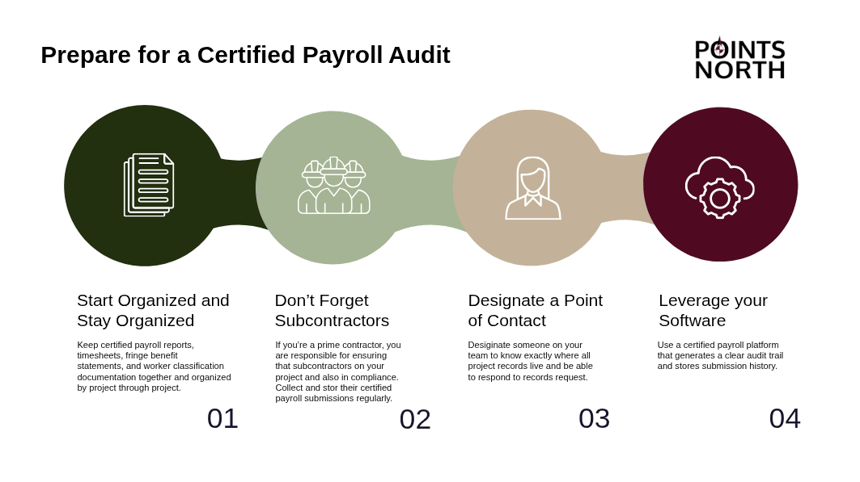
Good audit preparation isn't something you do when you get a notice. It's something you build into your project workflow from day one. Here's what that looks like in practice:
- Start organized and stay organized. Keep certified payroll reports, timesheets, fringe benefit statements, and worker classification documentation together and organized by project throughout the project, not just at closeout.
- Don't forget subcontractors. If you're a prime contractor, you are responsible for ensuring that subcontractors on your project are also in compliance. Collect and store their certified payroll submissions regularly. Subcontractor's Certified Payroll: Prevailing Wages and the Davis-Bacon Act covers what to expect from subs and how to manage that responsibility.
- Designate a point of contact. Someone on your team should know exactly where all project records live and be able to respond to a records request quickly and completely.
- Leverage your software. Using a certified payroll platform that generates a clear audit trail and stores submission history takes much of the manual burden off your team. Automated report generation reduces errors and makes it far easier to respond to a records request.
For a detailed look at recordkeeping expectations, What Government Contractors Need to Know About Prevailing Wage Records is worth a read.
Payroll Compliance Audit Checklist
Use this as a quick reference for each project:
- Weekly certified payroll reports submitted on time and in full
- Wage rates verified against current prevailing wage determinations for the project
- Worker classifications documented and accurate for the scope of work performed
- Fringe benefit contributions documented and supported by plan records or pay stubs
- All subcontractor certified payroll submissions collected and filed
- Timesheet records consistent with what is reported on certified payroll submissions
- All records retained for the required retention period, which is typically three years following project completion
For the full picture on reporting obligations, Certified Payroll Reporting Requirements for Contractors outlines what's expected on federal and state projects.
What Happens If Issues Are Found?
If a payroll compliance audit uncovers problems, the consequences will depend on the nature and severity of the issues. Common outcomes include:
- Back wages: Workers found to have been underpaid are entitled to the difference between what they were paid and what they should have been paid under the prevailing wage determination.
- Penalties and interest: Depending on the jurisdiction and the violation, additional penalties may apply.
- Debarment: Repeated or willful violations under the Davis-Bacon Act can result in debarment from federally funded contracts for up to three years.
Voluntary compliance and strong recordkeeping can meaningfully reduce the consequences of any issues that are found. Contractors who can demonstrate good-faith efforts to comply, and who can produce documentation quickly, are generally in a better position than those who cannot.
If an audit uncovers significant issues, working with legal counsel who specializes in prevailing wage law is a reasonable step. How To Avoid Davis-Bacon Act Violations outlines the most common violations and how to prevent them from occurring in the first place.
How Certified Payroll Software Reduces Your Audit Risk
Contractors who use purpose-built certified payroll software are better positioned when an audit arrives. Here's why:
- Fewer errors at submission. Automated report generation reduces the manual entry mistakes that lead to discrepancies between your payroll records and your certified reports.
- Up-to-date wage rates. Built-in wage rate lookups help ensure workers are classified and paid correctly based on current prevailing wage determinations.
- A built-in audit trail. When records are generated and stored in a centralized platform, producing documentation in response to an audit request takes hours, not days.
Certified Payroll Reporting by Points North is built specifically for contractors working on prevailing wage projects. From submission to storage, it keeps your records organized, accurate, and ready when you need them.
Get started with Certified Payroll Reporting and see how it fits your workflow.
Audits are a process, and contractors who keep clean records navigate them far more smoothly than those who don't. The best thing you can do to prepare for a certified payroll audit is to build good habits into every project from the start: accurate classifications, timely submissions, complete documentation, and a system that keeps it all in one place. The work you put in upfront is what gives you confidence when a request eventually comes in.