

Last Updated: September 2026
Healthcare costs keep climbing, and more employers are looking at individual coverage health reimbursement arrangements (ICHRA) as an alternative to a traditional group plan. An ICHRA, now also called the CHOICE Arrangement, lets you set a benefits budget and lets your employees choose coverage that fits their own situation.
Compliance and reporting for ICHRA works differently from a group plan at nearly every step: how affordability is calculated, which safe harbors apply, and which codes go on Form 1095-C. If you are an Applicable Large Employer (ALE) with 50 or more full-time equivalent employees, those differences determine whether your filing holds up under IRS review.
This guide walks through what changes when you offer an ICHRA, and what your team needs to track to stay compliant.
Navigate This Article
- What Is an ICHRA, and What Is the CHOICE Arrangement?
- Who Can Offer an ICHRA: The 11 Employee Classes
- How ICHRA Affordability Is Calculated
- ICHRA Affordability Safe Harbors
- ICHRA and the Employer Mandate
- ICHRA Reporting Requirements: Forms 1094-C and 1095-C
- Common ICHRA Compliance Questions
- Choosing ICHRA Compliance Support
Key Takeaways
- ICHRA is now also called the CHOICE Arrangement. CMS and the SBA adopted the new name in September 2026. The terminology changed, the rules did not, and no action is required from employers already offering one.
- ICHRA affordability uses a different calculation than a group plan. Take the age-banded lowest cost silver plan premium in the applicable ZIP code, subtract your monthly contribution, and compare what remains against the affordability percentage. That figure is 9.96% for plan years beginning in 2026 and 10.22% for plan years beginning in 2027.
- ICHRA has its own affordability safe harbors. The Look-Back Month safe harbor allows the LCSP premium from the previous year to be used for plans that start January 1. The Location safe harbor allows employers to use an employee's primary work address rather than their residential address. After these are applied, affordability is calculated using the standard W-2, rate of pay, and Federal Poverty Line safe harbors.
- Form 1095-C works differently. Line 14 codes 1L through 1U replace the standard offer codes, Line 15 reports the ICHRA calculation, and Line 17 reports the ZIP code used for affordability. An ICHRA code with a blank Line 17 is an incomplete return.
- The codes are distinguished by ZIP code, not by affordability. Codes 1L, 1M, 1N, and 1T use the employee home ZIP. Codes 1O, 1P, 1Q, and 1U use the work site ZIP. Only 1R signals that an offer was unaffordable.
- Most ICHRA compliance risk sits in reporting, not plan design. A sound offer reported incorrectly can still trigger information return penalties, separate from any Section 4980H exposure.
What is ICHRA, and What Is the CHOICE Arrangement?
What does ICHRA stand for?
ICHRA stands for Individual Coverage Health Reimbursement Arrangement. It is a type of health reimbursement arrangement that allows an employer to give employees tax-free allowances to purchase their own individual health insurance coverage.
The acronym is commonly misspelled as IHCRA or ICRA. All refer to the same arrangement.
How does an ICHRA work?
Rather than selecting a group health plan on behalf of your workforce, you set a monthly allowance. Employees purchase individual coverage through the Marketplace or elsewhere, and you reimburse them tax-free up to that allowance.
Two things separate an ICHRA from a traditional HRA. An ICHRA can reimburse individual insurance premiums, and it works alongside individual plans rather than being integrated with a group health plan. There are also no federal minimum or maximum contribution limits, so the allowance amount is yours to set.
For employers, that means more predictable benefits spending. For employees, it means coverage matched to their own needs instead of a single plan selected for everyone.
What is the CHOICE Arrangement?
CHOICE stands for Custom Health Option and Individual Care Expense. In September 2026, the Centers for Medicare and Medicaid Services and the Small Business Administration adopted CHOICE Arrangement as the new name for the ICHRA.
This was a change in terminology, not in the rules. Nothing about how an ICHRA operates, how affordability is determined, or how it is reported changed with the announcement. Separate federal legislation that would write the new name into statute remains pending.
In practical terms, employers offering an ICHRA do not need to make midyear plan changes, readopt their arrangement, or file anything additional. Expect to see both names used interchangeably during the transition. This guide uses ICHRA throughout.
Who Can Offer an ICHRA? The 11 Employee Classes
Any employer can offer an ICHRA regardless of size. What matters for ALEs is how the arrangement is structured across your workforce.
Federal rules allow you to divide employees into as many as 11 permitted classes, then decide which classes receive an ICHRA and which receive a traditional group health plan. Classes are built on objective employment criteria rather than individual circumstances. Examples include full-time employees, part-time employees, seasonal employees, salaried employees, hourly employees, and employees working in the same insurance rating area.
Three rules govern how classes can be used:
- You cannot offer the same class both an ICHRA and a traditional group health plan. A class receives one or the other.
- Classes must be defined clearly and applied consistently across the organization. Inconsistent application is where non-discrimination problems begin.
- Minimum class size requirements apply in certain situations, generally when an employer offers a group plan to some classes and an ICHRA to others.
Documenting how and why each class was established is worth the time. If your classes are ever questioned, contemporaneous records are far more persuasive than a reconstruction after the fact.
How Is ICHRA Affordability Calculated?
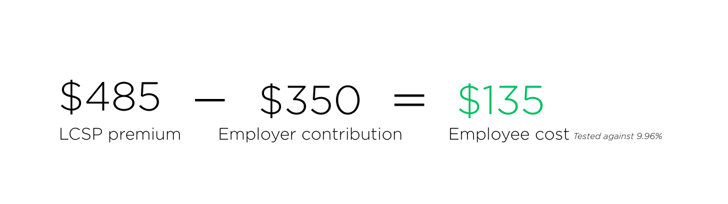
ICHRA affordability is calculated by taking the lowest cost silver plan (LCSP) premium available to the employee, subtracting your monthly ICHRA contribution, and comparing the remaining amount against the annual ACA affordability percentage.
The steps look like this:
- Identify the age-banded LCSP premium for self-only coverage in the applicable ZIP code.
- Subtract your monthly ICHRA contribution for that employee.
- Compare what remains against the affordability percentage for the plan year.
This is a different calculation from the one used for group health plans, where affordability is measured against the employee cost of your lowest-cost self-only option. With an ICHRA, the benchmark comes from the individual market rather than from your plan. The remaining amount you calculate here is also the figure reported on Line 15 of Form 1095-C. Same math, two purposes.
What affordability percentage applies to an ICHRA?
For plan years beginning in 2026, coverage is affordable when the employee required contribution does not exceed 9.96% of household income. For plan years beginning in 2027, that threshold rises to 10.22% under IRS Revenue Procedure 2026-26, the first time the percentage has moved above 10%.
The percentage is tied to when your plan year begins, not to the calendar year. A plan year running from July 2026 through June 2027 uses the 2026 percentage for its full duration. For employers on a non-calendar plan year, that can mean applying two different percentages within a single tax year, which is a frequent source of coding errors.
For penalty amounts, out-of-pocket maximums, and year-over-year context, see our guide to the ACA affordability percentage and payment parameters.
What makes LCSP premium data difficult to manage?
Before committing to an ICHRA, it's important to understand that not every state participates in the federally facilitated exchange. In states that run their own exchanges, LCSP premium data can be harder to access or may not be published in a usable format at all. Gathering it becomes a manual research task rather than a lookup.
LCSP premiums are also age-banded by postal code or FIPS code. That means the benchmark premium is specific to each employee, based on their age and their location. An employer with people in several states, or with regular turnover, is not pulling one number. They are pulling a number for every employee who received an offer of coverage, and refreshing it as the workforce changes. Non-calendar plan years add another layer, since different affordability percentages may apply to different months within the same tax year.
ICHRA Affordability Safe Harbors
ICHRA has its own affordability safe harbors, separate from the standard ACA safe harbors used with group plans. The Look-Back Month safe harbor allows the LCSP premium from the previous year to be used for plans that start January 1. The Location safe harbor allows employers to use an employee's primary work address rather than their residential address. After these are applied, affordability is calculated using the standard W-2, rate of pay, and Federal Poverty Line safe harbors.
What is the Look-Back Month safe harbor?
For plans that start in January, the Look-Back Month safe harbor allows you to use the LCSP premium from the previous year. That gives your team a published, stable premium to work from when setting and testing contributions ahead of the plan year, rather than waiting on current-year data.
The employee's age and location still determine which premium applies. The safe harbor changes which year of premium data you use, not whose premium you are looking at.
What is the Location safe harbor?
The Location safe harbor allows employers to use an employee's primary work address, rather than their residential address, to determine affordability. For employers whose people live across many ZIP codes but report to a small number of locations, this simplifies data gathering considerably. For employees who work from home, the home location is used to determine affordability.
The choice you make here carries directly into your reporting. Home ZIP codes and work site ZIP codes map to different Line 14 codes on Form 1095-C, so the safe harbor you select determines which codes your team will use.
How does employee age affect ICHRA affordability?
The employee age on the first day of the plan year governs the affordability calculation. For employees who become ICHRA-eligible partway through the plan year, the new age applies for the remaining period. There is no age-specific safe harbor. Both the Look-Back Month and Location safe harbors, however, protect employers against Section 4980H(b) penalties when applied correctly.
How do the standard ACA safe harbors work with an ICHRA?
Once you have determined the employee cost by subtracting your contribution from the LCSP premium, the familiar W-2, rate of pay, and Federal Poverty Line safe harbors apply in the same way they would for a fully insured or self-insured plan. The ICHRA-specific safe harbors handle the benchmark premium. The standard safe harbors handle the income side of the test.
ICHRA and the Employer Mandate
Offering an ICHRA does not remove you from the employer mandate. ICHRA offers count toward the 95% rule, which requires ALEs to offer coverage to at least 95% of their ACA full-time employees. An ICHRA offer is an offer of coverage for this purpose.
What is the difference between 4980H(a) and 4980H(b)?
- Section 4980H(a) applies when an employer fails to offer minimum essential coverage to at least 95% of full-time employees and at least one of those employees receives a premium tax credit through the Marketplace.
- Section 4980H(b) applies when coverage was offered but was either unaffordable or failed to provide minimum value, and at least one full-time employee receives a premium tax credit.
For an employer offering an ICHRA, 4980H(b) is usually the live risk. The offer exists, so the question becomes whether it was affordable under the calculation described above. Penalty amounts are indexed annually.
What else counts toward the employee required contribution?
Several arrangements affect affordability beyond the ICHRA allowance itself. Amounts made available through an HRA for the current plan year count toward the employee required contribution. Opt-out payments can increase an employee contribution beyond any wage reduction. Cafeteria plan flex credits reduce the required contribution when they qualify as health flex contributions, but non-health flex contributions do not.
If your benefits package includes any of these alongside an ICHRA, the interaction is worth reviewing before you calculate affordability.
ICHRA Reporting Requirements: Forms 1094-C and 1095-C
Reporting is where ICHRA compliance most often gets complex. You will still file Form 1094-C as your transmittal and Form 1095-C for each full-time employee. What changes is nearly everything inside Part II.
Alongside the forms, your team needs to track employee enrollments and waivers and maintain records of ICHRA reimbursements throughout the year. The form is only as accurate as the data behind it.
Which 1095-C codes apply to an ICHRA?
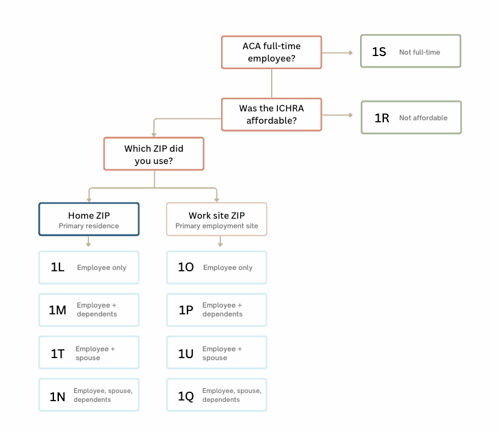
If you offer an ICHRA, Line 14 codes 1L through 1U replace the standard offer codes. An ICHRA employer does not use codes 1A through 1H at all. Codes 1V through 1Z are reserved for future use. Codes 1L, 1M, 1N, 1O, 1P, 1Q, 1T, and 1U are differentiated by which ZIP code you used to determine affordability, not by whether the ICHRA turned out to be affordable. Only code 1R signals that an offer was unaffordable.
|
Code |
Who was offered coverage |
ZIP used for affordability |
|
1L |
Employee only |
Primary residence |
|
1M |
Employee and dependents, not spouse |
Primary residence |
|
1N |
Employee, spouse, and dependents |
Primary residence |
|
1T |
Employee and spouse, no dependents |
Primary residence |
|
1O |
Employee only |
Primary employment site |
|
1P |
Employee and dependents, not spouse |
Primary employment site |
|
1Q |
Employee, spouse, and dependents |
Primary employment site |
|
1U |
Employee and spouse, no dependents |
Primary employment site |
|
1R |
ICHRA offered that was not affordable, for any covered combination |
Not applicable |
|
1S |
ICHRA offered to someone who was not a full-time employee |
Not applicable |
A shorter way to hold it: 1L, 1M, 1N, and 1T use the employee home ZIP code. 1O, 1P, 1Q, and 1U use the work site ZIP code. 1R means the ICHRA was not affordable. 1S means the person was not a full-time employee.
What goes on Line 15 for an ICHRA?
Line 15 reports the employee required contribution, and for an ICHRA that figure comes from the calculation covered earlier: the age-banded LCSP premium in the applicable ZIP code minus your ICHRA contribution. It represents the employee cost of coverage for themselves.
Line 15 is required for codes 1L, 1M, 1N, 1O, 1P, 1Q, 1T, and 1U. It is left blank for 1R and 1S.
Two rules prevent most Line 15 errors. First, zero is not the same as blank. If the employee cost is zero, enter 0.00, because a blank Line 15 paired with a code that requires an amount is an incomplete return. Second, if the amount changed during the year, do not use the All 12 Months box. Enter each month individually.
What is Line 17, and when is it required?
Line 17 reports the ZIP code used to determine ICHRA affordability. It exists for one reason, and it is used only for ICHRA offers. Employers who do not offer an ICHRA leave it blank.
Which ZIP code you enter follows directly from your Line 14 code:
- For codes 1L, 1M, 1N, and 1T, enter the ZIP code of the employee primary residence.
- For codes 1O, 1P, 1Q, and 1U, enter the ZIP code of the employee primary employment site.
Any ICHRA code paired with a blank Line 17 is an incomplete return. Line 17 is not required for codes 1R or 1S.
What is the employee age field in Part II?
Part II includes a field for the employee age as of January 1. It is used only in connection with ICHRA affordability, which is why it ties back to the age rules covered in the safe harbor section above. Employers who do not offer an ICHRA leave this field blank.
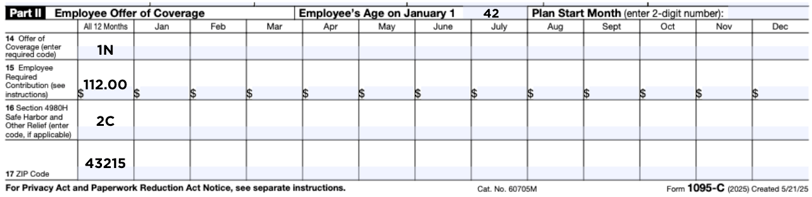
*The above is a reporting example for demonstration purposes.
Which Line 16 codes pair with ICHRA codes?
For codes 1L through 1Q, 1T, and 1U, valid Line 16 entries are blank, 2A, 2B, 2C, 2D, or 2E.
Codes 2F, 2G, and 2H are generally not used with ICHRA offers. Affordability is already communicated through the Line 14 code and the Line 17 ZIP code, so the standard safe harbor codes are redundant in this context.
Code 1R pairs with blank, 2A, 2B, or 2D. Code 1S pairs with 2B.
For the complete Series 1 and Series 2 code sets, the full pairing matrix, and month-by-month coding scenarios, see our complete guide to coding the ACA Form 1095-C.
Is an ICHRA reported on a W-2?
ICHRA reimbursements are excluded from an employee taxable income, so they are not reported as wages. Employers should confirm current-year W-2 reporting treatment against the applicable IRS instructions, as requirements for reporting the cost of employer-sponsored coverage can differ by arrangement type and employer size.
Common ICHRA Compliance Questions
Choosing ICHRA Compliance Support
If you are evaluating how to manage ICHRA reporting, whether that is a payroll add-on, a benefits platform, or dedicated compliance software, a few capabilities separate tools that genuinely fit ICHRA from tools that treat it as an afterthought.
Questions worth asking any provider:
- Can it access LCSP premium data for every state where you have employees, including states that do not use the federally facilitated exchange?
- Does it handle age-banded premiums by ZIP code at the individual employee level?
- Can it manage a non-calendar plan year and apply the correct affordability percentage to each month?
- Does it generate ICHRA-specific Line 14 codes, not just the standard offer codes?
- Does it populate Line 17 with the correct ZIP code based on the safe harbor you selected?
- Will it flag invalid code combinations before you file rather than after the IRS responds?
- Can it aggregate data across multiple locations, EINs, and payroll systems?
Many payroll providers handle group plan reporting well, but were not built for the LCSP lookup and ZIP-level affordability logic that an ICHRA requires.
ACA Reporter by Points North supports ICHRA reporting specifically. It generates Line 14, 15, 16, and 17 entries month by month, including ICHRA codes and ZIP-based affordability, and flags invalid code combinations and penalty-risk patterns before you file. ACA Reporter is integrated with CMS to look up LCSP premiums for states participating in the Federally Facilitated Exchange. Our team partners with you to review the results and prepare your submission, drawing on the payroll, employment, and benefits data your systems already produce. If a Letter 226-J arrives, you have the underlying data behind every code you reported.
Getting ICHRA Compliance Right
An ICHRA gives you real control over benefits spending, and for many employers that tradeoff is worth making. What it asks in return is precision. Affordability is calculated differently, the safe harbors are specific to ICHRA, and the reporting depends on Line 14, Line 15, and Line 17 telling one consistent story for every employee, every month.
The good news is that none of it is unpredictable. The rules are stable, the codes change rarely, and the work is manageable once your team knows what to track and where the data comes from.
If you would like a second set of eyes on how your ICHRA reporting is set up, our compliance specialists can walk through it with you.