
Nevada Prevailing Wage: Rates, Laws & Compliance Requirements
Last Updated: May 2026
If your company works on publicly funded construction projects in Nevada, prevailing wage compliance is not optional. It is a legal requirement with real financial and legal consequences for those who get it wrong. From setting the right pay rates before a project breaks ground to submitting accurate certified payroll reports every month, the obligations are detailed and the margin for error is slim.
This guide breaks down everything contractors, subcontractors, and payroll teams need to know about Nevada prevailing wage, including:
- What prevailing wage means in Nevada and which projects it applies to
- How Nevada wage rates are determined and where to find current figures
- Fringe benefits, overtime, and apprenticeship requirements
- Certified payroll reporting obligations
- Penalties for non-compliance and how to protect your business
Not working in Nevada? Check out our state-by-state guide to prevailing wage for detailed information on states with state-level requirements.
Table of Contents
- What Is Prevailing Wage in Nevada?
- Which Nevada Projects Require Prevailing Wage?
- What is Exempt?
- How are Nevada Prevailing Wage Rates Determined?
- Nevada Fringe Benefits
- Nevada Certified Payroll Reporting Requirements
- Overtime Rules Under Nevada Prevailing Wage
- Apprenticeship Requirements on Nevada Public Works
- Penalties for Nevada Prevailing Wage Violations
- Staying Compliant with Nevada Prevailing Wage Laws
What Is Prevailing Wage in Nevada?
Prevailing wage refers to the minimum compensation, including both base hourly pay and fringe benefits, that contractors and subcontractors must pay workers employed on qualifying publicly funded construction projects. The intent is to ensure workers on government-funded jobs are paid wages that reflect what is standard for their trade in that region, preventing wage undercutting and maintaining fair labor standards across the industry.
In Nevada, prevailing wage law is governed by Nevada Revised Statutes (NRS) Chapter 338, specifically NRS 338.020 through 338.090. These statutes outline how rates are determined, who must be paid, what fringe benefits qualify, how compliance is monitored, and what happens when contractors fall short. Nevada also stands apart for its rate consistency across funding sources: after the U.S. Department of Labor adopted Nevada's prevailing wage rates for federal Davis-Bacon compliance in 2026, contractors now follow a single set of Nevada rates, whether a project is state-funded or federally funded. Coverage thresholds remain separate (federal Davis-Bacon applies to federally funded contracts exceeding $2,000, while Nevada state prevailing wage applies to public works contracts over $100,000), but the underlying rate schedule is unified.
Enforcement falls under the Nevada Office of the Labor Commissioner (OLC), which operates within the Department of Business and Industry. The OLC oversees prevailing wage determinations, investigates complaints, and administers penalties for violations.
The law has been updated several times to expand its reach. Two significant changes came in 2019. Assembly Bill 136 lowered the contract threshold that triggers prevailing wage requirements from $250,000 to $100,000, bringing more publicly funded projects under the law's coverage. That same legislation repealed the 90% rule for schools, meaning school districts and the Nevada System of Higher Education must now pay workers the full prevailing wage rate. Senate Bill 243, also passed in 2019, restructured how rates are determined by establishing four regional wage zones and requiring the Labor Commissioner to conduct contractor surveys in odd-numbered years only.
Which Nevada Projects Require Prevailing Wage?
Nevada prevailing wage requirements apply to public works projects that are funded fully or in part with public money and have a contract value exceeding $100,000. Under NRS 338.010, a public work includes any project involving the construction, repair, or reconstruction of public buildings, roads, or utilities. The law covers all contract and temporary workers on qualifying projects per NRS 338.050, meaning the obligation extends beyond direct hires to anyone furnishing labor on the job site.
Contracts for construction work commissioned by the Nevada System of Higher Education where estimated costs exceed $100,000 are also subject to prevailing wage requirements, even if the work does not otherwise qualify as a traditional public works project.


What Is Exempt?
Not every publicly connected project triggers Nevada prevailing wage obligations. The following are exempt:
- Contracts related to the routine operation or normal maintenance of a public body, such as janitorial services or landscaping
- Contracts entered into in response to an emergency or disaster
- Work performed for or involving a railroad company
- Registered apprentices who are enrolled in a bona fide apprenticeship program and registered with the Nevada State Apprenticeship Council
- Design professionals, including engineers, architects, land surveyors, and landscape architects
How Nevada Prevailing Wage Rates Are Set
Prevailing wage rates in Nevada are determined by the Labor Commissioner using data gathered from contractor surveys and collective bargaining agreements (CBAs). When a particular craft or type of work is governed by a CBA, the Labor Commissioner must include all compensation required under that agreement in the prevailing wage determination, including zone pay and premium pay for overtime shifts, weekends, and holidays.
Under NRS 338.025, the state is divided into four prevailing wage regions for the purpose of wage determinations:
- Washoe Region: Washoe County
- Northern Rural Region: Carson City and the counties of Churchill, Douglas, Elko, Eureka, Humboldt, Lander, Lyon, Mineral, Storey, Pershing, and White Pine
- Clark Region: Clark County
- Southern Rural Region: The counties of Esmeralda, Lincoln, and Nye
The Labor Commissioner conducts contractor surveys in odd-numbered years. New wage rates are issued on October 1 of the survey year and remain effective for a two-year cycle. In even-numbered years, the Labor Commissioner reviews existing rates to determine whether adjustments are warranted based on CBA changes or other relevant data. The current active rate cycle covers October 1, 2025 through September 30, 2027, with the 2025-2027 rates available on the Nevada Labor Commissioner's website at labor.nv.gov. Nevada provides all prevailing wage rate updates directly to the U.S. Department of Labor for simultaneous adoption at both state and federal levels, applying to both annual updates and individual classification amendments.
When determining which rate applies to a specific job classification, the Labor Commissioner uses a 50% rule: if more than 50% of total hours reported for a given classification are paid at a particular rate, that rate prevails. If no single rate accounts for more than 50% of hours, the average rate is used.
Wage rates in effect at the time bids are opened for a public works project must be paid for the duration of the contract or for the 36 months immediately following the bid opening, whichever comes first. For projects that extend beyond 36 months, updated rates may apply under NRS 338.030.
Per NRS 338.020, prevailing wage rates must be included in every public works contract and posted in a location visible to workers at the job site.
Nevada Prevailing Wage Fringe Benefits
Prevailing wage in Nevada covers more than base hourly pay. Under NRS 338.010 and NRS 338.035, the total compensation package must include bona fide fringe benefits. Qualifying fringe benefits include:
- Pension contributions
- Health and welfare benefits
- Vacation and holiday pay
- Apprenticeship training program costs
- Other bona fide benefits that provide a tangible benefit to the worker
To qualify as bona fide under NRS 338.010, fringe benefits must be contributed at least monthly to an independent third-party fund, plan, or program established solely for the benefit of workers and their dependents. Critically, none of the assets in that fund may revert to or be credited to the contributing employer or sponsor under any circumstances.
Contractors may partially satisfy their prevailing wage obligation through fringe benefits rather than cash wages, but only to the extent that those benefits are annualized. The Labor Commissioner must be notified when a contractor is discharging part of their wage obligation through fringe benefits, and the benefits provided must be documented accordingly.
Stay Audit-Ready on Nevada Public Works
for exactly that, applying the right prevailing wage rate to the right classification before payroll runs. Want your team out of the reporting altogether? Our Managed Service team generates your certified payroll reports, manages submissions, and keeps your records audit-ready for the Nevada Labor Commissioner.
Nevada Certified Payroll Reporting Requirements
Certified payroll reporting is how prevailing wage compliance is documented and verified on Nevada public works projects. Both contractors and subcontractors are required to maintain payroll records and submit certified payroll reports to the awarding public body on a monthly basis. Under NRS 338.070, these reports must be submitted no later than 15 days after the end of each calendar month.
Nevada does not mandate a specific state form, but every certified payroll report must contain sufficient information to verify compliance. Required information includes:
- The name and identifying information of each worker
- Each worker's job classification
- Hours worked during the reporting period
- Rate of pay
- Identification of any apprentices on the project
- Whether workers are contributing to a bona fide fringe benefit program
Managing certified payroll across multiple workers, classifications, and regional wage rates is one of the most time-intensive compliance tasks on any public works project. Points North's certified payroll software is built to handle the complexity, helping teams submit accurate, complete reports on time and stay ahead of potential compliance issues.
Worker Classification
Worker classification is one of the most consequential elements of any certified payroll report. Nevada recognizes approximately 42 distinct trade classifications, with regional variations across the four wage zones bringing the total number of published classifications to more than 150. Misclassifying a worker, whether accidentally or deliberately, can trigger back wage assessments, penalties, and investigations. Given the volume of workers and classifications on larger projects, particularly those operating across multiple wage regions, accurate classification tracking is a significant operational responsibility.
Contractors and Subcontractors
Under NRS 608.150, the general contractor on a public works project bears ultimate responsibility for prevailing wage compliance, including the accuracy of subcontractor payroll. Contractors have the right to withhold payment from subcontractors to cover penalties resulting from a subcontractor's non-compliance, and may pursue recovery in court if payment has already been made.
Electronic filing of certified payroll records is addressed in NRS 338.070, and contractors should confirm current electronic submission requirements with the awarding body at the start of each project.
Overtime Rules Under Nevada Prevailing Wage
Nevada prevailing wage law requires that overtime be paid at one and one-half times the applicable prevailing rate when a worker exceeds either 40 hours in a scheduled workweek or 8 hours in a single workday. Both thresholds include all hours worked for the contractor or subcontractor during that period, not only hours spent on the public works project itself.
One commonly used exception is the 10-4 agreement. When a contractor and worker mutually agree in advance to a schedule of 10 hours per day across 4 calendar days within a single workweek, the standard daily overtime threshold shifts accordingly.
For trades governed by collective bargaining agreements, additional premium pay requirements may apply, including double time for certain weekend, holiday, or extended shift work. These requirements are incorporated directly into the prevailing wage determination for the applicable craft and region.
Apprenticeship Requirements on Nevada Public Works
Nevada law reflects a firm legislative position that apprenticeship programs are essential to building and maintaining a skilled construction workforce in the state. Under NRS 338.01165, contractors and subcontractors engaged in horizontal construction on a public works project must use one or more apprentices for at least 3% of the total hours of labor worked for each apprenticed craft or type of work, provided that more than three workers are employed in that craft on the project.
As of January 1, 2021, the Labor Commissioner, working in collaboration with the Nevada State Apprenticeship Council, has the authority to increase the required apprentice utilization percentage by up to 2 percentage points through regulation.
Contractors are required to enter into a formal apprenticeship agreement for all apprentices used on a public works project. Apprentices must be registered with the Nevada State Apprenticeship Council to qualify for the prevailing wage rate exemption. An apprentice who graduates from an apprenticeship program while still employed on a public works project continues to be counted as an apprentice for the purposes of the utilization requirement for the duration of that project. Learn more about apprenticeship-to-journeyman ratios here.
Failure to meet apprenticeship utilization requirements is a separate compliance obligation with its own penalty exposure under NRS 338.01165.
Penalties for Nevada Prevailing Wage Violations
Non-compliance with Nevada prevailing wage law can result in multiple layers of financial and legal consequences. The Labor Commissioner is empowered to impose penalties after providing the contractor with an opportunity for a hearing.
The Labor Commissioner must assess the full difference between the prevailing wages that were required and the wages actually paid (NRS 338.090). This is not discretionary; it is a mandatory assessment upon a finding of non-compliance.
In addition to back wages, financial penalties are assessed on a sliding scale of $20 to $50 per day, per worker, based on the contractor's bond amount under NAC 338.120. On projects with large workforces and extended timelines, these per-day, per-worker penalties can accumulate quickly.
The Labor Commissioner may recover its own investigative and prosecutorial costs as an additional administrative penalty. The awarding public body may also require the contractor to pay the costs it incurred to investigate the matter.
Violations of Nevada prevailing wage law can be charged as a misdemeanor. A misdemeanor conviction in Nevada is punishable by up to 6 months in county jail and a fine of up to $1,000.
Serious or repeat violations can result in temporary or permanent disqualification from bidding on public works projects in Nevada. Under NRS 338.017, the Labor Commissioner notifies the State Contractors' Board and relevant agencies upon imposing an administrative penalty. The Office of the Labor Commissioner maintains a public Disqualification List of contractors who have been barred from public works bidding.
Willful falsification of certified payroll records can result in fines of up to $1,000 and/or imprisonment.
What Triggers an Investigation?
Understanding what draws regulatory scrutiny is just as important as knowing the penalties. Common triggers include:
- Underpayment of prevailing wages for any worker classification
- Certified payroll reports that are inaccurate, incomplete, or submitted late
- Failure to report workers to the public body as required
- Subcontractor non-compliance that the general contractor failed to catch or correct
Staying Compliant With Nevada Prevailing Wage Laws
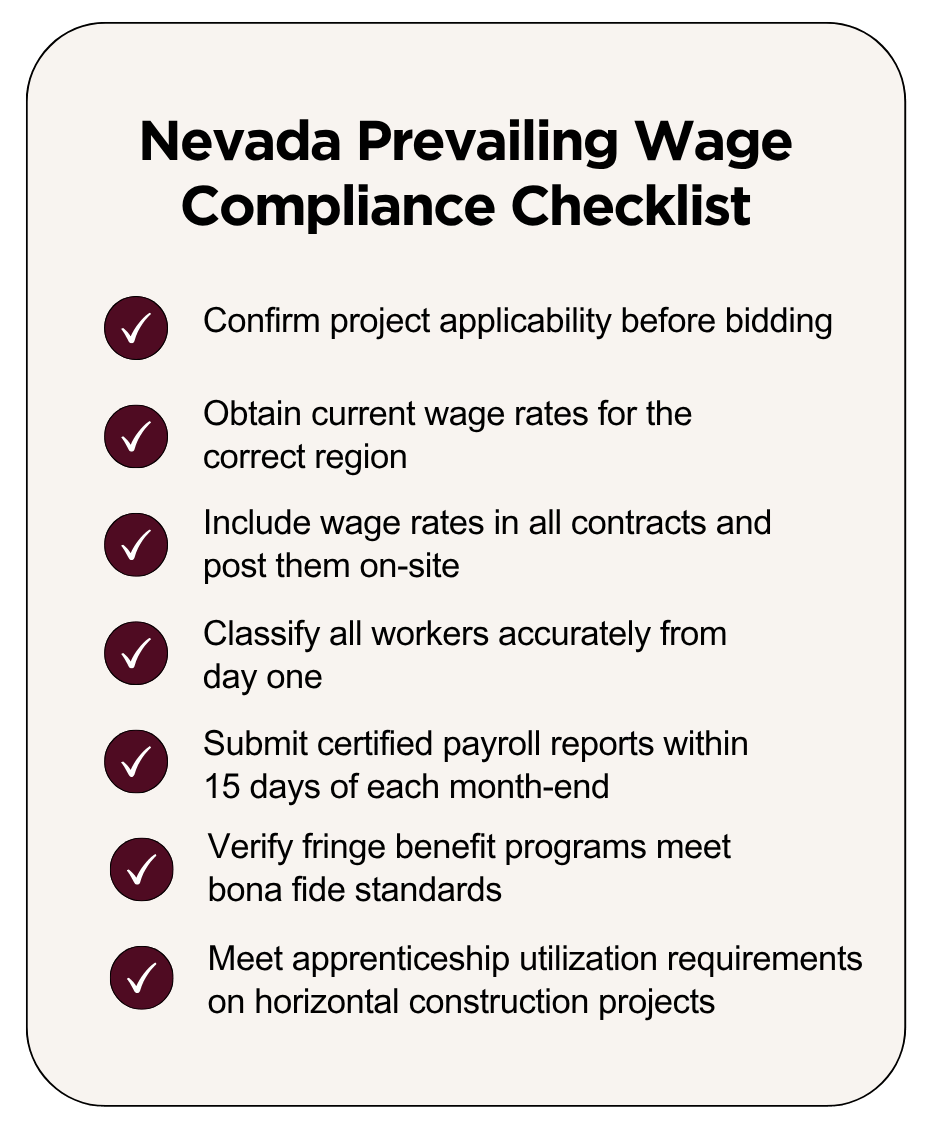
Prevailing wage compliance is not a one-time task. It requires attention at every stage of a project, from pre-bid preparation through final closeout. The following steps reflect the core obligations contractors and payroll teams need to manage consistently:
- Confirm project applicability before bidding. Verify that the project exceeds the $100,000 contract threshold and qualifies as a public work under NRS 338.010. Confirm which Nevada wage region applies based on the project location.
- Obtain current wage rates for the correct region. Pull the applicable 2025-2026 prevailing wage rates from the Nevada Labor Commissioner's website before finalizing your bid. Rates in effect at bid opening are locked in for the project's duration, up to 36 months.
- Include wage rates in all contracts and post them on-site. This is a statutory requirement under NRS 338.020, not just a best practice.
- Classify all workers accurately from day one. Review Nevada's 42 job classifications carefully and assign each worker the correct classification based on the work they actually perform, not their job title. Misclassification is one of the most common and costly compliance errors.
- Submit certified payroll reports within 15 days of each month-end. Build this deadline into your payroll calendar from the start of the project. Late or incomplete reports are a direct compliance trigger.
- Verify fringe benefit programs meet bona fide standards. Confirm that all benefits being used to offset the wage obligation meet the independence and irrevocability requirements under NRS 338.010.
- Meet apprenticeship utilization requirements on horizontal construction projects. Track apprentice hours by craft from the beginning of the project to ensure you meet the 3% minimum threshold where required.
Accurate, timely certified payroll reporting is one of the most effective safeguards against violations. Points North is built to help construction payroll teams manage Nevada's state-level reporting requirements with confidence, reducing the manual burden and minimizing the risk of errors that lead to penalties.
Nevada prevailing wage law places meaningful obligations on every contractor and subcontractor working on publicly funded projects in the state. From understanding which projects qualify and what rates apply, to correctly classifying workers and submitting certified payroll reports on time, compliance requires consistent attention and reliable processes.
The stakes for getting it wrong are significant. Back wages, daily financial penalties, criminal misdemeanor exposure, and debarment from future public works contracts are all on the table for contractors who fall short of their obligations under NRS Chapter 338.
Points North's certified payroll software is designed to take the complexity out of state-level compliance, helping your team stay organized, accurate, and audit-ready on every public works project.
.

See How It Works for Your Nevada Projects
Want to see what fits your business before you commit? Book a time with our team and we'll walk you through both paths: handling your prevailing wage rates and calculations in-house with WageIQ, or handing your Nevada reporting and submissions to our Managed Service team entirely. We'll help you figure out the right fit for how you work.