
Alaska Prevailing Wage: Rates, Certified Payroll, and Compliance
Last Updated: August 2026
If you are bidding on public construction in Alaska, the state requires prevailing wages on qualifying projects. The challenge is not the wage itself. It is understanding Alaska's unique compliance requirements. Alaska's rules look different from most states, and a few of them, from remote-site housing to daily overtime, can quietly reshape a bid.
These requirements come from a set of state laws known as the Little Davis-Bacon Act. Beyond the rates, you need to know how certified payroll works, what must be filed before day one, and where the state rules depart from federal Davis-Bacon. This guide covers what applies, when, and the Alaska-specific rules that most often catch contractors off guard.
Not working in Alaska? Check out our state-by-state guide to prevailing wage for detailed information on requirements in other states.
Table of Contents
- What is Alaska Prevailing Wage?
- Alaska's Little Davis-Bacon Act
- Alaska Prevailing Wage vs. Federal Davis-Bacon
- Alaska Prevailing Wage Rates and Pamphlet 600
- Certified Payroll Requirements in Alaska
- Fringe Benefits, Overtime, and Remote-Site Requirements
- Notice of Work and Filing Requirements
- Penalties for Non-Compliance
- Your Alaska Prevailing Wage Compliance Checklist
What Is Alaska Prevailing Wage?
Alaska prevailing wage is the minimum hourly wage and fringe benefits contractors must pay workers on covered public construction in the state, keeping public projects from being won on underpaid labor.
These requirements come from the Little Davis-Bacon Act, administered by the Alaska Department of Labor and Workforce Development (DOLWD). The law covers laborers, mechanics, and field surveyors; including field surveyors is one way Alaska differs from many states.
The threshold to know is $25,000. Prevailing wage requirements apply to public construction contracts that exceed that amount. Older sources sometimes cite a $2,000 figure, but that is outdated for Alaska. Coverage ultimately depends on the nature of the project and its funding source.
Alaska's Little Davis-Bacon Act
Alaska's prevailing wage law lives in Title 36 of the Alaska Statutes and mirrors the federal law at the state level. It applies to public construction under contract for the state or a political subdivision, including state agencies, the state university, boroughs, cities, villages, and school districts.
Covered work is broad: on-site field surveying, erection, alteration, extension, repair, painting, and redecorating of buildings, highways, and other improvements to real property. Routine maintenance generally falls outside the definition, but the line is not always obvious, and DOLWD enforces the law, including retroactive payment of prevailing wages, on any project that qualifies.
One common point of confusion is Alaska Hire. The state's 90 percent resident hire preference has not been enforced since 2019, when the Attorney General concluded it was unconstitutional. Older guides still treat it as a live obligation; it is not, and you should not build it into labor planning.
Coverage can get complicated on projects involving mixed funding, leases, utility relocations, or insurance proceeds, so contact the nearest Wage and Hour office whenever there is doubt, ideally before bid.

|
Factor |
Alaska Little Davis-Bacon Act |
Federal Davis-Bacon Act |
|---|---|---|
|
Funding source |
State or political subdivision (borough, city, school district) funds |
Federal funds or federally assisted funds (grants, loans, guarantees) |
|
Threshold |
Public construction contracts over $25,000 |
Construction contracts over $2,000 |
|
Wage determinations |
Pamphlet 600, issued by Alaska DOLWD twice a year |
Wage determinations issued by the U.S. Department of Labor, found on SAM.gov |
|
Certified payroll |
State certified payroll (Form 07-6058 or an equivalent format), filed with DOLWD before the Friday of every second week |
Weekly certified payroll (Form WH-347 or an equivalent format), filed with the contracting agency |
|
Enforcement |
Alaska DOLWD, Wage and Hour Administration |
U.S. DOL, Wage and Hour Division |
Alaska Prevailing Wage vs. Federal Davis-Bacon
Alaska's state law and the federal Davis-Bacon Act both set wage floors, but they apply to different funding sources. State or local funding points to the Little Davis-Bacon Act; federal or federally assisted funding, such as grants, loans, or loan guarantees, points to Davis-Bacon.
Some projects, such as certain highway work, use both. When they do, you must comply with the more stringent provisions of each, and a higher federal rate governs. DOLWD enforces the state law only. The table below lays out the differences.
Alaska Prevailing Wage Rates and Pamphlet 600
Alaska publishes its prevailing wage rates in Pamphlet 600, officially titled Laborers' and Mechanics' Minimum Rates of Pay, where you confirm the correct rate for every classification. Two features set Alaska apart, and both matter most on long jobs:
- The 10-day bid rule. The rates that apply are those in effect at least 10 days before the final date for submitting bids. Pamphlet 600 is reissued twice a year, in spring (around April) and fall (around September), so your bid date determines the governing edition.
- The 24-month rate lock. Once set, rates hold for the life of the contract or 24 months, whichever comes first, measured from the prime contract award date. If a project runs longer, the latest determination takes over for the next 24 months. Change orders, extensions, and scope additions not separately bid ride on the original determination.
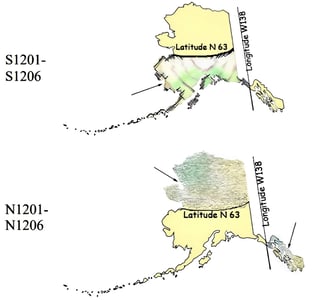
Alaska also sets rates regionally. The primary split runs along the N63 latitude line into northern and southern regions, with laborer classifications further divided by the W138 longitude line and a separate region for plumbers in the 1st Judicial District. Each rate has two parts, a basic hourly rate and a fringe amount, which together make the total prevailing wage.
If your work does not fit an established classification, request a special wage rate determination from the Commissioner in writing, at least 30 days before award.Keeping up with Pamphlet 600, twice a year, across regions
Alaska reissues rates every spring and fall, splits them by region, and locks them per project for up to 24 months. WageIQ will store the correct Pamphlet 600 rates and fringes for each project and apply them before payroll runs, so the right numbers reach every worker. Prefer to hand it off? Our Managed Service team sources current rates, generates your certified payroll, and manages submissions for you.
Paying the right wage is only half of compliance; you also have to prove it with certified payroll. These reports document who worked, in what classification, for how many hours, and at what wage, backed by a sworn statement of compliance.
The cadence is biweekly, not weekly. Contractors, subcontractors, and owner/operators file before the Friday of every second week for the preceding period, unlike federal Davis-Bacon's weekly reports.
The state form is Form 07-6058, a two-part document pairing the payroll record with a Statement of Compliance. You may file your own format as long as it contains all the information 07-6058 requires, with one exception: the Statement of Compliance cannot be re-keyed into other software, so that page must be used as issued.
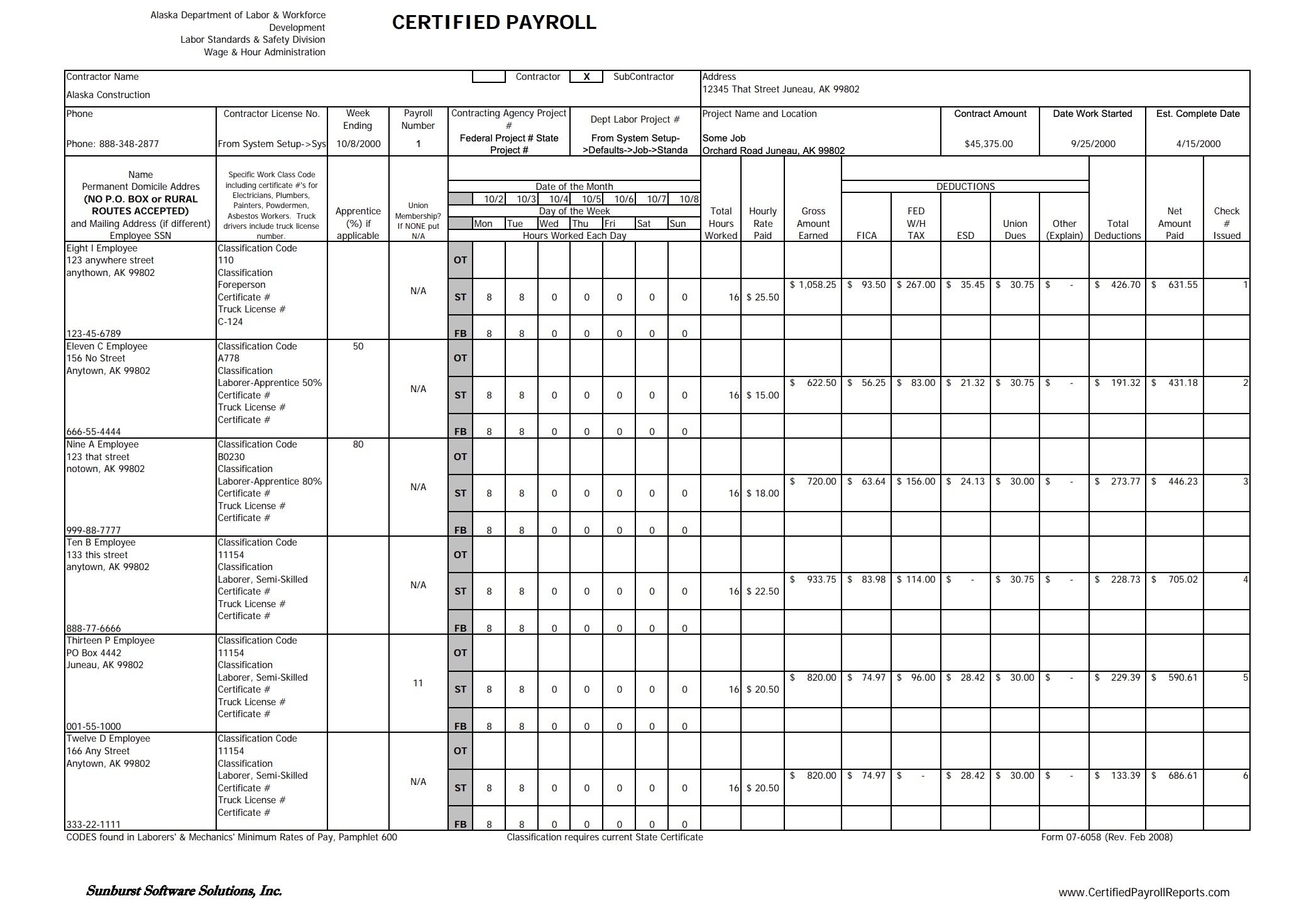
A few details catch contractors off guard:
Owner/operators must be listed
A sole proprietor, partnership, or LLC taxed as such who performs hands-on work appears on certified payroll, reporting actual hours; after expenses, their pay must meet or exceed the prevailing rate for each hour.
Working corporate officers count too.
Owners, shareholders, and members who perform physical construction work must be paid prevailing wage and shown on the report.
Reports go to the regional office
Certified payroll is filed with the DOLWD regional office for the judicial district where the work is performed: Juneau for the 1st, Anchorage for the 3rd, and Fairbanks for the 2nd and 4th.
Filing is done on paper or through myAlaska's LSS Online Services. As prime contractor, you must ensure every subcontractor receives the DOLWD project number and files correctly. This recurring, deadline-driven work is exactly what Certified Payroll Reporting is built to simplify.
Fringe Benefits, Overtime, and Remote-Site Requirements
Fringe Benefits
The fringe portion can be delivered in three ways: a union trust fund, an approved benefit plan, or payment directly to the worker as gross wages. Contributions to a plan or fund must be made at least monthly. Base rate plus fringe must equal the full prevailing wage, shown accurately on your certified payroll.
Overtime Requirements
Alaska is a daily overtime state, a common surprise for Lower 48 contractors. Under state wage and hour law, covered employees earn one and a half times the basic hourly rate for hours beyond eight in a day, on top of the usual over-40-in-a-week standard. Fringe benefits are paid for all hours worked but not multiplied for overtime. The daily rule often hits on compressed remote schedules, so account for it during bidding.
Remote-Site Board, Lodging, and Per Diem
This is one of Alaska's most distinctive requirements and easy to overlook at bid. On projects 65 or more road miles from the nearest international airport (Anchorage, Fairbanks, or Juneau), or on sites unreachable by road in a two-wheel-drive vehicle, contractors must provide adequate board and lodging to covered workers. For highway projects, distance is measured from the project midpoint.
Per diem may substitute only for classifications the department has designated, marked in Pamphlet 600, and must be paid on the same day as wages. It is prohibited on several specified highway corridors, and alternative arrangements can be approved as long as wages stay at or above the prevailing rate. Check remote-site status before you bid; housing a full crew is not a cost to discover mid-project.
Alaska adds an administrative layer many states do not: a formal filing and fee process tied to the start and finish of the job, and these filings directly affect final payment.
- Notice of Work. Before work begins, the party contracting with the agency designates a prime contractor, who files a Notice of Work listing every contractor on the job and each contract price.
- Filing fee. The fee is 1 percent of the total contract amount, including all subcontract work, capped at $5,000 and paid solely by the prime contractor. It applies to contracts exceeding $25,000.
- Emergency exception. Work may begin before filing only in immediate response to an emergency, in which case the notice and fee are due no later than 14 days after work begins.
- Notice of Completion. At the end, the prime contractor files a Notice of Completion with any additional fees owed on increased contract amounts. DOLWD then has 30 days to tell the agency how much, if anything, to withhold. Final payment is released only after the department confirms filings are complete, no investigation is open, and no violation notice has been issued.
Penalties for Non-Compliance
Most problems trace to a familiar handful of mistakes: the wrong classification rate, misclassified workers, underpaid or misdocumented fringe benefits, certified payroll filed late or not at all, and a missed Notice of Work filing or fee. When violations occur, the consequences stack up:
Contractors who disregard their obligations can be barred from public construction for three years, a bar that extends to firms in which they hold an interest.
Your Alaska Prevailing Wage Compliance Checklist
.png?width=800&height=883&name=Alaska%20certified%20payroll%20professional%20(1).png "Alaska certified payroll professional (1)")
Before Bidding
- Confirm the contract exceeds $25,000 and meets the definition of public construction; when in doubt, call Wage and Hour before bid.
- Identify whether funding is state, federal, or both, and which rules govern.
- Pull the Pamphlet 600 edition in effect 10 days before your bid date; confirm region and classifications.
- Measure road miles from the nearest international airport and budget board and lodging or per diem.
- Budget the 1 percent Notice of Work fee (up to $5,000) and biweekly payroll time.
During Construction
- File the Notice of Work and pay fees before work begins, or within 14 days for emergency work.
- Post the wage scale at the site; pay workers weekly and unconditionally.
- File certified payroll (Form 07-6058 or an equivalent with the required Statement of Compliance) before the Friday of every second week, including owner/operators and hands-on officers.
- Track the 24-month rate lock from the award date; apply the current determination if the project runs past it.
- Contribute fringes at least monthly, pay per diem on the same day as wages, and confirm subs are filing.
Project Closeout
- File the Notice of Completion with any additional fees on increased contract amounts.
- Retain all payroll records at least three years.
- Run an internal payroll review before final payment; DOLWD verification gates release.
How Certified Payroll Reporting Helps
Alaska asks a lot administratively: biweekly certified payroll on a specific state form, regional rate schedules that reissue twice a year, a 24-month rate lock, remote-site obligations, and filings that gate final payment. Managing it by hand across projects is where errors and missed deadlines creep in.
WageIQ handles the hardest part before payroll runs, calculating the correct Pamphlet 600 rates and fringes and working with the payroll systems you already use. If you would rather hand it off entirely, our Managed Service team sources current rates, generates your certified payroll, and manages submissions, keeping records that satisfy Alaska's three-year retention requirement.