
Prevailing Wage Pennsylvania: A Guide to Compliance for Public Works Contractors
Last Updated: February 2026
Pennsylvania has one of the most established and nuanced prevailing wage systems in the country. With a strong construction sector supporting public infrastructure across the state, contractors working on public projects must navigate detailed wage determinations, reporting requirements, and enforcement rules that vary by county and municipality.
Enacted in 1961, the Pennsylvania Prevailing Wage Act (43 P.S. §§ 165-1 through 165-17) was designed to ensure workers on publicly funded projects receive fair compensation. The Department of Labor & Industry (DLI), through its Bureau of Labor Law Compliance, is responsible for issuing wage determinations, enforcing compliance, and overseeing appeals. For contractors, understanding how these rules apply in practice is critical to avoiding costly violations and maintaining eligibility for public work.
This guide breaks down how Pennsylvania's prevailing wage system works, where compliance risks commonly arise, and how contractors can manage certified payroll requirements across multiple counties and municipalities.
Not working in Pennsylvania? Check out our state-by-state guide to prevailing wage.
Understanding Pennsylvania Prevailing Wage Requirements
Prevailing wage requirements apply to contractors and subcontractors performing work on covered public works projects that are funded wholly or partially with public money. These projects typically include construction, reconstruction, demolition, alteration, and repair work performed on behalf of state or local entities.
One of the most common areas of confusion is the distinction between construction and maintenance work. Maintenance is narrowly defined and often exempt from prevailing wage requirements, while most construction-related activities are covered. Misclassifying work as maintenance when it qualifies as construction can quickly lead to underpayment violations and enforcement action.
Who Must Comply?
Pennsylvania prevailing wage requirements apply to contractors and subcontractors working on covered public works projects. The Pennsylvania Prevailing Wage Act defines public works as construction, reconstruction, demolition, alteration, or repair work performed for state or local government entities.
Public bodies that award these contracts also carry compliance responsibilities. Before a project goes to bid, the awarding agency must obtain the applicable wage determination from DLI and include it in the contract specifications. Contractors should verify that this information is present in bid documents, as its absence does not eliminate the obligation to pay prevailing wages.


Governing Laws and Administration
The Pennsylvania Prevailing Wage Act (43 P.S. §§ 165-1 through 165-17) establishes the legal framework for prevailing wage in Pennsylvania. Regulations under Pennsylvania Code Chapter 34, Subchapter E provide additional implementation details.
The Bureau of Labor Law Compliance within the Department of Labor & Industry is responsible for administering the law, issuing wage determinations, investigating complaints, and enforcing compliance. Contractors who disagree with enforcement decisions may appeal to the Prevailing Wage Appeals Board.
Thresholds That Determine Coverage
Pennsylvania applies a dual threshold system to determine when prevailing wage requirements apply. These thresholds are strictly enforced and should be evaluated early in the bidding process.
- A $25,000 threshold applies to most public works construction projects. This figure has remained unchanged since 1963, making it one of the oldest unmodified thresholds in the country.
- A $100,000 threshold applies to locally funded highway and bridge projects under Act 89 of 2013.
Projects may not be divided or phased to avoid meeting these thresholds. This anti-circumvention rule means multi-phase projects are evaluated cumulatively, so contractors must consider the total project cost rather than individual segments when determining compliance obligations.
The distinction between construction and maintenance work also affects coverage. Construction includes activities that alter, repair, or improve a structure beyond routine upkeep. Maintenance work is narrowly defined as routine, day-to-day tasks that preserve existing functionality without substantial alteration. For example:
- Construction: Replacing a roof, installing new flooring, or repairing structural damage
- Maintenance: Changing light bulbs, cleaning gutters, or patching small cracks
When in doubt, contractors should treat ambiguous work as construction to avoid misclassification risk.
How Pennsylvania Prevailing Wage Rates Are Determined
Prevailing wage rates in Pennsylvania are set by the Department of Labor & Industry at the county level and are specific to each project. Unlike states that publish annual rate books, Pennsylvania issues wage determinations on a project-by-project basis. Rates apply to laborers, mechanics, and workers and consist of a base hourly wage plus required fringe benefits.
These rates are often influenced by collective bargaining agreements (CBAs), particularly in counties with strong union presence. Wage determinations are organized into four construction categories:
- Building construction
- Highway construction
- Heavy construction
- Residential construction
Because adjoining political subdivisions can influence locality-based determinations, contractors must obtain the correct wage determination directly from DLI for each project to ensure accuracy. Relying on rates from a previous project, even one in the same county, can result in underpayment if rates have changed.
Pennsylvania Prevailing Wage Compliance Requirements
Staying compliant with Pennsylvania's prevailing wage requirements involves more than paying the correct rate. Contractors must meet specific obligations around worker classification, fringe benefits, job site postings, and apprenticeship standards.
Workers must be classified based on the actual duties they perform, not their job titles. Misclassifying a worker in a lower-paid trade when they are performing higher-paid work is one of the most common violations and a frequent trigger for investigations.
Pennsylvania requires contractors to pay fringe benefits as part of the prevailing wage rate. Acceptable forms include:
- Contributions to bona fide benefit programs (health insurance, pension, vacation funds)
- Cash equivalent payments paid directly to workers
- Authorized deductions under the Wage Payment and Collection Law
Contractors should document how fringe benefits are allocated for each worker and ensure the total compensation meets or exceeds the applicable determination.
Contractors must post the applicable prevailing wage rates at the job site in a location accessible to all workers. This requirement applies for the duration of the project and is a basic compliance obligation that is easy to overlook but frequently cited in audits.
Apprentices working on prevailing wage projects must be registered with the Pennsylvania Apprenticeship and Training Council. Unregistered apprentices must be paid the full journeyworker rate for their classification. Proper documentation of apprenticeship agreements should be maintained throughout the project.
What Pennsylvania Does Not Require
One detail that often surprises contractors coming from other states: Pennsylvania does not require premium rates for overtime, shift differentials, or weekend and holiday work under the state prevailing wage law. While federal projects or specific CBA terms may still apply premium requirements, the state law itself does not mandate them. This distinction matters when calculating labor costs for bids on state-funded work.
Managing Pennsylvania Prevailing Wage Across Multiple Projects?
Juggling public works in more than one Pennsylvania county means keeping rates and records straight on all of them at once. WageIQ simplifies the rate side with county-level prevailing wage tracking and automated calculations, so the right numbers land before payroll runs. Want the reporting handled too? Our Managed Service team generates your Form LLC-25 and certified payroll reports, manages submissions, and keeps your records audit-ready. See it in action with the form below.
Certified Payroll Reporting Requirements in Pennsylvania
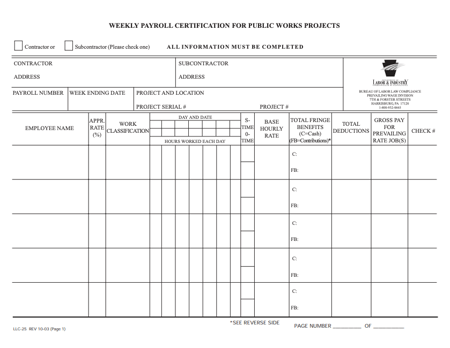
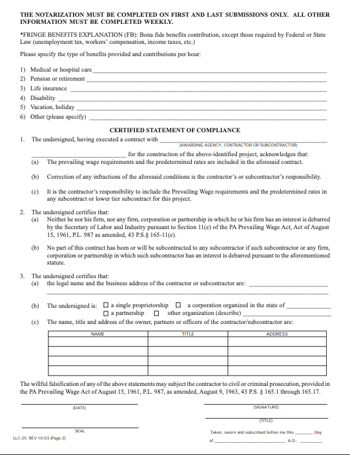
Form LLC-25
This Pennsylvania-specific requirement is a frequent source of errors for contractors that rely on federal processes or manual tracking.
To remain compliant, contractors must ensure their weekly submissions include the following elements:
- Accurate worker classifications tied to actual job duties
- Hours worked, including regular and overtime hours
- Wages paid and corresponding fringe benefits
- A signed certification affirming the accuracy of the report
Contractors are also responsible for collecting and submitting certified payroll reports from all subcontractors working on the project. See an example of this report below.
Federal WH-347 From
This federal form is a weekly certified payroll report required for contractors and subcontractors on federally funded construction projects over $2,000. It ensures compliance with the Davis-Bacon Act by detailing worker hours, classifications, and wage rates. Deep dive into the WH-347 form here
Record Retention
Payroll records must be retained for a minimum of three years and be readily available for inspection by the Bureau of Labor Law Compliance. This applies to prime contractors and subcontractors alike. Records should include not only certified payroll reports, but also supporting documentation such as timesheets, benefit records, and worker classification justifications.
Because reporting issues are one of the most common triggers for audits, consistency and documentation are critical throughout the life of the project.
Prevailing Wage Violations, Penalties, and Enforcement in Pennsylvania
Prevailing wage enforcement in Pennsylvania is designed to protect workers and promote fair competition. Investigations are often triggered by worker complaints, routine audits, or discrepancies identified during project reviews.
This occurs when contractors pay workers less than the applicable prevailing wage rate or fail to provide the full fringe benefit amount specified in the wage determination. Even small per-hour shortfalls can add up to significant liability over the course of a project.
Assigning a worker to a lower-paid classification than the duties they actually perform is one of the most frequently cited violations. Classification must be based on the work being done, not the worker's job title or the rate a contractor budgeted for.
Missing fields, inconsistent hours, or unsigned certifications on Form LLC-25 can trigger an audit even when wages were paid correctly. Errors in subcontractor reports are equally problematic, as the prime contractor is responsible for the accuracy of all submissions.
Contractors are required to display the applicable prevailing wage rates in a visible, accessible location at the work site for the duration of the project. This is one of the simplest requirements to meet, but it is frequently overlooked and commonly flagged during inspections.
Penalties may include recovery of back wages, civil fines, withholding of contract payments, and debarment from public works projects for up to three years. Debarred contractors are published on a public list, which can have lasting reputational impacts beyond the debarment period itself.
Workers who report prevailing wage violations are protected under anti-retaliation provisions. Contractors may not take adverse action against employees who file complaints or cooperate with investigations.
Contractors who disagree with enforcement decisions have the right to appeal through the Prevailing Wage Appeals Board. However, appeals can be time-consuming and costly, making prevention the most effective strategy.
The financial impact of non-compliance can be severe. In one notable case, a Pennsylvania contractor was ordered to pay $20.7 million in a wage theft case involving prevailing wage violations on public works projects.
Best Practices for Compliance with Pennsylvania Prevailing Wage
Contractors that successfully manage Pennsylvania prevailing wage requirements tend to focus on consistency and documentation throughout the project lifecycle.
Pre-Bid Phase
- Verify applicable thresholds ($25,000 standard or $100,000 for highway/bridge projects)
- Obtain the correct DLI wage determination for the project locality
- Identify proper worker classifications based on anticipated duties
- Calculate accurate labor costs including base wages and fringe benefits
- Review whether the work qualifies as construction or maintenance
- Learn more about how to bid on prevailing wage jobs

During Project Execution
- Post required wage rates at the job site
- Submit weekly Form LLC-25 reports accurately and on time
- Classify workers based on actual work performed, not job titles
- Track and document fringe benefits properly
- Monitor subcontractor compliance throughout the project
- Maintain detailed payroll records in real time
Active Project Phase
- Ensure all final certified payroll reports are submitted
- Verify subcontractor compliance through project closeout
- Retain comprehensive records for at least three years
- Review project performance to identify lessons learned for future bids
.

How Points North Supports Pennsylvania Prevailing Wage Compliance
For a mid-sized contractor juggling multiple Pennsylvania county projects simultaneously, keeping track of different wage determinations, submission deadlines, and subcontractor reports can quickly become overwhelming. That is exactly the kind of challenge Points North was built to solve.
The platform simplifies county-level wage tracking, generates Pennsylvania-specific Form LLC-25 reports, and maintains secure, cloud-based payroll records that meet the state's three-year retention requirements. Integration with popular payroll systems reduces manual data entry and the errors that come with it. Real-time compliance monitoring across active projects helps contractors catch issues before they become violations.
For contractors that need additional assurance, Points North managed services can oversee wage determinations and reporting on their behalf. By reducing manual effort and improving accuracy, contractors spend less time correcting errors and more time pursuing new public work opportunities.
Turn Compliance Into a Competitive Advantage
Pennsylvania's prevailing wage rules are detailed, but they're manageable with the right system behind them. Contractors who stay proactive reduce risk, protect margins, and bid public works across the state with confidence. WageIQ gives in-house teams the automation to get rates and calculations right every time, while our Managed Service team offers a fully managed option, handling report generation and submissions for firms that would rather put compliance entirely in expert hands. Ready to simplify Pennsylvania prevailing wage compliance?