
Prevailing Wage North Carolina: What Davis-Bacon Means for North Carolina Contractors
Last Updated: February 2026
North Carolina does not have a state prevailing wage law. Unlike states such as California, New York, or Illinois, which maintain their own prevailing wage statutes, North Carolina relies entirely on the federal Davis-Bacon Act to set wage standards on publicly funded construction projects. And with $12.3 billion in federal infrastructure funding allocated to projects statewide, according to ASCE’s 2026 Report Card for North Carolina's Infrastructure, the Davis-Bacon Act is playing a bigger role in the state's construction landscape than ever.
For contractors working on federally funded projects in North Carolina, Davis-Bacon compliance is a contractual requirement. This guide covers how the Davis-Bacon Act applies to North Carolina contractors, including prevailing wage rate determinations, certified payroll reporting, labor compliance oversight, penalties for violations, and best practices for staying ahead of enforcement. Whether you're a small electrical contractor in Raleigh or a large general contractor managing multi-tier subcontractors across the state, this is what you need to know.
Not working in North Carolina? Check out our state-by-state guide to prevailing wage for detailed information on states with state-level requirements.
Prevailing Wage Basics in North Carolina
North Carolina's Department of Labor does not set or enforce prevailing wage rates. The state explicitly defers to the federal government, directing contractors to the U.S. Department of Labor's Wage and Hour Division offices in Charlotte and Raleigh for wage determination information.
This puts North Carolina in the same category as other states without their own prevailing wage laws, including Florida, Georgia, and South Carolina, where the federal Davis-Bacon Act is the sole wage floor on public works projects. On the other end of the spectrum, states like California, New York, and Ohio maintain their own prevailing wage frameworks that often layer on top of federal requirements. For a deeper look at how state and federal prevailing wage laws differ, we've broken down the comparison separately.
The Davis-Bacon Act applies to all federally funded or assisted construction contracts exceeding $2,000. The “federally assisted” distinction is important: projects financed through federal grants, loans, loan guarantees, or insurance also trigger Davis-Bacon requirements, even if a federal agency is not the direct contracting party. This means Davis-Bacon wages in North Carolina can apply to highway projects funded through the Federal Highway Administration, school renovations backed by USDA loans, or infrastructure work supported by FEMA grants.
For North Carolina contractors, the practical implication is straightforward: if federal money is touching the project, assume Davis-Bacon applies until you confirm otherwise. The “over $2,000” threshold is low enough that virtually all federally connected construction work in the state is covered.
How Prevailing Wage Rates Are Determined in North Carolina
The U.S. Department of Labor's Wage and Hour Division determines prevailing wage rates by conducting wage surveys of construction workers in specific geographic areas. These surveys capture what workers in various trades are actually being paid on similar projects in a given region.
The types of work covered include construction, alteration, or repair of public buildings, roads, highways, and other publicly owned infrastructure. This broad definition encompasses everything from new school construction to highway resurfacing to bridge rehabilitation, all of which are common project types across North Carolina's growing infrastructure pipeline.
Prevailing wage rates in North Carolina are made up of two components: the basic hourly rate and fringe benefits. Fringe benefits can include health insurance, pension contributions, and vacation pay. Contractors can either contribute to a qualified fringe benefit plan or pay the fringe amount as cash wages directly to workers.
With 100 counties, North Carolina’s wage determinations can vary significantly across the state. Prevailing wage rates for a project in the Charlotte metro area will look very different from those in rural western North Carolina. The decentralized nature of the state’s local governments only adds to the variation. Contractors should always pull the correct wage determination from SAM.gov for the specific county and construction type before bidding.
One detail worth noting: wage determinations are locked at the time of contract award and remain effective for the life of the project. There are no mid-project rate increases unless the contract itself is formally modified.
Because North Carolina has no state prevailing wage law, there is no state-level compliance coordinator. Enforcement responsibility falls on the contracting federal agency and the DOL’s Wage and Hour Division.
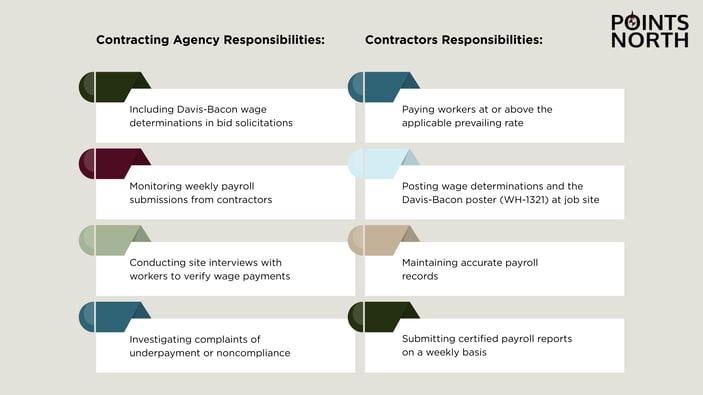
Contracting Agency Responsibilities:
- Including Davis-Bacon wage determinations in bid solicitations
- Monitoring weekly payroll submissions from contractors
- Conducting site interviews with workers to verify wage payments
- Investigating complaints of underpayment or noncompliance
Contractor Responsibilities:
- Paying workers at or above the applicable prevailing rate
- Posting wage determinations and the Davis-Bacon poster (WH-1321) at the job site
- Maintaining accurate payroll records
One point of context for North Carolina contractors: As a right-to-work state, North Carolina's workforce is predominantly non-union. Davis-Bacon rates, however, are often calculated from union wage survey data. This can create confusion for non-union contractors unfamiliar with the rate-setting methodology. Regardless of how the rates are derived, compliance is based on the published wage determination and not on whether a contractor’s workforce is unionized.
Violations and Penalties
Davis-Bacon enforcement is serious, and the penalties reflect that. The most common violations on North Carolina projects include underpayment of wages or fringe benefits, misclassification of workers into lower-paid trades, falsification of certified payroll records, and failure to post wage determinations at the job site. For a detailed look at what to watch out for, see our guide on how to avoid Davis-Bacon Act violations.
County-by-County Variations
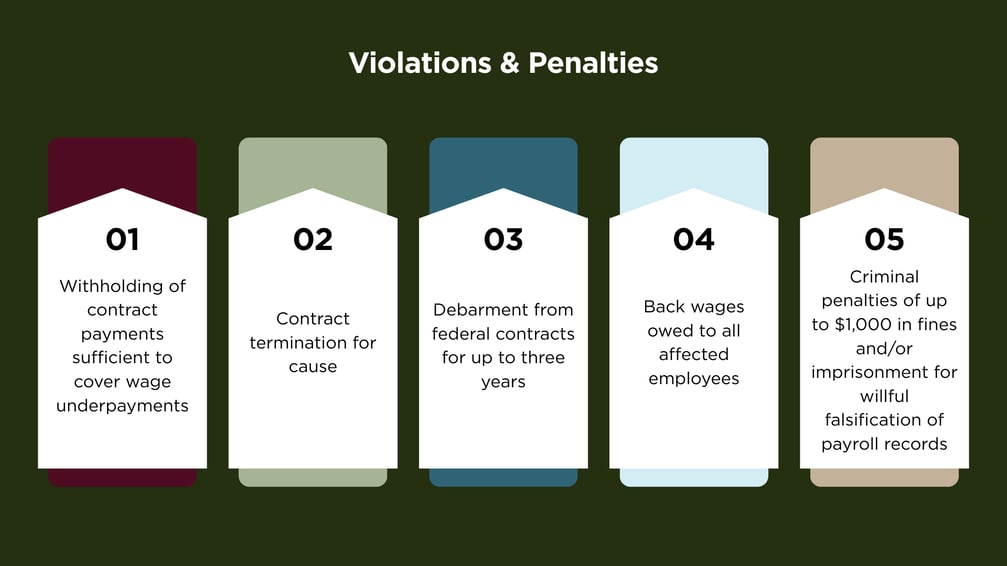
- Withholding of contract payments sufficient to cover wage underpayments
- Contract termination for cause
- Debarment from federal contracts for up to three years
- Back wages owed to all affected employees
- Criminal penalties of up to $1,000 in fines and/or imprisonment for willful falsification of payroll records
Prime contractors should pay particular attention here: on North Carolina's large federally funded projects, which frequently involve multiple tiers of subcontractors, the prime contractor is responsible for subcontractor compliance. If a subcontractor underpays workers or submits inaccurate payroll, the prime contractor faces the consequences.
Apprenticeship Requirements
Federal apprenticeship standards apply to all Davis-Bacon projects in North Carolina. Any apprentice working on a covered project must be registered with the DOL’s Office of Apprenticeship or a recognized State Apprenticeship Agency.
North Carolina does not have state-mandated apprenticeship requirements for prevailing wage work. The state does operate an apprenticeship program through NCWorks and ApprenticeshipNC, but participation is voluntary. That said, if a contractor employs apprentices on a Davis-Bacon project, those apprentices must be enrolled in an approved program, and the apprentice-to-journeyworker ratio must comply with the program's standards.
Apprentice wages are set as a percentage of the journeyworker prevailing rate, according to the approved program schedule. Contractors cannot simply pay a reduced rate without documentation showing the apprentice is enrolled in and meeting the requirements of a registered program.
Certified Payroll Reporting in North Carolina
North Carolina certified payroll requirements follow the federal standard: contractors must submit certified payroll reports weekly for all laborers and mechanics working on covered projects.
The required form is WH-347 (Payroll Form), accompanied by a Statement of Compliance. For detailed guidance on completing each section, see our instructions for filling out certified payroll forms. Each report must include employee name, classification, hours worked (daily and weekly), rate of pay, gross earnings, deductions, net pay, and fringe benefit contributions.
The Statement of Compliance is signed under penalty of perjury, certifying that the payroll is correct and complete. This is not a formality, as falsification carries criminal penalties.
Additional Requirements:
- Posting: The Davis-Bacon poster (WH-1321) and the applicable wage determination must be displayed at the job site.
- Record retention: All payroll records must be retained for a minimum of three years from project completion. For more on what to keep and how, see our article on prevailing wage record keeping for government contractors.
With federal infrastructure spending surging in North Carolina, the volume of certified payroll reporting is increasing significantly. Contractors new to Davis-Bacon work are especially at risk of common reporting errors. Automating WH-347 generation, tracking compliance deadlines, and reducing manual data entry can save significant time and reduce risk. Certified Payroll Reporting software is built to handle exactly these challenges by generating compliant reports, flagging errors before submission, and keeping your certified payroll on track.
Pre-Bid Phase:
- Verify Davis-Bacon applicability. Check funding sources, not just the contracting agency, to determine whether a project triggers prevailing wage requirements.
- Pull the correct wage determination. Search SAM.gov for the specific North Carolina county and construction type. Using the wrong determination is a compliance violation from day one.
- Build prevailing wage costs into your bid. Include both hourly rates and fringe benefit obligations in your estimates. Underbidding because you missed fringe costs is a common and costly mistake.
During the Project:
- Classify workers correctly from day one. Misclassification is the most common Davis-Bacon violation. If a worker performs journeyworker duties, they must be paid the journeyworker rate, regardless of their job title.
- Submit certified payroll weekly. Late or missed submissions attract scrutiny and can trigger audits.
- Post required notices. Wage determinations and the Davis-Bacon poster must be visible at the job site at all times.
- Monitor subcontractor payrolls. As the prime contractor, you are liable for subcontractor compliance. Review their payroll submissions regularly.
Post-Project:
- Retain all records. Keep payroll records for at least three years after project completion.
- Conduct an internal audit. Review payroll submissions before project close-out to proactively identify and resolve discrepancies.
- Resolve issues early. Address any payroll discrepancies before the contracting agency's final review. Proactive correction is always better than reactive enforcement.
The Bottom Line
North Carolina may not have a state prevailing wage law, but the Davis-Bacon Act applies to every federally funded or assisted construction project in the state valued at $2,000 or more. For contractors, that means understanding prevailing wage rates for North Carolina, filing accurate certified payroll reports weekly, classifying workers correctly, and taking responsibility for subcontractor compliance.
The penalties, debarment, contract termination, back wages, and criminal prosecution, are not abstract risks. They are enforcement realities that affect North Carolina contractors every year.
Certified Payroll Reporting software from Points North simplifies Davis-Bacon compliance for North Carolina contractors with automated WH-347 generation, real-time tracking, and built-in error prevention. With billions in federal funding flowing into North Carolina, prevailing wage compliance is more important than ever before.

Get North Carolina Davis-Bacon Reporting Right the First Time
On federal projects in North Carolina, one outdated wage determination can turn into a costly problem. WageIQ keeps you current by tracking federal determinations for every county and automating your prevailing wage calculations, so the right rates reach every worker before payroll runs. Rather not handle the reporting at all? Our Managed Service team generates your WH-347 forms, manages subcontractor reporting, and handles submissions for you.