

Last updated: May 2026
If your organization has received an IRS Letter 5699, or you want to make sure you never do, this guide walks through exactly what the notice means, how to respond, and how to protect your organization from costly penalties down the line.
Letter 5699 is one of the most consequential pieces of mail an Applicable Large Employer (ALE) can receive. It is not a penalty, but it is the warning that comes before one. The good news is that employers who respond promptly and thoroughly almost always have a path to resolution. The challenge is that the path requires the right records, the right strategy, and a quick start.
What is IRS Letter 5699?
IRS Letter 5699, formally titled "Missing Information Return Form 1094/1095-C," is the IRS's initial outreach to organizations the agency believes were ALEs for a given tax year but did not file required ACA information returns. The letter is essentially a question: the IRS thinks you should have filed, and they want to know why you didn't.
A Letter 5699 typically contains:
- The tax year in question
- The taxpayer identification number on file
- The date the letter was issued
- An IRS contact name, telephone number, and e-fax number
- A response deadline (30 days from the date on the letter)
- The four response options the IRS asks you to choose from
For the IRS's own guidance on the letter, see the IRS's "Understanding Your Letter 5699" page.
It is important to understand what Letter 5699 is not. It is not a penalty assessment. It is not a final determination of non-compliance. It is the IRS opening a conversation, and your response shapes everything that follows.
Why employers receive Letter 5699
The IRS identifies likely ALEs by cross-referencing W-2 filings against its ACA reporting database. When W-2s exist under a given EIN but matching 1094-C and 1095-C filings cannot be located, the system generates a Letter 5699 automatically.
Employers receive these letters for a few common reasons:
- Forms filed under a different EIN. Multi-entity organizations sometimes file under a parent EIN while W-2s are issued under subsidiaries
- Genuine non-filing. The employer didn't realize they were an ALE, or the responsibility fell through the cracks
- Mistaken ALE status assumption. A small EIN within a larger controlled group can technically be subject to filing even when standalone headcount is below 50
- Filing rejection that wasn't resolved. AIR system rejections that were never corrected look identical to non-filings from the IRS perspective
There is one subtlety worth understanding before you respond, and it shapes the entire defense strategy.
The IRS calculates proposed Letter 5699 exposure from your raw W-2 count, not your actual full-time employee count. The burden of proof is on the employer.
When the IRS estimates potential penalty exposure on a Letter 5699, it typically bases that estimate on the total number of W-2s filed for the EIN. That count includes part-time, seasonal, variable-hour, and PRN workers who would not have triggered ACA filing requirements at all. The result is that proposed exposure on a Letter 5699 is almost always inflated relative to actual liability. Documenting the difference between raw W-2 count and actual full-time count under ACA measurement rules is one of the most important things an employer can do.
A refresher on the ACA Employer Mandate
To understand why Letter 5699 matters, it helps to revisit what triggers ACA filing obligations in the first place.
Under the ACA's Employer Mandate, an organization is considered an Applicable Large Employer (ALE) if it employed an average of 50 or more full-time and equivalent employees during the prior calendar year. ALEs are required to:
- Offer Minimum Essential Coverage (MEC) to at least 95% of full-time employees and their dependents
- Ensure that coverage is affordable under one of the IRS-approved safe harbors
- Ensure that coverage meets Minimum Value (MV)
- File Forms 1094-C and 1095-C with the IRS each year, and furnish 1095-C statements to full-time employees
Letter 5699 is the IRS's way of asking why the filing piece of that obligation didn't happen.
How to respond to Letter 5699
You have 30 days from the date on the letter, not the date you receive it. By the time the envelope reaches your desk, you may already have less than four weeks.
The letter offers four response options:
- Forms were filed under a different EIN. Provide the name, EIN, and date the returns were filed
- You should have filed but did not. Submit the delinquent forms with your response, or provide a timeline for when you will file electronically
- You were not an ALE for the year in question. Provide your full-time and full-time equivalent calculations
- Another reason applies. Provide a clear explanation supported by documentation
Once you have identified the right response option, the actual response process looks like this:
Verify every detail on the letter against your records, including EIN, tax year, and filing history
Pull supporting documentation immediately (more on this in the next section)
Determine the correct response path based on your situation
Prepare your written response with all supporting documentation
Submit via certified mail with tracking
Keep copies of everything for your records
You have 30 days from the date on the letter, not the date you received it. Pull supporting data immediately.
Building an audit-ready defense
The strength of your response depends on the strength of your documentation. Even employers who actually did file can receive a Letter 5699 if their data didn't reconcile cleanly. The path to resolution runs through records.
The documentation employers most often need:
- Time and attendance data to separate full-time, part-time, variable-hour, seasonal, and PRN workers in the W-2 count
- Documented look-back measurement periods proving how variable-hour employees were classified for any given month
- Plan documents and offers of coverage by employee, including any waivers
- Affordability safe harbor calculations using W-2 wages, Rate of Pay, or Federal Poverty Line methods
- TIN solicitation records if any 1095-C forms were filed with missing or incomplete TINs
- AIR system acceptance confirmations for any filings that were submitted
Employers without continuous tracking systems often face a difficult reconstruction project under a 30-day deadline. Employers with the right records in place often resolve the matter with a single response letter.
Penalty exposure if Letter 5699 is ignored
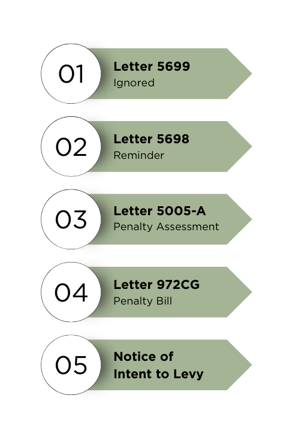 When a Letter 5699 goes unanswered, the IRS escalates through a defined sequence:
- Letter 5698: A reminder notice that the original 5699 was not answered
- Letter 5005-A: A formal penalty assessment for failure to file information returns
- Letter 972CG: The penalty bill with payment demand
- Notice of Intent to Levy: Final collection stage
The penalties themselves come from two parts of the Internal Revenue Code. IRC Section 6721 covers failure to file correct information returns with the IRS. IRC Section 6722 covers failure to furnish correct payee statements to employees. Both can apply to the same form, effectively doubling exposure.
If the IRS determines the employer was an ALE that also failed to offer compliant coverage, additional Employer Shared Responsibility Payment (ESRP) penalties under IRC Section 4980H come into play through a follow-up Letter 226-J.
For current penalty dollar amounts and the specifics of each year's enforcement cycle, see our annual update on Letter 5699.
How to avoid Letter 5699 in the first place
The best response to Letter 5699 is making sure you never receive one. That requires four things working together year-round:
- Accurate ALE determination each year, including controlled group analysis where applicable
- Timely 1094-C and 1095-C filings with the IRS by the annual deadline
- AIR system acceptance confirmation rather than just submission
- Audit-ready records maintained continuously, not reconstructed at year-end
The best response to Letter 5699 is making sure you never receive one. Continuous tracking and audit-ready records are the foundation.
How ACA Reporter by Points North Helps
ACA Reporter is built around the records employers need most when a Letter 5699 arrives. The platform tracks full-time status continuously, applies measurement period logic to variable-hour workers, documents offers of coverage by employee and month, generates accurate 1094-C and 1095-C forms, and transmits them through the IRS AIR system with confirmation.
The result is an audit-ready record set that supports both prevention and response. If a Letter 5699 ever arrives, the documentation needed to respond is already in place, and the response itself becomes a matter of pulling the right reports rather than reconstructing months or years of history.
Already received a 5699? Talk to a Points North specialist by filling out the form below.