
Prevailing Wage Michigan: Navigate the Reinstated Law and New Compliance Requirements
Last Updated: February 2026
Michigan is one of the only states in the country to repeal and then reinstate its prevailing wage laws, creating a compliance landscape that many contractors are still navigating. After a multi-year gap from 2018 to 2024 when prevailing wage requirements were not in effect, Act 10 of 2023 restored them effective February 13, 2024. A 2024 amendment further expanded coverage to include qualifying energy facility projects.
The reinstated law brought several new requirements along with it, including mandatory contractor registration, a $500 annual fee, and a phased transition to online certified payroll reporting through the Michigan Department of Labor and Economic Opportunity (LEO). Whether you’re returning to prevailing wage compliance after the repeal period or working with Michigan’s requirements for the first time, this guide covers what you need to know.
Not working in Michigan? Check out our state-by-state guide to prevailing wage.
Michigan Prevailing Wage Basics
Michigan’s prevailing wage requirements are governed by the Prevailing Wage on State Projects Act, commonly known as Act 10 of 2023. This legislation restored prevailing wage protections that were originally established under Act 166 of 1965 and repealed in 2018. The reinstated law took effect on February 13, 2024, and is administered by the Michigan Department of Labor and Economic Opportunity (LEO).
Act 10 applies to state-funded construction projects involving public buildings, schools, roads, bridges, and highways. The law covers construction mechanics, which includes skilled and unskilled laborers, helpers, assistants, and apprentices performing physical construction work. Employees in executive, administrative, professional, office, or custodial roles are excluded from prevailing wage requirements.
The minimum contract threshold for prevailing wage coverage is $28,000. Any state project meeting this threshold that requires or involves construction mechanics must include prevailing wage provisions in the contract.
What Qualifies as a Public Works Project in Michigan?
Under Act 10, covered work includes new construction, alteration, repair, installation, painting, decorating, completion, demolition, conditioning, reconditioning, or improvement of public buildings, schools, works, bridges, highways, or roads that are financed in whole or in part by the state.
In 2024, Senate Bill 571 (Public Act 110 of 2024) expanded the definition of “state project” to include qualifying energy facility projects. This covers solar energy facilities, wind energy facilities, and energy storage facilities with a nameplate capacity of 2 megawatts or more. The expansion became effective April 2, 2025, and means that contractors working on renewable energy projects in Michigan should verify whether prevailing wage requirements apply to their work.

Michigan vs Federal Davis-Bacon Requirements
Michigan’s state prevailing wage (Act 10) and the federal Davis-Bacon Act both establish wage floors for construction work on public projects, but they apply to different funding sources and operate independently.
Act 10 applies to projects funded by the state of Michigan. The federal Davis-Bacon Act applies to federally funded construction projects exceeding $2,000. When a project involves mixed funding—both state and federal dollars—contractors may need to comply with both sets of requirements and pay the higher applicable rate.
An important distinction: if a project is subject to federal Davis-Bacon requirements, Act 10 may not apply to the same work. Contractors should confirm their specific obligations with the contracting agent for any project with mixed funding.
Rate-setting also differs between the two. Michigan’s prevailing wage rates are based on local collective bargaining agreements. Federal Davis-Bacon rates are determined by the U.S. Department of Labor through wage surveys and are published separately.
How Michigan Prevailing Wage Rates Are Determined
Prevailing wage rates in Michigan are derived from local collective bargaining agreements between construction mechanics and employers. These rates are published by county on the LEO website and vary based on county, trade classification, and type of work.
Before advertising a project for bids, the contracting agent is required to have the commissioner determine the prevailing rates of wages and fringe benefits for all classes of construction mechanics involved in the contract. These rates must be included in the project specifications and printed on the bid documents. If a contract is not awarded or construction does not begin within 90 days of the commissioner’s determination, a redetermination is required before the contract can be awarded.
When no local collective bargaining agreements exist for a particular trade or locality, the commissioner determines rates based on the nearest comparable area or through public hearings.
LEO publishes rate schedules organized by county, making it important for contractors to look up rates specific to the project location. You can access current rate schedules on the LEO’s prevailing wage page at michigan.gov.
Posting and Recordkeeping Requirements
Contractors are required to conspicuously display prevailing wage and fringe benefit rates at the construction site. They must also maintain accurate records showing each worker’s name, occupation, and actual wages and benefits paid. These records must be retained for a minimum of three years.
Every contract for a state project must include language stating that construction mechanics are intended beneficiaries of the prevailing wage provisions and have the right to bring legal action if the contract is violated.
Michigan Contractor Registration Requirements
One of the significant additions under the reinstated law is a mandatory registration requirement. All contractors and subcontractors that employ construction mechanics must register with LEO’s Wage and Hour Division before bidding on or performing work on any state prevailing wage project.
Registration requires a $500 annual fee and is valid for one year. The application must include the business address, entity type, financial interest holders, and an agent for service of process. Without an active registration, a contractor cannot bid on or perform work on prevailing wage projects.
LEO has the authority to suspend or revoke a contractor’s registration for significant or repeated violations of the Act. Registration fees are deposited into the Prevailing Wage Fund, which was created by SB 571 within the State Treasury to support administration and enforcement.
Compliance Built for Michigan's Prevailing Wage Law
From a first state-funded project to prevailing wage obligations spread across Michigan, the goal is the same: stay compliant without losing hours to paperwork. WageIQ keeps your prevailing wage rates and calculations accurate before payroll runs, while our Managed Service team is ready to generate your certified payroll reports and manage submissions if you'd rather not handle reporting in-house. Choose the support that matches how your business runs.
Certified payroll reporting is one of the central compliance mechanisms under Michigan’s prevailing wage law. Contractors and subcontractors are required to submit certified payroll records to document that workers are being paid at or above the applicable prevailing wage rates.
Certified payroll records must be transmitted no later than 10 days after the end of each pay period. The submitter electronically attests that the records are complete and accurate and acknowledges that violations may result in enforcement actions, including consequences for their registration.
Michigan’s certified payroll submission requirements have been phased in under the 2024 amendment:
• As of April 2, 2025: contractors must submit certified payroll to the contracting agent or through LEO’s online tool, as applicable.
• As of April 2, 2026: certified payroll must be submitted online through LEO’s system as the primary submission method, with required electronic attestation.
Certified payroll records submitted through the state’s system are viewable by the public at no cost, but the system is designed to protect sensitive worker information; home addresses, telephone numbers, and Social Security numbers are not displayed. One exception to note: if a contractor or subcontractor is already required by law to transmit certified payroll to the Michigan Department of Transportation (MDOT), they are not required to submit separately under this section.
For contractors who have historically managed certified payroll through manual processes, the transition to online submission is a good reason to evaluate whether your current systems and workflows can handle digital reporting efficiently.
Fringe Benefits and Overtime in Michigan
Michigan’s prevailing wage rates consist of two components: a base hourly wage and fringe benefits. Both are published together in LEO’s county-by-county rate schedules.
Fringe benefits may include health insurance, pension contributions, vacation pay, training fund contributions, and similar benefits. Contractors have flexibility in how they deliver fringe benefits; they can provide actual benefits, pay cash equivalents, or use a combination of both.
Overtime requirements follow standard federal and state labor law guidelines. Both the base wage and fringe benefit amounts are factored into overtime calculations as required by applicable law.
Michigan Prevailing Wage Violations and Penalties
Michigan takes prevailing wage compliance seriously, and the penalty structure reflects that. Violations carry several layers of consequences:
The commissioner may assess fines of up to $5,000 per violation, plus an additional 10% penalty.
Full wages and fringe benefits owed to underpaid workers, including interest.
Both contractors and subcontractors can be held liable for wage violations.
The contracting agent may terminate the contractor’s right to proceed, hire another contractor to complete the work, and charge excess costs back to the original contractor.
DLEO may suspend or revoke a contractor’s registration for significant or repeated violations.
Worker Protections and Anti-Retaliation
The law includes strong protections for workers who report prevailing wage violations. Contractors cannot discharge, discipline, retaliate against, or discriminate against workers who report violations or express intent to do so.
Workers also have a private right of action under the Act. They can bring a lawsuit in court for damages, injunctive relief, and reinstatement, and may recover actual costs and attorney fees. Importantly, workers are not required to exhaust administrative remedies before filing a civil action, they can go directly to court.
Pre-Bid Phase
- Verify that your contractor registration with LEO is current and active (annual $500 renewal).
- Confirm whether the project meets the $28,000 minimum threshold for prevailing wage coverage.
- Determine whether the project is subject to state prevailing wage (Act 10), federal Davis-Bacon, or both. Projects already covered by Davis-Bacon are exempt from Act 10.
- Obtain the commissioner’s prevailing wage determination for the applicable county and trade classifications.
- Review LEO’s published rate schedules by county to accurately estimate labor costs in your bid.
- For energy facility projects, confirm whether the project meets the 2+ megawatt nameplate capacity threshold.
- Factor in fringe benefit obligations when calculating total labor costs.

During Project Execution
• Ensure prevailing wage rates and fringe benefit requirements are reflected in your bid pricing.
• Verify that all subcontractors you plan to use are registered with LEO. Unregistered subcontractors cannot perform work on prevailing wage projects.
• Include required contract language stating that construction mechanics are intended beneficiaries with the right to legal action.
• Confirm prevailing wage and fringe benefit rates are printed on bid documents per Act 10 requirements.
• Review project specifications for any energy facility or specialized classification requirements.
Active Project Phase
• Post prevailing wage and fringe benefit rates conspicuously at the job site.
• Submit certified payroll records within 10 days of each pay period end through the applicable method (contracting agent or LEO’s online system).
• Maintain accurate records for each construction mechanic, including name, occupation, hours worked, and wages and benefits paid. Retain records as required by applicable state and federal law.
• Monitor subcontractor compliance. Both contractors and subcontractors are jointly and severally liable for wage violations.
• Track any mid-project rate changes published by LEO for the applicable county.
• Ensure all workers are classified correctly and paid at the appropriate trade rate.
• After project completion, retain records as required by applicable state and federal law.
Navigate Michigan's Reinstated Prevailing Wage Rules
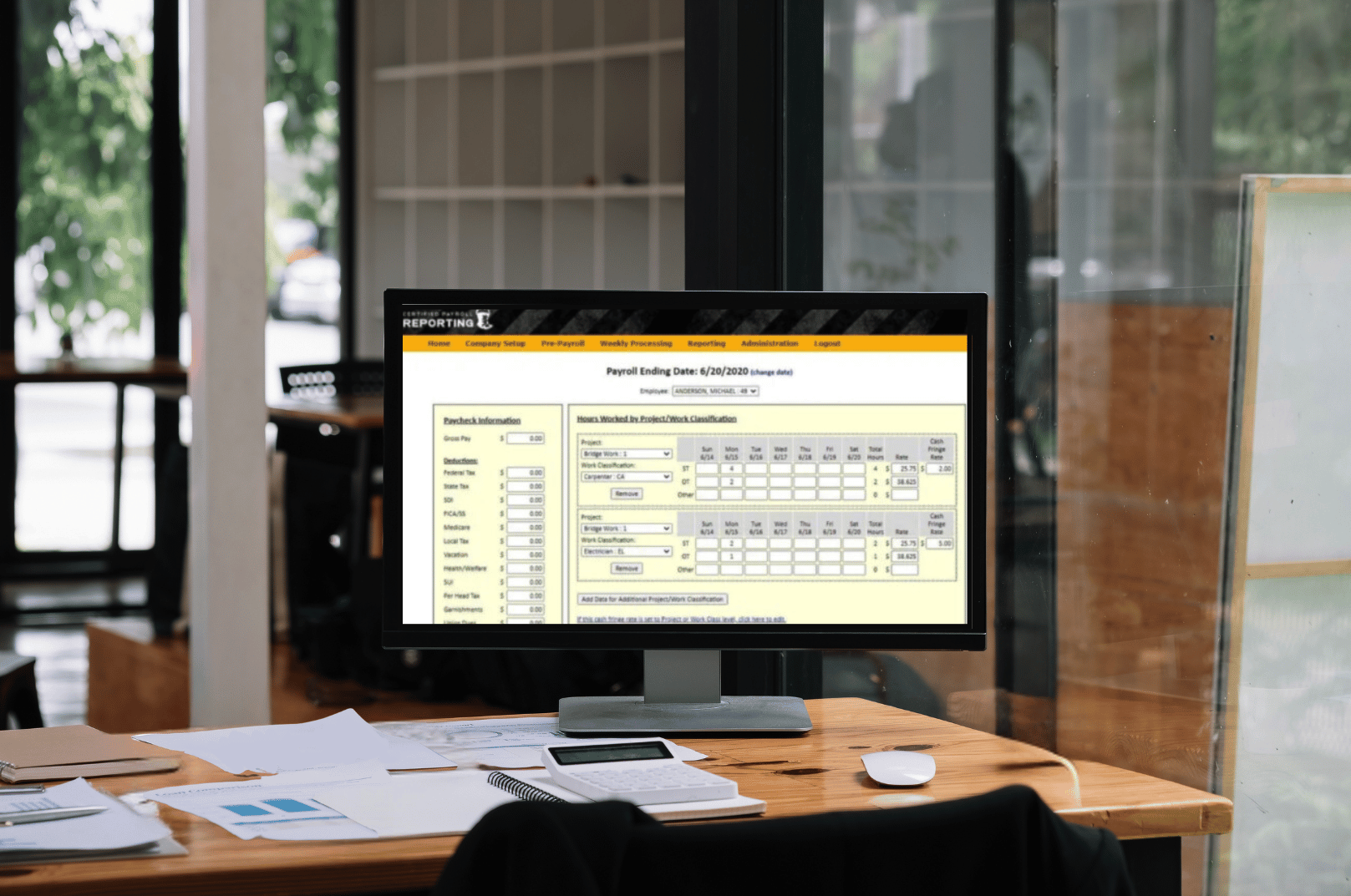
Now that Michigan's prevailing wage law is back in effect, contractors face a county-by-county rate system and online reporting requirements that get complicated fast, especially across multiple projects or counties. WageIQ streamlines the rate side with automated prevailing wage calculations and rate management built for Michigan's county-specific schedules, plus integration with the payroll systems you already use. If you'd rather offload the reporting completely, our Managed Service team manages report generation, submissions, and recordkeeping for you.